Support justice-driven, accurate and transparent news — make a quick donation to Truthout today!
Rapid melting of West Antarctic ice shelves that serve as a crucial defense against worsening sea level rise may be “unavoidable,” comprehensive new research finds, even under optimistic scenarios of climate crisis mitigation.
The study, published online in Nature Climate Change on Monday, finds that West Antarctic ice shelves are slated for “widespread increases” in melting, with greenhouse gas-caused ocean warming accelerating the rate of glacier melt in recent decades and into the future.
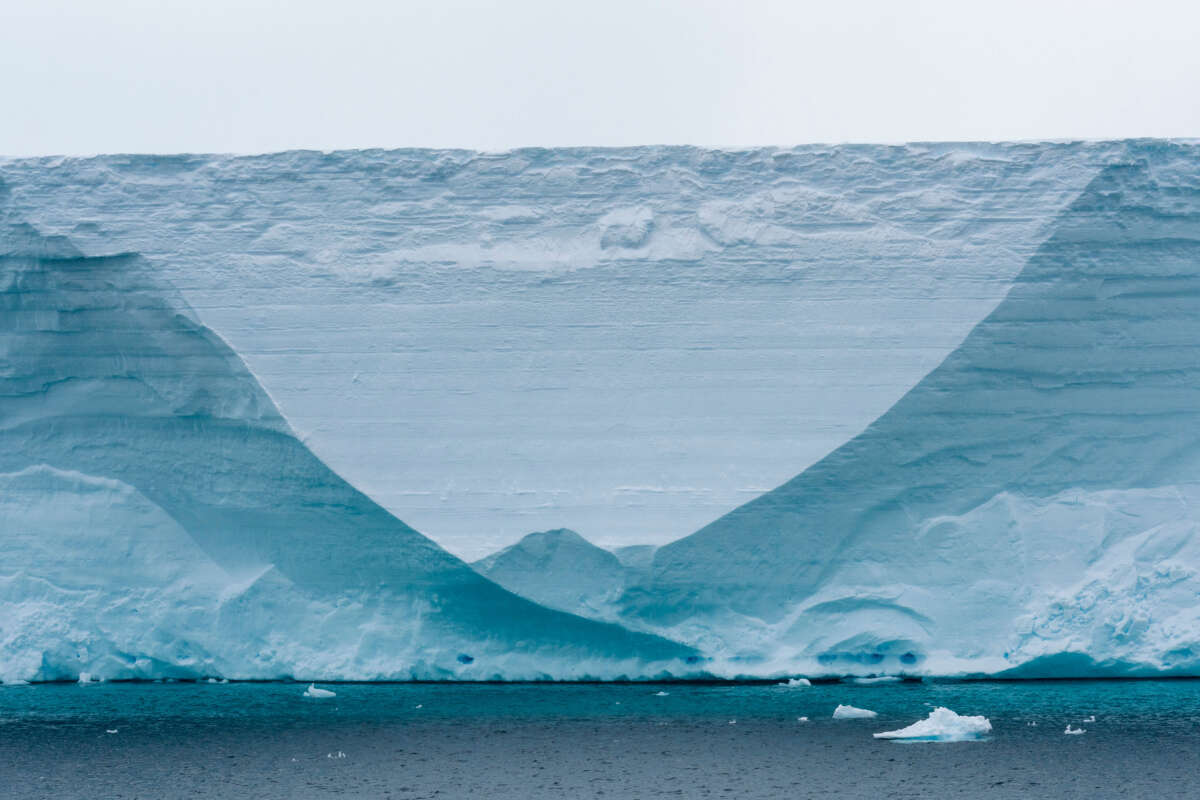
The ice shelves serve as a buttress keeping the West Antarctic Ice Sheet — including the Thwaites Glacier, or the Doomsday Glacier, so named for its potential to contribute dramatically to sea level rise — on land, preventing glaciers from spilling into the sea. Together, the West Antarctic Ice Sheet glaciers contain enough water to cause 5.3 meters of sea level rise, the study notes.
It’s not clear how much the average sea level would rise in the scenarios modeled by the study. But it could suggest that current estimates of sea level rise may be conservative.
The findings are extremely dire and should spur action to prevent even further melting in other parts of the world, the researchers said.
“It appears we may have lost control of the west Antarctic ice shelf melting over the 21st century,” Kaitlin Naughten, the study’s lead author and ocean modeler with the British Antarctic Survey, told reporters. This means that even under scenarios of mitigating the climate crisis and limiting fossil fuel use that the study deems “unrealistically ambitious,” the ice shelves will still be rapidly melted.
“West Antarctic ice shelf melting is one impact of climate change that we’re probably just going to have to adapt to, and that very likely means some amount of sea level rise we cannot avoid,” Naughten said. “Coastal communities will either have to build around or be abandoned.”
The study’s authors say their analysis, using a sophisticated model looking at several future scenarios of global warming, is to their knowledge the most comprehensive look at ice melting in the West Antarctic yet.
But they also emphasize that despite the grim outlook for the West Antarctic ice shelf, there is no reason to give up on climate crisis mitigation.
“This study does not undermine the importance of mitigation in limiting the impacts of climate change. Mass loss from the [West Antarctic Ice Shelf] is just one component of sea-level rise, and other regions of Antarctica are unlikely to lose substantial mass if current emissions targets are met,” they wrote. “This is to say nothing of the many impacts of climate change beyond sea-level rise.”
Scientists not involved with the study said that the findings are sobering. “It is likely that we passed a tipping point to avoid the instability of the West Antarctic Ice Sheet,” said U.K.-based National Oceanography Center senior research scientist Tiago Segabinazzi Dotto, who noted that the research is consistent with previous findings that predicted the “imminent” collapse of the West Antarctic ice shelves. “However, the pace of this collapse is still uncertain – it can happen in decades for some specific ice shelves or centuries.”
We lost 15 percent of our traffic overnight.
We now have three full months of data since Google changed its search to feature AI results. The numbers are worse than we anticipated. Overall readership that comes to Truthout through Google is down 54 percent against last year. The number of new readers who discover Truthout via Google searches is down 49 percent, and returning users from Google are down 51 percent.
We lost 15 percent of our readership overnight. This was a readership we painstakingly built over decades, and it vanished because Google chose corporate greed over a healthy democracy.
We anticipate a loss of roughly $500,000 in online revenue as a result of this massive traffic plunge in the next year alone.
The only way we can keep publishing is with strong reader support. We are asking you to start a monthly donation to Truthout today — anything you can do, whether $5 or $25, makes a difference.