Did you know that Truthout is a nonprofit and independently funded by readers like you? If you value what we do, please support our work with a donation.
A Washington, D.C. resident who was detained by police for playing Darth Vader’s theme from Star Wars while filming Natural Guard troops in D.C. this summer has filed a lawsuit, arguing that his constitutional rights were violated.
Sam O’Hara is suing D.C. police and a member of the Ohio National Guard who alerted police that he was playing the song, alleging his First Amendment speech rights and Fourth Amendment rights against improper seizure were violated.
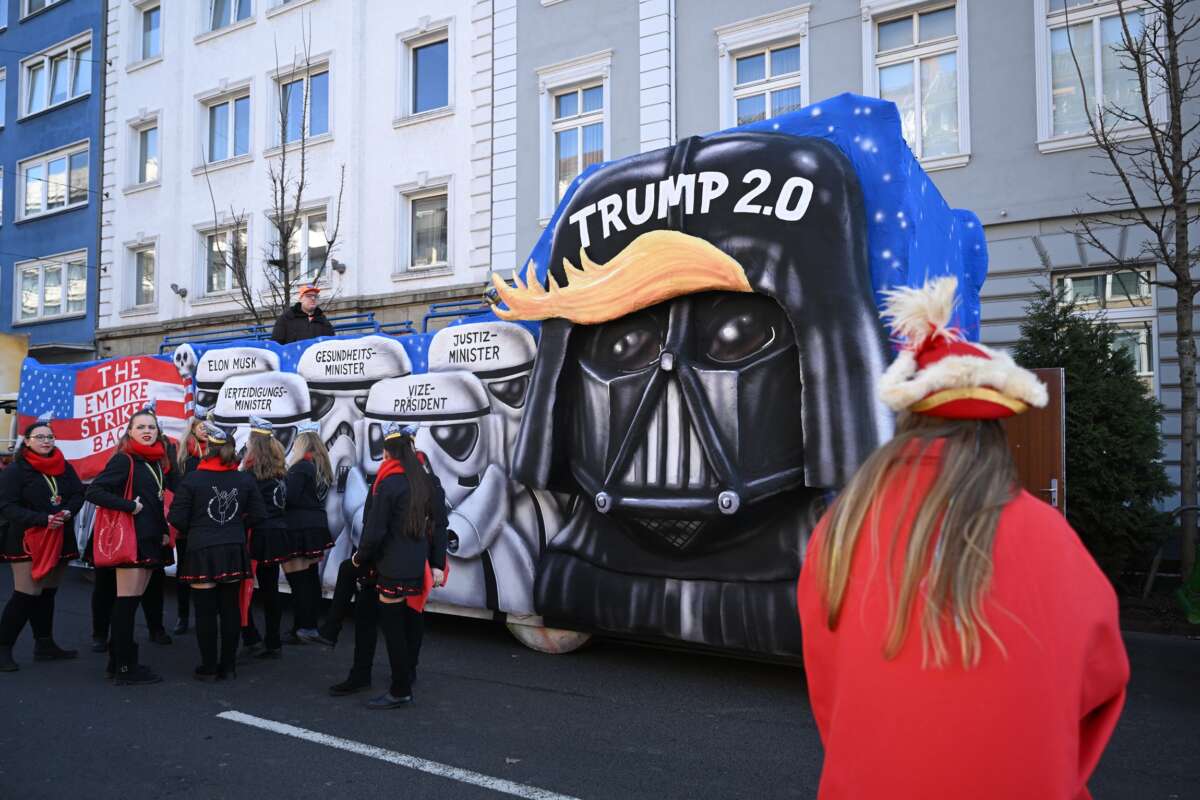
On September 11, to convey his disgust with President Donald Trump’s deployment of troops to D.C., O’Hara played “The Imperial March” on his phone while trailing behind the National Guard. The song is used in the Star Wars franchise to convey the presence of the evil emperor and his second-in-command, Darth Vader. According to O’Hara’s account, he walked behind the National Guard while they moved through the streets, keeping enough distance that he wasn’t interfering with their activities but close enough that they could hear the music.
Within minutes, one of the Guard members threatened to call the police on O’Hara, telling him they would “handle” him if he didn’t stop. O’Hara kept on, and shortly after, D.C. police arrived and “tightly handcuffed” him for around 20 minutes, the complaint alleges.
O’Hara’s complaint alleges that, despite being “several feet away” from the National Guard, police officers had insinuated before detaining him that he was “harassing” and even “assaulting” the troops. The officers also dismissed the idea that his action was a form of protest.
“You better define protest. This isn’t a protest. You are not protesting,” one of the officers told O’Hara, the complaint states.
O’Hara is being represented by the American Civil Liberties Union (ACLU). Although the complaint seeks monetary judgment, O’Hara says he is pursuing the lawsuit because he doesn’t want infringements on freedom of speech to go unchallenged.
“I would not be able to sleep at night knowing that I did not stand up for myself and stand up for my First Amendment rights,” he said in an interview with The Washington Post.
O’Hara also made clear that his protest wasn’t against the troops themselves, but rather the actions of the administration, stating in that same interview:
I think the men and women who signed up to serve their country did not have this in mind, that they would be policing their fellow citizens. My protest is to make sure that everyone knows that this is coming from the top. These orders are coming from an administration that seeks to use fear and tactics to make sure their power extends to branches of government where it doesn’t belong.
Humor is widely accepted to be a key aspect of protest movements, and is a protected form of speech. Several acts of civil dissent across the country, including No Kings protests and demonstrations against federal immigration officials, have featured music, satire, and individuals wearing inflatable animal costumes, such as frogs.
The silliness is oftentimes used to showcase that the presence of federal agents in U.S. cities is both unwanted and unwarranted, and to counter the Trump administration’s descriptions of those who are opposed to his agenda.
“We’re trying to show how absurd it is when the administration here and leadership of ICE … says that the protesters are rabid dogs or violent or whatever,” one Portland-based demonstrator recently explained.
Press freedom is under attack
As Trump cracks down on political speech, independent media is increasingly necessary.
Truthout produces reporting you won’t see in the mainstream: journalism from the frontlines of global conflict, interviews with grassroots movement leaders, high-quality legal analysis and more.
Our work is possible thanks to reader support. Help Truthout catalyze change and social justice — make a tax-deductible monthly or one-time donation today.