Truthout is an indispensable resource for activists, movement leaders and workers everywhere. Please make this work possible with a quick donation.
A new poll suggests that most voters in the U.S. think democracy is under threat, with a majority also stating that they are more concerned about making voting easier than rooting out supposed fraud in elections.
An NPR/PBS NewsHour/Marist poll, conducted June 22 to 29, asked voters which attitudes aligned more with their own line of thinking: whether democracy is alive and well in the U.S., or under threat. A troublingly-small 27 percent felt democracy was thriving, while 69 percent expressed fears about its preservation.
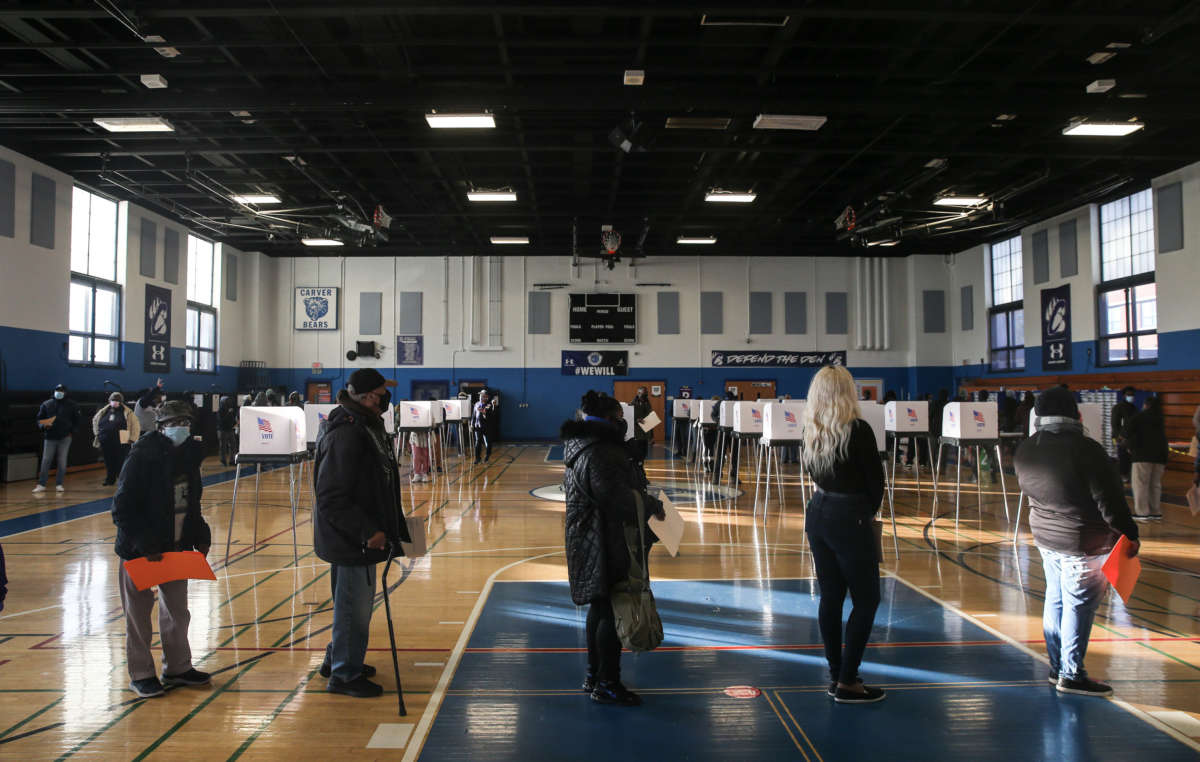
Respondents were also asked about their views regarding election fraud and access to voting. A majority, 56 percent, said they were more worried about access to voting, versus just 41 percent that said voter fraud troubled them more.
There were considerable partisan differences on the question. While a majority of Democratic-leaning respondents (85 percent) and independents (52 percent) said they were more concerned about access to voting, most Republican-leaning voters (72 percent) said that preventing fraud was more important. Among those that voted for President Joe Biden in last year’s election, 82 percent said access to voting was the most important among the two items, while 79 percent of Trump voters said making sure ineligible voters don’t cast a ballot was the more urgent issue.
Despite polls showing majority support for making it easier to vote, Republican-led state houses across the country, reacting to former President Donald Trump’s false claims of election fraud, have pushed for unnecessary and restrictive changes to voting laws that diminish voters’ access to the polls, particularly for communities of color. In the first half of 2021 alone, 14 states have passed into law at least 22 acts that make it harder to vote.
Some Republican lawmakers in several states are also pushing for so-called election audits, which are likely to create greater barriers to voting. Most voters, however, view these audits in a negative light, with 57 percent of Americans in a recent Monmouth University poll saying they are “partisan efforts to undermine valid election results.” Conversely, only a third of respondents in that poll (33 percent) said they viewed such audits as “legitimate efforts to identify potential voting irregularities.”
While the Biden administration’s Department of Justice has said it would challenge these state voter suppression laws in courts as unconstitutional, the Supreme Court delivered a devastating blow to such a move, ruling along partisan lines on Thursday that the Voting Rights Act of 1965 could not be used to challenge voting rules changes in Arizona made a few years ago.
We lost 15 percent of our traffic overnight.
We now have three full months of data since Google changed its search to feature AI results. The numbers are worse than we anticipated. Overall readership that comes to Truthout through Google is down 54 percent against last year. The number of new readers who discover Truthout via Google searches is down 49 percent, and returning users from Google are down 51 percent.
We lost 15 percent of our readership overnight. This was a readership we painstakingly built over decades, and it vanished because Google chose corporate greed over a healthy democracy.
We anticipate a loss of roughly $500,000 in online revenue as a result of this massive traffic plunge in the next year alone.
The only way we can keep publishing is with strong reader support. We are asking you to start a monthly donation to Truthout today — anything you can do, whether $5 or $25, makes a difference.