Truthout is a vital news source and a living history of political struggle. If you think our work is valuable, support us with a donation of any size.
Following weeks of relentless bombing, the U.S. military campaign against Iran’s southern regions prompted by the collapse of the June 17 memorandum of understanding continues with intermittent frequency as the White House is reportedly seeking to strike Iran every now and then to keep the Strait of Hormuz open.
At least 59 Iranians have been killed since June 28, Hossein Kermanpour, a spokesperson for Iran’s Ministry of Health said, largely during the new round of airstrikes launched on July 7 that punctured a shaky ceasefire agreement brokered by Pakistan. This number excludes the casualties of the latest U.S. military escalation starting on August 31 following a month-long pause. On September 1, at least five people, including a 4-year-old child, were killed when the U.S. bombed a wedding party in Kuhestak City in Hormozgan Province, roughly 30 miles south of Minab.
In line with his earlier threats, President Donald Trump ordered attacks on Iran’s civilian infrastructure in July, targeting bridges, airports, desalination plants, and railroad networks, mostly in the southern provinces of Khuzestan, Bushehr, Hormozgan, and Sistan-Baluchestan. In March, Secretary of Defense Pete Hegseth had claimed the U.S. military does not target civilians. The Pentagon told media the July strikes targeted “military logistics infrastructure” without providing evidence that such infrastructure was in fact military or the intended target.
Beyond the environmental harm and infrastructural damage that they caused, the airstrikes have recalled memories of the eight-year Iran-Iraq War of the 1980s for the residents of southern Iran. During that war, the former Iraqi leader Saddam Hussein invaded parts of the south in a bid to overthrow the newly born Islamic Republic. By some estimates, 750,000 Iranians were killed in that war, when Hussein’s army bombed thousands of houses in cities like Abadan, Dezful, and Khorramshahr. At least 500,000 Iraqis were also killed in what became the longest conventional war of the 20th century.
Government corruption and economic isolation prevented a full-fledged reconstruction in the years that followed, and the southern provinces remain underdeveloped despite their vast natural and petroleum reserves. According to the latest national welfare reports, Sistan-Baluchestan, Hormozgan, and Khuzestan respectively ranked first, third, and 14th out of Iran’s 31 provinces for the highest levels of poverty.
Now, as Iranians come to grips with the reality of life under lingering threats by the United States and Israel and a war that still rages on, the south’s strained resources may fail to withstand a naval blockade, increasing water stress, periodic electricity blackouts, and disrupted livelihoods that were largely dependent on coastal trade and marine economy.
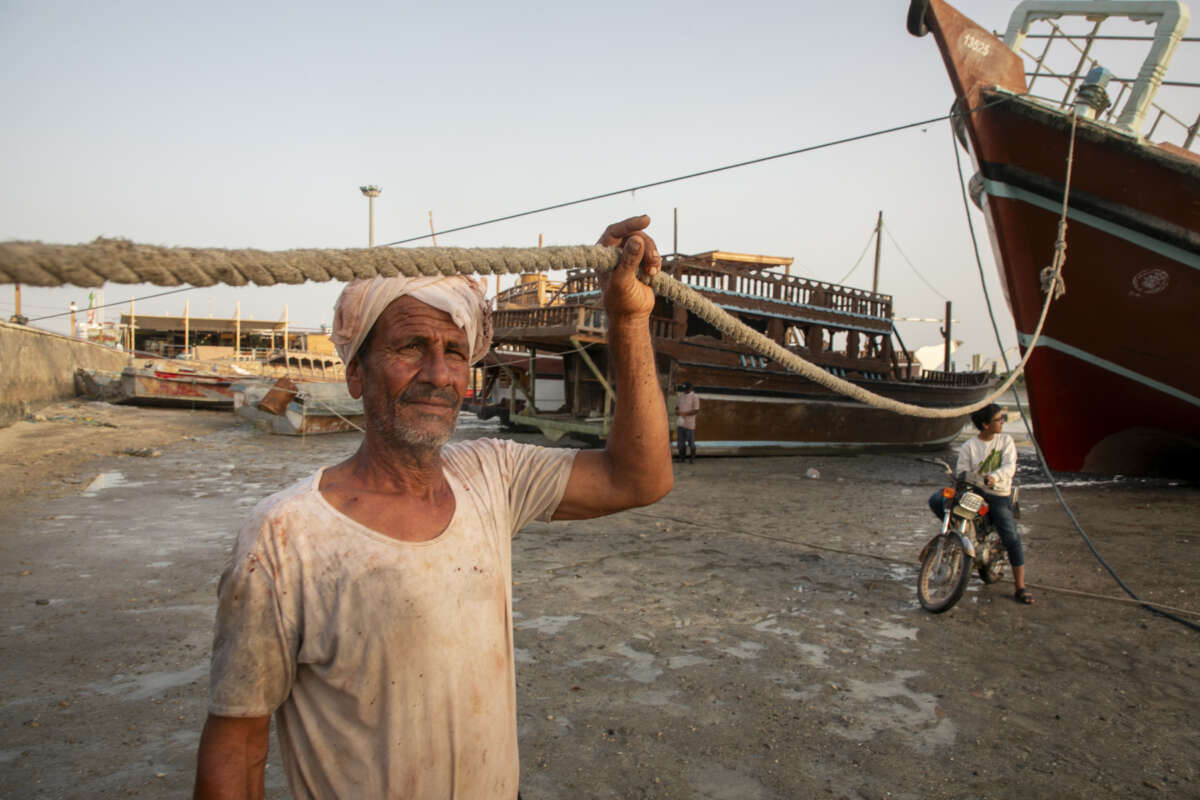
According to Hormozgan Province authorities, nearly 30 wooden Lenj boats sailing through the Persian Gulf have been destroyed since the beginning of the war. These traditional boats are hand-built vessels that can take up to two years to be assembled, and their robust architecture ensures decades-long durability, which means they can be quite expensive, as well.
Part of a 3,000-year-old tradition, the skill of building and sailing Lenj boats was inscribed on UNESCO’s List of Intangible Cultural Heritage in Need of Urgent Safeguarding in 2011. The tradition not only includes the know-how to make the boats, but also the folk music, rituals, and festivals that are associated with the painstaking process, often carried out by low-income village dwellers who have inherited the craft from their ancestors.
It’s estimated that, in Hormozgan alone, a total of 423 fishing boats of various types have been damaged or destroyed since February 28, when a volley of unprovoked U.S.-Israeli airstrikes started the war. Provincial officials say each boat could support up to four households, and there are currently 14,000 boats operated by the private sector practitioners whose main source of income is commercial and artisanal fishing.
Hormozgan’s Qeshm Island, a Sunni-majority locality of 150,000 people, which was documented in the writings of the Greek navigator Nearchus as the first inhabited island of the Persian Gulf, also sustained significant damage. There is a growing oil slick around the island that has now extended to the Hara mangrove forests, and U.S. airstrikes on the Chahkooh Canyon on July 30 damaged and destroyed at least 47 residential properties.
The south’s strained resources may fail to withstand a naval blockade, increasing water stress, periodic electricity blackouts, and disrupted livelihoods.
Three members of a family of five were killed in those airstrikes, including the 40-year-old taxi driver Qeisar Jafari, his wife Zahra Jafari, and their 2-year-old son Sina. Their two other children, now orphaned, survived the bombing. A New York Times investigation found that a 2,000-pound bomb known as Mark-84 was used in the attacks, leaving a 30-foot-wide crater, displacing 20 households living nearby.
The U.S. military is estimated to have expended $47 billion worth of munitions in the Iran war, including the Precision Strike Missile (PrSM), which is Lockheed Martin’s state-of-the-art smart weapon developed in 2023, and was first used in combat on February 28, targeting a sports hall and an adjacent elementary school in the southwestern city of Lamerd. The strikes killed 21 civilians.
In the first week of the war, Qeshm’s multi-effect distillation desalination plant was bombed in airstrikes that Iran said was carried out by the U.S. military, even though Trump didn’t admit responsibility for the attacks. Water supply to 30 villages on the island was disrupted.
“Damage to water systems, roads, housing, ports or energy infrastructure does not occur in isolation. In communities already dealing with water scarcity, environmental degradation, economic pressures and uneven infrastructure, every additional disruption reduces resilience,” Nima Shokri, co-director of the United Nations University Hub on Engineering to Face Climate Change, told Truthout.
“A damaged water system means greater household costs and unreliable supply; damaged transport affects access to employment and services; pollution affects fishing and coastal livelihoods,” he said. “The environmental consequences, therefore, become part of the civilian and economic consequences of the conflict, rather than a separate issue to be considered afterwards.”
Shokri, who is currently working to document the impacts of the oil leaks affecting the Hara mangrove biosphere, says transparent technical support can help mitigate the crisis, even though Iran, according to him, has significant expertise in marine science and oil-spill response.
“Qeshm has been a UNESCO Global Geopark since 2017, so its geological and ecological importance extends beyond Iran. International assistance could support independent environmental assessment, restoration of damaged ecosystems, water infrastructure and scientific monitoring,” he added.
When Trump moved to fulfill his threats of targeting Iran’s civilian infrastructure, which international law experts say would constitute war crimes, bridges and railroad network across Hormozgan were the early targets. On July 16 and 17, at least six bridges in Bandar Khamir were bombed, reportedly killing eight people. The junction station connecting Bandar Abbas to Shahid Rajaee Port was also bombed, disrupting transportation for at least a day.
A scholar of architecture at Cornell University sees parallels between the recent experiences of southern Iran with conflict and what these regions endured during the 1980-88 Iran-Iraq War.
In Hormozgan alone, a total of 423 fishing boats of various types have been damaged or destroyed since February 28.
“The historical continuity is very direct. Southern Iran is again being attacked across landscapes that absorbed some of the heaviest destruction of the Iran-Iraq War,” Farzin Lotfi-Jam told Truthout.
“A UN postwar mission found that 80 percent of streets in Khorramshahr and 40 percent in Abadan required rehabilitation or resurfacing because of war damage and interrupted maintenance,” he said, referencing the substantial costs of the eight-year war.
“In Khuzestan’s electrical system, the UN found that two-thirds of reconstruction had relied on materials diverted from development projects elsewhere, while planned improvements to the Abadan and Khorramshahr power system had not been completed because of the war,” he added.
Lotfi-Jam, who is the recipient of the 2022 League Prize from the Architectural League of New York, says these figures encapsulating the impact of the war with Iraq suggest how war reaches into the future, arguing that infrastructure is “stored social time” and destroying it forces a society to spend that time twice.
“Reconstruction consumes steel, concrete, engineering capacity, public money, and years of labor that would otherwise produce new housing, infrastructure, environmental repair, education, or public services,” he added.
Some of the unique architectural styles, wildlife habitats, and historical sites of Iran can be found in the southern provinces that have come under attack from the U.S. From the sprawling Bronze Age archaeological site Shahr-i Sokhta in the Sistan and Baluchistan Province to the Shushtar historical hydraulic system in Khuzestan, these remnants of ancient times have been conserved throughout centuries despite political upheavals and foreign invasions.
To many observers, including Iranian-American academics serving their communities in the United States, threats against Iran’s civilian infrastructure are deeply distressing.
“When I hear the news of the attacks, I of course feel sad for the people affected, but as an architectural historian, I also think about these and other cultural sites in the region,” said Farshid Emami, an associate professor of art history at Rice University.
“A damaged water system means greater household costs and unreliable supply; damaged transport affects access to employment and services; pollution affects fishing and coastal livelihoods.”
Emami told Truthout these threats also sadden him on a personal level. “My mother is a mechanical engineer, and one of the last projects she was involved in was the water system for new industrial cities on the Qeshm Island. Iran’s infrastructure was developed through the efforts of engineers like my mother.”
“It belongs to the Iranian people, not any government,” he added.
The coastal province of Bushehr, which borders the Persian Gulf, was affected by the latest round of U.S. attacks, too. The July 9 airstrikes on the Bonud village wharf incinerated 10 boats belonging to local fishermen. Earlier in March, U.S.-Israeli airstrikes had destroyed five merchant ships berthed at Shahid Haghgoo maritime terminal in Bushehr’s Solhabad neighborhood.
The toll of the war on Bushehr has been notably high as it was one of the primary targets of the U.S.-Israeli campaign. The world’s largest offshore natural gas field, South Pars, which Iran shares with Qatar, is located off the coast of Bushehr Province. The processing hub in the city of Asaluyeh was hit in March 18 airstrikes that knocked out nearly one-third of Iran’s energy production.
More than 8,000 residential and commercial buildings have been damaged in Bushehr over the past six months, local officials say, and July 22 attacks by the U.S. military damaged agricultural machinery in the Dashti County. Iran Meteorological Organization has also reported that of its 10 weather surveillance radars, two have been rendered inoperable, including one in Bushehr.
Weather radars require complex technology, as well as installation and maintenance expertise, and although dozens of countries operate them, they are not very common in the Middle East. The World Meteorological Organization lists nine weather radars in Iran, which is different from the official figure, but this still makes Iran the sixth Asian country with the largest number of such systems currently in use.
A major casualty of the war in Bushehr is its international airport. In use since 1919 when it first served as a stopover point for Britain’s Royal Air Force planes, the airport’s main passenger terminal has reportedly been razed to the ground. At least one newly purchased commercial passenger plane parked on the apron caught fire and was destroyed during airstrikes in March, and 11 sections of its two flight lines were bombed at different times.
“If you are going to support a war, or pay for one with your taxes, the least you can do is know who and what you are bombing … The dehumanization and anonymity of some nebulous enemy makes atrocity possible.”
The latest phase of the U.S.-Israeli aggression against Iran has also affected areas of the south that were less known globally. The Azini Estuary, near the small town of Bandar-e Sirik, is one of the few places in the world where two species of mangrove plants, namely the Avicennia marina and loop-root mangrove (Rhizophora mucronata) co-occur. The Bandar-e Sirik area has been bombed on multiple occasions since the ceasefire collapsed.
Ari Honarvar, an Iranian-American writer and author of the 2021 novel A Girl Called Rumi has launched a social media series, ironically titled “Get to know the people and places you bomb.” In 19 episodes so far, she has offered visual guides to Iranian towns and cities that have been targeted in the war without prompting international outcry. She told Truthout the series began as “an act of radical empathy and rehumanization.”
“If you are going to support a war, or pay for one with your taxes, the least you can do is know who and what you are bombing,” she said. “Know their history, their poets, their food, their children’s names. The dehumanization and anonymity of some nebulous enemy makes atrocity possible.”
According to Honarvar, who also organizes resilience workshops for refugees from war-torn regions, vulnerable communities often pay the highest price during periods of geopolitical and environmental stress. The events of the recent months are not a new wound but mark the “reopening of one that never healed,” Honarvar said.
“The communities of southern Iran never fully recovered from the Iran-Iraq War,” Honarvar added. “The reconstruction was incomplete, trauma unprocessed, and minority communities like Arab, Baloch, Bandari communities bore a disproportionate burden.”
Press freedom is under attack
As Trump cracks down on political speech, independent media is increasingly necessary.
Truthout produces reporting you won’t see in the mainstream: journalism from the frontlines of global conflict, interviews with grassroots movement leaders, high-quality legal analysis and more.
Our work is possible thanks to reader support. Help Truthout catalyze change and social justice — make a tax-deductible monthly or one-time donation today.