Part of the Series
Struggle and Solidarity: Writing Toward Palestinian Liberation
Truthout is a vital news source and a living history of political struggle. If you think our work is valuable, support us with a donation of any size.
The Israeli security cabinet approved a plan presented by Prime Minister Benjamin Netanyahu on August 8 to fully occupy the Gaza Strip and forcibly displace the residents of Gaza City from the north of the territory to the south.
The news of the plan spread rapidly among those of us in Gaza, leaving us in a state of shock and despair. We had been following the updates in hopes of hearing about a possible ceasefire — not a full occupation and a new wave of displacement. Since the Israeli plan was announced, the Israeli army has intensified its artillery bombardment and airstrikes on the southern part of Gaza City.
The decision comes at a time when starvation has severely gripped the Gaza Strip. According to UN officials, since late May, nearly 1,400 people struggling to obtain basic food supplies have been killed through Israel’s failed food distribution. In addition, more than 500,000 people in Gaza are facing starvation, and all 320,000 children under the age of 5 are at risk of severe malnutrition.
The Israeli plan was met with condemnation from both Western and Arab countries, who warned that it would further diminish the chances of achieving a permanent ceasefire and bring nothing but more destruction and suffering. Nevertheless, Netanyahu insisted that he would press ahead with his plan, refusing to yield to rhetorical pressure from other nations.
Some reports, citing statements from Israeli officials, indicated that the plan will be implemented in phases. The first phase involves the occupation of Gaza City by displacing its roughly 1 million residents to areas Israel designates as “safe zones,” while providing what Netanyahu’s office describes as humanitarian aid to civilians outside the combat zones. Israel has bombed safe zones it has designated itself repeatedly over the course of its assault on Gaza; meanwhile, the current aid scheme run by the Gaza Humanitarian Foundation has been described by the UN as a “death trap.”
The mass forcible displacement will reportedly be followed by intensified airstrikes aimed at clearing the way for troops to encircle the city and conduct incursions into residential neighborhoods. Netanyahu has said that the military will also focus on occupying the refugee camps in the central Strip.
In Gaza City, most people view this plan as a continuation of Israel’s systematic strategy to replicate the devastation seen in Gaza’s northern governorate, Rafah, and Khan Younis — targeting the few remaining areas in the Strip that still have residential buildings and landmarks. This could pave the way for Israeli right-wing extremists to bring back settlements in Gaza and confine the Palestinian population to a specific area in the south, in preparation for their forced displacement outside the Strip.
During the 22-month war, most of Gaza City’s neighborhoods — now marked as the first target in Israel’s latest plan — have endured bloody massacres, relentless bombardment, suffocating starvation, and temporary military incursions. However, they have so far been spared the total destruction that devastated Rafah and other parts of the Strip, as the most intense fighting and incursions have, until now, been concentrated in the city’s eastern areas, including Al-Tufah, Al-Shujaiya, and Al-Zaytun.
Now, Gaza City — especially its central and western areas, which were already overcrowded with residents — has become even more congested, as thousands of evacuees have poured in from the eastern part of the city and from the northern governorate, including Beit Hanoun, Jabalia, and Beit Lahia. This influx followed the Israeli military operation called Gideon’s Chariots by Israel, and known as “Markeb Jadoun” on the ground in Gaza, which launched in May. By that operation’s end, Israel had seized large parts of the northern Strip and confined its population to specific areas within Gaza City.
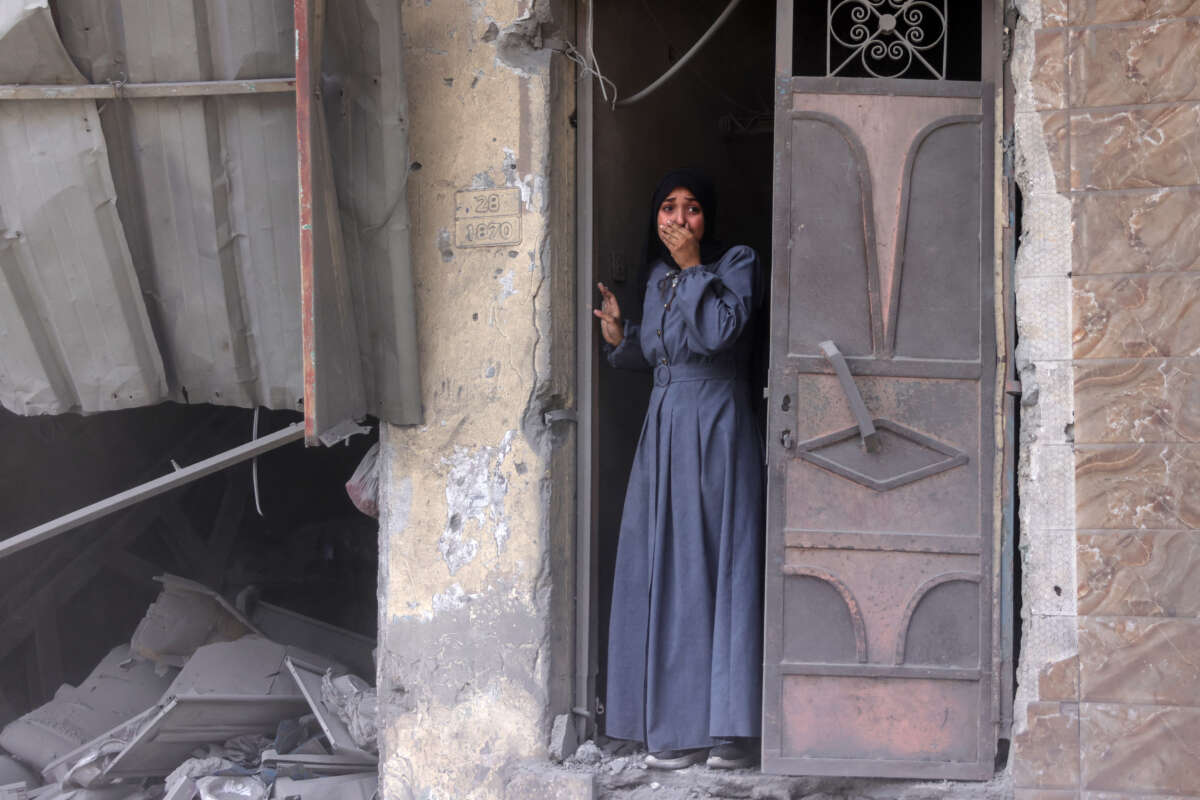
Most people in Gaza City, including both evacuees and original residents who lost their homes, are now living in flimsy tents that lack basic necessities, crammed into makeshift camps set up in any available spaces — playgrounds, parks, and even along Gaza City’s beach. Others have taken shelter in schools and public institutions that have been converted into housing for displaced families, where conditions are equally harsh; in some cases, a single classroom accommodates three or four families.
The overcrowded conditions in Gaza City mean that any large-scale military invasion would trigger a humanitarian catastrophe, forcing more than 900,000 people to flee under the looming threat of massacres and a bloody invasion. They would be pushed toward the south, where evacuation orders have already covered most areas and Israeli forces have seized two of the area’s largest cities — Rafah and Khan Younis.
Ahmed Totah, 56, said that during the ceasefire in January 2025, he and his family managed to return to their home in the Jabalia refugee camp after 16 months of displacement in the south. However, Totah was only able to live in his home for two months before the Israeli military resumed the war and expanded their operations in the north, reaching his neighborhood.
Refusing to move back south, Totah decided to flee to the western part of Gaza City, to an area called Al-Rimal, where he set up his tent in a public park called Al-Jundi.
“Isn’t the hell we are already living through enough?” Totah said. “Now Israel wants to displace us once again to the south. We have no food or clean water, and we live in flimsy tents that offer no protection from the scorching sun or the cold of winter. On top of that, the daily bombardments terrorize us. We are exhausted and have no energy left to face the suffering of yet another displacement. We have literally reached a point where we prefer death over living this life.”
Rawan Husain Ali, 22, said she has been displaced in the heart of Gaza City since the early days of the war, after her neighborhood, Al-Shujaiya, was declared a dangerous war zone by the Israeli army. “The news of the Israeli occupation plan for Gaza City has brought back all the dark memories of destruction, killing, and displacement I endured in Al-Shujaiya,” she said. “My entire family is now consumed by worry, depression, and relentless thoughts about where we will live, where we will go, and how long our displacement will last. We have already lost our father and our home — we cannot bear to lose anything more or be displaced to the unknown. We can no longer endure such horrors.”
As hundred thousands of families in Gaza City, like those of Husain Ali and Totah, brace for yet another chapter of suffering that could end in their displacement from the Strip, Palestinians in Gaza ask an urgent question : Will the world move beyond mere words to take meaningful action that protects civilians, halt Israel’s catastrophic plan, and save what remains of the devastated Strip before it is too late?
Media that fights fascism
Truthout is funded almost entirely by readers — that’s why we can speak truth to power and cut against the mainstream narrative. But independent journalists at Truthout face mounting political repression under Trump.
We rely on your support to survive McCarthyist censorship. Please make a tax-deductible one-time or monthly donation.