
Honest, paywall-free news is rare. Please support our boldly independent journalism with a donation of any size.
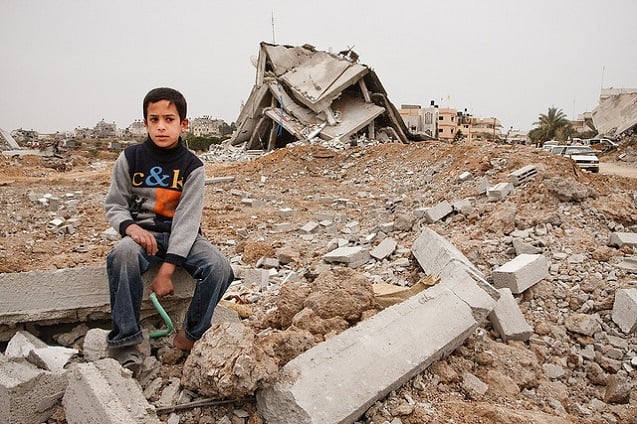 andlun1 / Flickr)” width=”637″ height=”424″ />(Photo: andlun1 / Flickr)
Raed Abufayyad is watching Al Jazeera when he sees his cousin’s corpse.
“There! That’s Muhammad!” Raed says. He darts his finger to the screen: a man’s body lies face-down on a dirt path.
It is Wednesday, 23 July. We are in Raed’s home in the small city of San Mateo, about a fifteen minutes’ drive from San Francisco.
Raed, 31, knew that his cousin had been killed by an Israeli sniper in Gaza earlier that day, leaving behind a wife and six children. Muhammad, who was aged 36, is the ninth member of Raed’s extended family to be killed since the Israeli assault on Gaza began.
Images of Raed’s home village of al-Qaraqa fill the screen. We see desolate, emptied streets; towering above them are the half-standing skeletons of bombed-out buildings.
The on-air reporter has gone along with a few brave workers from the Palestine Red Crescent Society who have entered the village to retrieve the dead and search for the injured. Muhammad was one of those killed.
Evacuated
Until the previous week, Raed’s brother, Tareq, and sister, Rasha, were living in the family’s Gaza home. But then, on 18 July, al-Qaraqa — near Khan Younis in southern Gaza — was evacuated.
Now the entire population of al-Qaraqa lives at the Mustafa Hafez elementary school near Nasser Hospital in Khan Younis. The school is run by UNRWA, the United Nations agency for Palestine refugees.
Raed’s father, Issa, left Gaza for San Francisco in the early 1990s. Over the course of the following ten years he brought his six children over, one by one. Together, Raed and Issa run a limousine company that works out of San Francisco International Airport, not far from their home.
Since Israel began its latest offensive against Gaza, they have called Tareq every night. It is important that they hear his voice every day. “If he picks up, we know he’s alive,” says Jebreel, his 24-year-old brother.
I am joining the Abufayyads for one of their chats with Tareq.
To their relief, he answers the phone. They put it on speaker and translate from Arabic for my benefit. It is 10:30pm in California, 8:30am in Gaza.
Tareq has just found out that their house has been bombed: half of the first floor caved in, and their ten acres of agricultural land have been severely damaged.
Bombs “Feel So Close”
“Our village has become a ghost town,” Tareq says.
“The west side of Khan Younis is now being bombed,” Tareq adds. “You feel the bombs are so close to you.”
At the shelter, the women and girls sleep in the classrooms, and the men sleep in the halls and playground.
There is one tank of water to share among the 1,500 people. “Water is only for drinking — no washing hands, showers, anything,” Tareq, who was married last year, says.
Tareq says that the people at the camp rely on the radio to get news, but no one feels hopeful that the assault will end soon.
Tareq asks Raed to send money through Western Union because he heard that it will open for a short period that day.
Aged 32, Tareq is the only one of the siblings who cannot leave Gaza. In 2007, he tried to join his family, but when he arrived at San Francisco International Airport he was picked up by Homeland Security’s Customs and Border Protection and placed into deportation proceedings under the allegation that he “had the potential” to become affiliated with Hamas.
It was a spurious charge that the Abufayyads fought for years — while Tareq languished in a California jail. Eventually, they succumbed to the deportation proceedings.
Tareq was deported to Gaza in 2011, and was in Khan Younis when Israel attacked Gaza in November 2012. He tells his family that there is simply no equivalence between that offensive and what Israel is doing now.
“Sick of Being Victims”
The extreme cruelty of Israel’s actions is underscored later that night. Just hours after I leave the Abufayyads’ house, Israel bombs an UNRWA school in the northern Gaza town of Beit Hanoun. At least sixteen people are killed.
I have known the Abufayyads for more than a year now, since I first reported on Tareq’s unjust deportation. Still, they are cautious when they speak to me about Gaza and careful to avoid any overtly political or controversial statements.
Their reserve is understandable considering the erroneous charges against Tareq concerning Hamas, a US-designated “terrorist” organization.
But tonight their talk becomes a bit more direct as the evening wears on.
“Palestinians are sick of being the victims,” Jebreel says. “Now, everyone is standing together, supporting each other.”
Important Message: Please Read
For 25 years, Truthout has survived by publishing impactful investigative journalism and analysis; distributing full editions 365 days a year; and building a community of readers who support us with small, hard-earned donations.
Eighty percent of our $3 million yearly budget comes from small donors alone. Of those, 8,000 readers support us with monthly donations. Back in 2018, when Facebook decided to suppress the circulation of posts made by organizations, thereby cutting readers off from seeing many articles shared by the news organizations they had intentionally decided to follow, Truthout’s total traffic declined by 40 percent, as nearly all of our traffic from that platform disappeared.
Now, Google has recently rolled out its AI search bar, providing AI summaries instead of directing readers to our site. Google Search is our single largest source of traffic; it’s the route by which nearly one third of our readers find us. Much like in 2018, a shocking 40 percent of our Google traffic has disappeared overnight.
It will not be easy for Truthout to shoulder this blow. Nor will it be easy for our peers and collaborators — news sites that depend on traffic and aren’t bankrolled by large corporations.
If you can support Truthout with a donation today, you can help us resist the AI onslaught. Please give today.