Part of the Series
Struggle and Solidarity: Writing Toward Palestinian Liberation
Support justice-driven, accurate and transparent news — make a quick donation to Truthout today!
For the third consecutive year, Ramadan unfolds as Gazans continue to endure crushing living conditions that strip us of our most basic human rights and dignity. The war may have nominally stopped, but its suffering has not. More than 83 percent of buildings in Gaza have been destroyed, while Israeli forces still control more than half of the Gaza Strip. As a result, many Gazans now live in overcrowded camps, sheltering in flimsy tents that offer no protection from the bitter cold of winter nor the heat of summer. These tents have turned daily life into a living nightmare, depriving families of the ability to experience the spiritual essence of Ramadan as we once did before the war.
Before the war in Gaza began, Ramadan was always a month eagerly awaited, when streets and homes were decorated with colorful lanterns and golden crescents. Traditional markets were filled with an array of dates, nuts, coffee, desserts, and pickles. Islamic nasheeds (devotional songs) resonated through the streets, creating a special and sacred atmosphere. Families would patiently await the Maghrib adhan — the call to prayer that occurs at sunset — to break their long day of fasting, gathering around iftar tables filled with a variety of delicious and vibrant foods, special drinks, and desserts made only during Ramadan, such as kharoub (a sweet drink made by steeping carob) and qatayef (pancake-like dumplings stuffed with nuts or cream). Children would run into the streets after our fast-breaking evening iftar meal, playing on swings, enjoying fireworks, and sharing laughter. Most importantly, mosques were filled with worshippers performing the Taraweeh nightly prayers, sacred ritual that fostered a sense of peaceful togetherness.
Over the past two Ramadans, all of us in Gaza were deprived of nearly everything that once made the month special. Streets that had once remained crowded late into the night fell silent by the afternoon, resembling ghost towns — no decorations, no lights, only an overwhelming emptiness. We fasted for long hours, and if we were fortunate, we broke our fast with nothing more than canned food, lentil soup, or bread made from expired flour. Most of the time, we ended iftar still hungry, painfully remembering how abundant and diverse our iftar tables had once been, shared in the warm presence of our loved ones. Moreover, relentless bombardment and bloody massacres prevented us from performing Taraweeh prayers together in the few remaining mosques, most of which had been destroyed by Israeli forces. In those years, Ramadan was for the first time stripped of its spiritual beauty, transformed from a month of mercy and reflection into one marked by pain and suffering.
Despite the terrible living conditions that persist in the current moment, many in Gaza see this Ramadan as a chance to reclaim some of the joys of the holy month that were lost over the past two years.
We cannot celebrate Ramadan as we did before Israel’s war on Gaza, however, because the genocide has left nothing in our lives intact — many families have lost their homes, their loved ones, or both, and some are still unable to return to the neighborhoods they once called home, which remain under Israeli control. Access to basic necessities has become a luxury we can no longer afford. Moreover, the reality of living in tents has forced many into a life reminiscent of the Nakba. Yet, despite all this, the people around me remain determined to observe Ramadan in a way that feels markedly different from the previous two Ramadans spent amid war, making the most of what little they have.
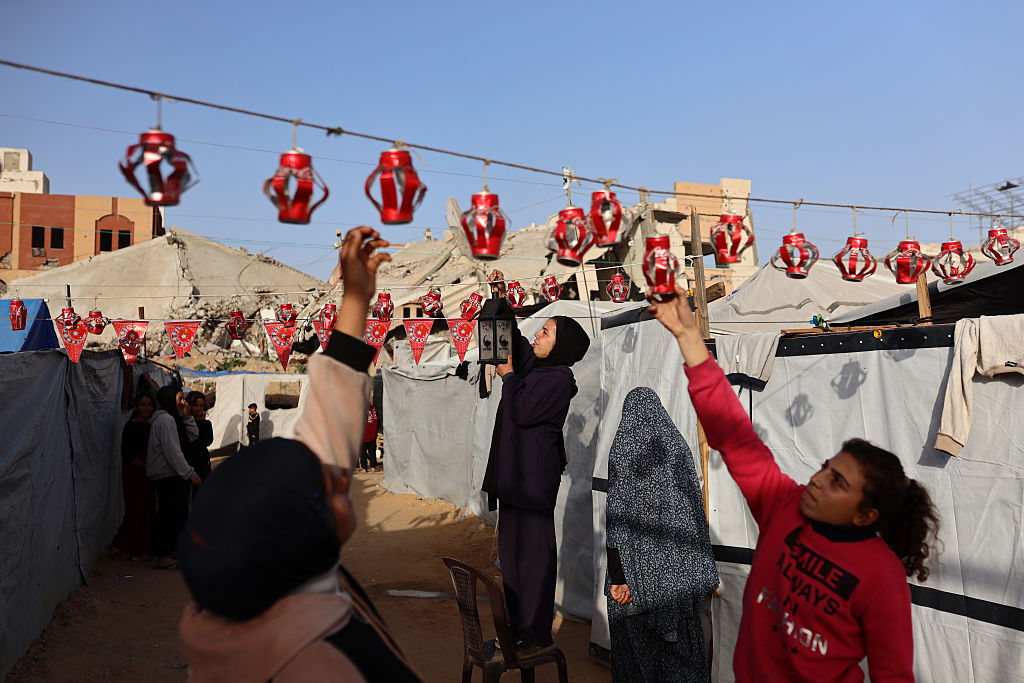
People have begun decorating their tents with lanterns and crescents made from humanitarian aid boxes.
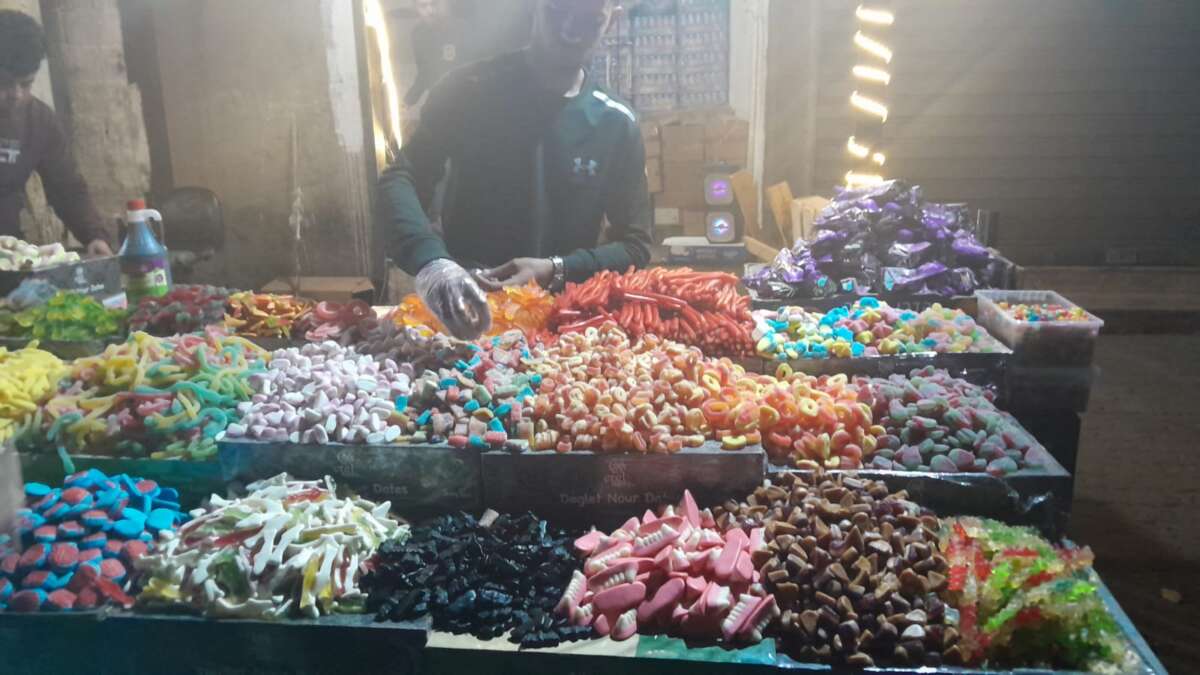
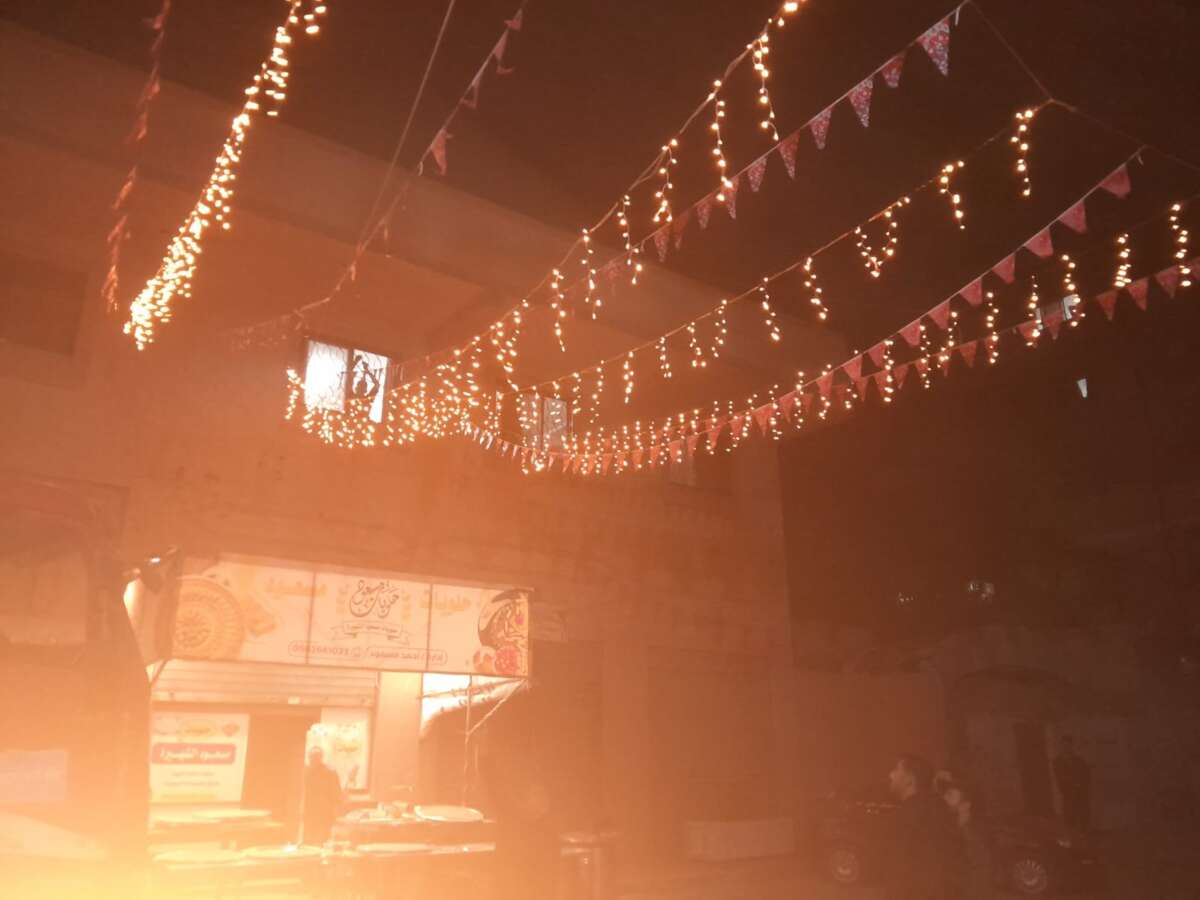
Signs of resilience and hope are visible in the ways people have begun decorating their tents with lanterns and crescents made from humanitarian aid boxes, painting murals, cleaning the streets of rubble, and stringing illuminated lights. Traditional markets, such as Al-Zawya Market, have reopened, offering a variety of Ramadan goods and decorations. Dessert shops have started preparing an array of Arabic sweets that Gazans love to enjoy after iftar, including qatayef, kunafa (a crunchy, buttery dessert made with shredded phyllo dough), and awameh (deep-fried dough balls soaked in fragrant syrup). Families plan to hold communal iftars beside the rubble of their homes and are making makeshift mosques for Taraweeh prayers. Musaharatis walk through neighborhoods, beating drums as a way of welcoming Ramadan.
Alham Al-Harazeen 43, told me that before the war, Ramadan in her Al-Zaytoun neighborhood carried a special warmth. “I clearly remember how my daughters and I used to clean and decorate our home,” she said. “We worked tirelessly to prepare the iftar table with different kinds of food — desserts, salads, cheese-stuffed sambosa, and roasted chicken. We would invite friends to share iftar with us in our garden, under the olive trees my husband planted.”
She added that her home has since been completely destroyed and that her neighborhood now lies under Israeli control. Al-Harazeen and her family are currently living in a tent in western Gaza City. “We dreamed that the implementation of the second phase of the ceasefire would allow us to spend this Ramadan in our destroyed neighborhood, but that did not happen,” she told me.
Families plan to hold communal iftars beside the rubble of their homes and are making makeshift mosques for Taraweeh prayers.
Despite the harsh living conditions in the tents and the distance from her neighborhood, Al-Harazeen said her family is trying to cope and preserve the spirit of Ramadan, especially for the sake of their children. “For my young children, I cleaned the tent, bought a new carpet, colorful decorations, and prayer clothes, and prepared an empty space in front of the tent where we could have iftar meals,” she said. “I just want them to feel that this Ramadan is different.”
Sojood Al-Khor, 23, told me that for her family, Ramadan this year will be entirely different from the two Ramadans experienced during the war, which were distorted by pain and suffering.
She explained that the spiritual beauty of the past two Ramadans was destroyed as fear and depression dominated people’s lives, alongside the hardships of displacement, heavy bombardment, constant anxiety, and the bitterness of loss. She also pointed to the severe shortage of food and clean water, saying, “We used to fast knowing that our iftar would be nothing more than a bowl of lentil soup.”
She added, “Today, we are awaiting Ramadan with great enthusiasm. We long to hear the call to prayer echoing through the streets, to eat healthy and delicious food, followed by qatayef — sweets from which the occupation deprived us for years.”
Al-Khor continued, “We will eat maqluba [a layered dish of spiced rice, meat and vegetables], traditional maftoul [bulgur couscous], and Palestinian musakhan [roasted chicken with sumac]. We will drink juice and clean water. We will celebrate without rockets interrupting our joy and without the screams of loss.”
She concluded, “We thank God for this blessing and ask Him to preserve it, make it complete, and spare us from returning to suffering once again.”
Meanwhile, Ahmed Al-Bourdini, 43, told me that, like many Gazans, he had hoped to enjoy this Ramadan after two years of deprivation. However, the harsh reality surrounding him has made that impossible.
“I live in a torn tent that does not have enough space for my seven family members. I also lost my job as a carpenter as a result of the war. I see the markets filled with types of food we have been deprived of for years, but I cannot afford to buy any of them,” Al-Bourdini said. “The only food we have throughout the day is what my children receive from the charity kitchen — nothing more than lentils, rice, or beans — meals we have grown tired of eating.”
“We will gather around the iftar table, but we will still be missing many of our loved ones, including my aunt, my uncle, and my friends, who were killed in the war.”
“It breaks my heart that Ramadan is coming and I cannot afford to prepare a vibrant, delicious iftar table for my children,” he said.
Samar Alsindawi, 27, said that although she sees this Ramadan as an opportunity to reclaim some of the joys she and her family were deprived of, it remains a sad one.
“This Ramadan allows us to feel some of the spiritual essence of the holy month,” she told me. “I can see decorations, and markets resonating with Islamic nasheeds and filled with foods we were long deprived of, including vegetables, fruits, eggs, and chicken. However, we are still missing many things that made Ramadan special and can never be restored. We lost our home and our neighborhood — the very place that once gave Ramadan its meaning — and now most of us are living in tents in the streets.”
“We will gather around the iftar table, but we will still be missing many of our loved ones, including my aunt, my uncle, and my friends, who were killed in the war — the people we laughed with, shared iftar with, and prayed Taraweeh alongside,” she concluded. “Without them, every Ramadan will feel empty.”
A terrifying moment. We appeal for your support.
In the last weeks, we have witnessed an authoritarian assault on communities in Minnesota and across the nation.
The need for truthful, grassroots reporting is urgent at this cataclysmic historical moment. Yet, Trump-aligned billionaires and other allies have taken over many legacy media outlets — the culmination of a decades-long campaign to place control of the narrative into the hands of the political right.
We refuse to let Trump’s blatant propaganda machine go unchecked. Untethered to corporate ownership or advertisers, Truthout remains fearless in our reporting and our determination to use journalism as a tool for justice.
But we need your help just to fund our basic expenses. Over 80 percent of Truthout’s funding comes from small individual donations from our community of readers, and over a third of our total budget is supported by recurring monthly donors.
Truthout has launched a fundraiser to add 432 new monthly donors in the next 7 days. Whether you can make a small monthly donation or a larger one-time gift, Truthout only works with your support.