
Honest, paywall-free news is rare. Please support our boldly independent journalism with a donation of any size.
When Juan was granted bond on August 6, it looked as if he would soon be freed from a Brooklyn immigration jail to return to his 6-year-old daughter, 10-month-old son, his partner, and his job at a grocery store.
Since he has no criminal record and support from his church, employer and family, the Colombian native was required to post only the minimum bond: $1,500. Immigration Judge Charles Conroy noted in his decision at New York’s Varick Street court that the government had submitted no evidence whatsoever that Juan posed any danger. But just a few hours later, U.S. Immigration and Customs Enforcement (ICE) blocked his freedom by invoking a special regulation that was created a month after the 9/11 attacks “to prevent the release of aliens who may pose a threat to national security.”
ICE had rarely resorted to this “automatic stay” of a judge’s bond decision in the past — just three times in the five years from 2020 to 2024. But, according to data released to Documented in response to a Freedom of Information Act (FOIA) request, that changed drastically this summer. In less than 12 weeks, from July 1 to Sept. 16, ICE filed to block a judge’s order granting release 877 times across the country, records from the Justice Department’s Executive Office for Immigration Review (EOIR) show.
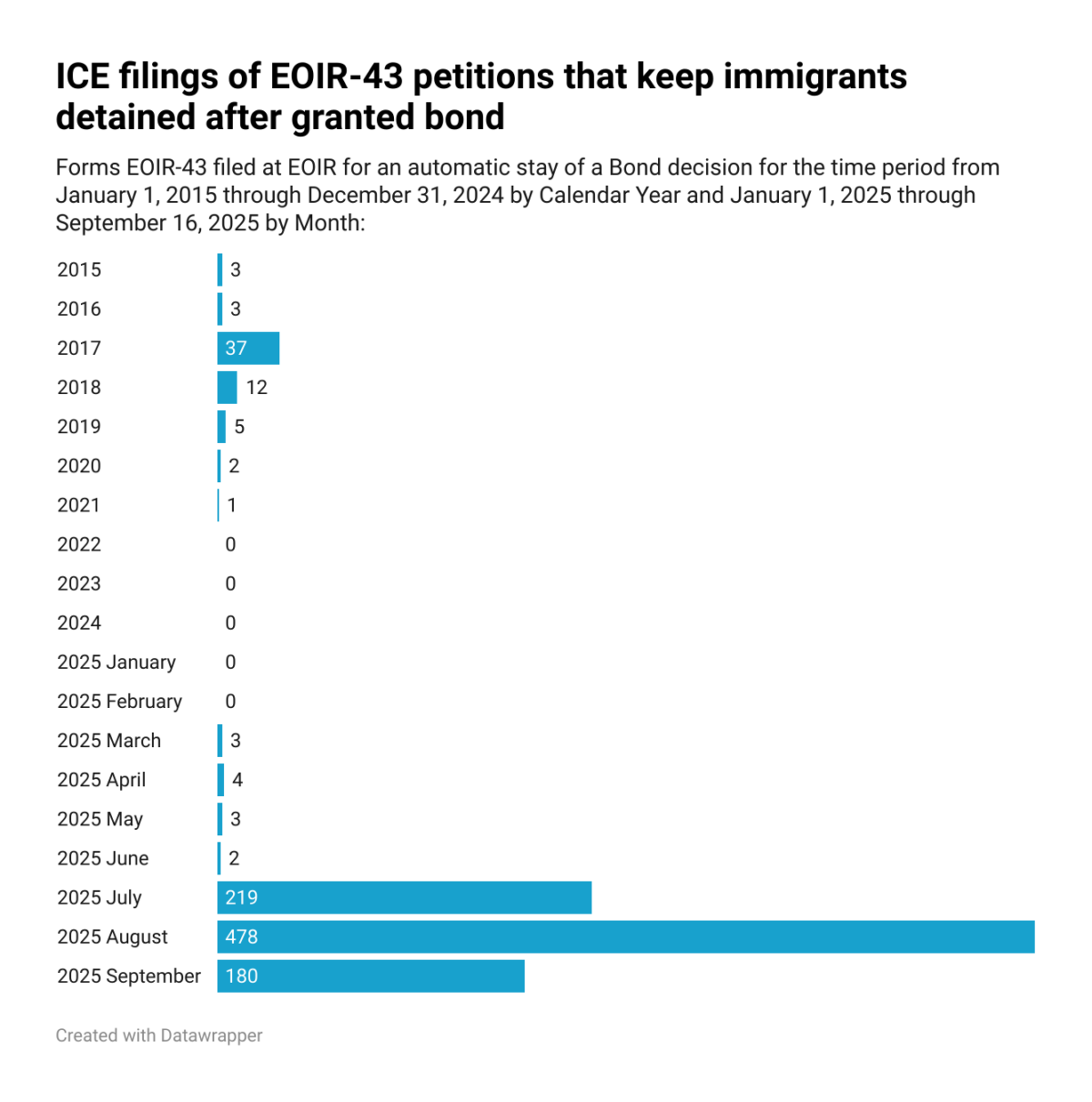
This means ICE and the Department of Homeland Security now claim to have unilateral power to delay a detainee’s release pending appeal. It’s not necessary to get approval from the judge who granted bond or from the Board of Immigration Appeals. ICE only has to file a form with the court, called an EOIR-43, with a short note from a senior attorney that says there is valid reason for it.
In response to the Trump administration’s aggressive use of the regulation (8 C.F.R. § 1003.19(i)(2)), there’s been at least 50 federal district court rulings in the last six months holding that ICE had violated detainees’ constitutional rights to due process in individual cases.
“This ‘heads I win, tails you lose’ process deprives Petitioner of his due process rights and has no place in the law,” a federal judge in Manhattan wrote in a Nov. 25 decision ordering the release of another detainee, a Salvadoran man who’d been jailed since February.
Raha Jorjani, an immigration attorney with the Alameda County Public Defender’s Office, published an academic study of the automatic-stay regulation in 2010. She said it wasn’t surprising that federal judges have so often rejected use of the rule. “Immigration attorneys and advocates have long warned about the dangers of such regulations remaining in effect, and the current administration’s prolific abuse of the regulations validates those concerns,” she said via email.
Federal authorities maintain that enough safeguards are built into the system to protect detainees’ right to due process.
Juan (Documented is withholding his name due to his pending asylum request) was one of the 478 immigration detainees blocked from release during the month of August after ICE attorneys used their automatic-stay-in-jail card. He’d already been jailed for 59 days, starting on June 9 with sleepless nights in the overcrowded lockup at 26 Federal Plaza, where ICE detained him when he reported for a check-in.
ICE began using the “automatic stay” work around routinely at the same time the agency issued a July 8 memo that radically re-interpreted federal law to expose millions more non-citizens to mandatory detention — no opportunity for a bond hearing — if they entered the country without a visa. In technical terms, ICE has re-defined who is an “applicant for admission.” Federal courts have ruled in 282 cases that this July 8 revision violated the constitutional rights of individual detainees, with the government winning in only six cases, according to the most comprehensive list of rulings available, compiled in mid-November by a federal judge in Philadelphia.
In the cases where detainees were getting favorable bond rulings from immigration judges, ICE filed for hundreds of automatic stays to stop the bond rulings from taking effect during an appeal.
These entwined policies have contributed to a massive increase in the number of immigration detainees who give up the right to contest their deportation charges and instead request voluntary departure from the country, as previously reported.
As many others have done, Juan’s attorneys filed a habeas petition in federal court that challenged both prongs of the government’s offensive on constitutional grounds. He was ordered released from the Metropolitan Detention Center in Brooklyn on Oct. 21, the same day his suit was filed. A more detailed decision on Nov. 18 found, as nearly all other judges did previously, that the government was wrong in its claim that Juan was not entitled to a bond hearing. The judge wrote that it wasn’t necessary to determine if the “automatic stay” was unconstitutional, but many other judges have.
Manhattan federal judge Vernon Broderick wrote in a Nov. 25 decision that federal district courts have ruled more than 50 times since June 2025 that ICE had violated the constitutional right to due process through its use of the automatic-stay regulation. The U.S. attorney’s office in Manhattan was able to point to just two rulings favorable to the government. (One of those cases was for a detainee whom the federal appeals court in Boston has since ordered released.)
The ruling was a victory for a Salvadoran man from Queens who was identified in court only as M.P.L. He had been held by ICE at Orange County Correctional Facility in Goshen for nearly nine months by the time Broderick ordered his release. He had no criminal record in the 18 years he’d been living in the United States, but the government contended he’d had ties to the MS-13 gang while living in El Salvador. The immigration judge found that ICE had offered conflicting evidence concerning the gang connection, and ruled that M.P.L.’s 18 years in the United States showed he wasn’t a danger; bond was set at $1,500. The federal court order restored that decision.
As cases like M.P.L.’s mount up, judges are expressing frustration. “The government requests that I ignore precedent from the Supreme Court, a case from within this District, and over 50 district court decisions in the last 6 months across the country,” Broderick wrote. “I decline that invitation.”
Nicholas Biase, a spokesperson for Jay Clayton, the U.S. attorney in Manhattan, declined to comment on the case or on his office’s continued defense of the new ICE detention policies.
ICE and the Department of Homeland Security didn’t respond to requests for comment.
ICE lawyers have rushed to invoke the automatic stay, as Manhattan federal judge Dale Ho described in two rulings that were in favor of a 23-year-old Salvadoran man.
J.M.P., as he is named in federal court records, had been assaulted by MS-13 gangsters who extorted money from him and his family’s bakery in El Salvador, Ho wrote. At the age of 14, he was convicted of an attempted homicide (with no one injured), and served 14 months in a juvenile facility, according to court records. After that, he eventually fled to the United States in 2020 at the age of 18 to avoid further attacks.
On Jan. 29, ICE held J.M.P. at the Orange County Jail, contending he was subject to mandatory detention because of alleged ties to the MS-13 gang. An immigration judge denied him a bond hearing, but J.M.P.’s attorney filed a habeas petition in federal court, leading to Judge Ho’s Sept. 10 order that he be given a bond hearing.
With the government’s insistence on “mandator detention” cleared away, the immigration judge released J.M.P. on a $15,000 bond, finding that he’d been a victim of gang extortion in El Salvador, not a member of MS-13.
That oral ruling at 1:39 p.m. on Sept. 19 set off a bureaucratic race, court records show. At 1:57 p.m., a fund that assists immigration detainees with bond money filed a request with ICE to accept the necessary payment. At 2:59 p.m., ICE filed the EOIR-43 form again, this time saying that it intended to appeal the bond decision. This blocked J.M.P.’s release once more.
J.M.P.’s lawyers went back to federal court, where Judge Ho ruled that his rights were again being violated, and that ICE must release J.M.P. once he posted bond.
“The government appears to be suggesting that, to obtain his freedom, J.M.P. could simply accept deportation to El Salvador — the country where he has said he fears harm and persecution if he returns,” the judge wrote. “That is no alternative.”
Sign up for Early Arrival, Documented’s newsletter, here, and get your immigration and policy news from New York, Washington, and nationwide in your inbox 3x per week.
Media that fights fascism
Truthout is funded almost entirely by readers — that’s why we can speak truth to power and cut against the mainstream narrative. But independent journalists at Truthout face mounting political repression under Trump.
We rely on your support to survive McCarthyist censorship. Please make a tax-deductible one-time or monthly donation.