Honest, paywall-free news is rare. Please support our boldly independent journalism with a donation of any size.
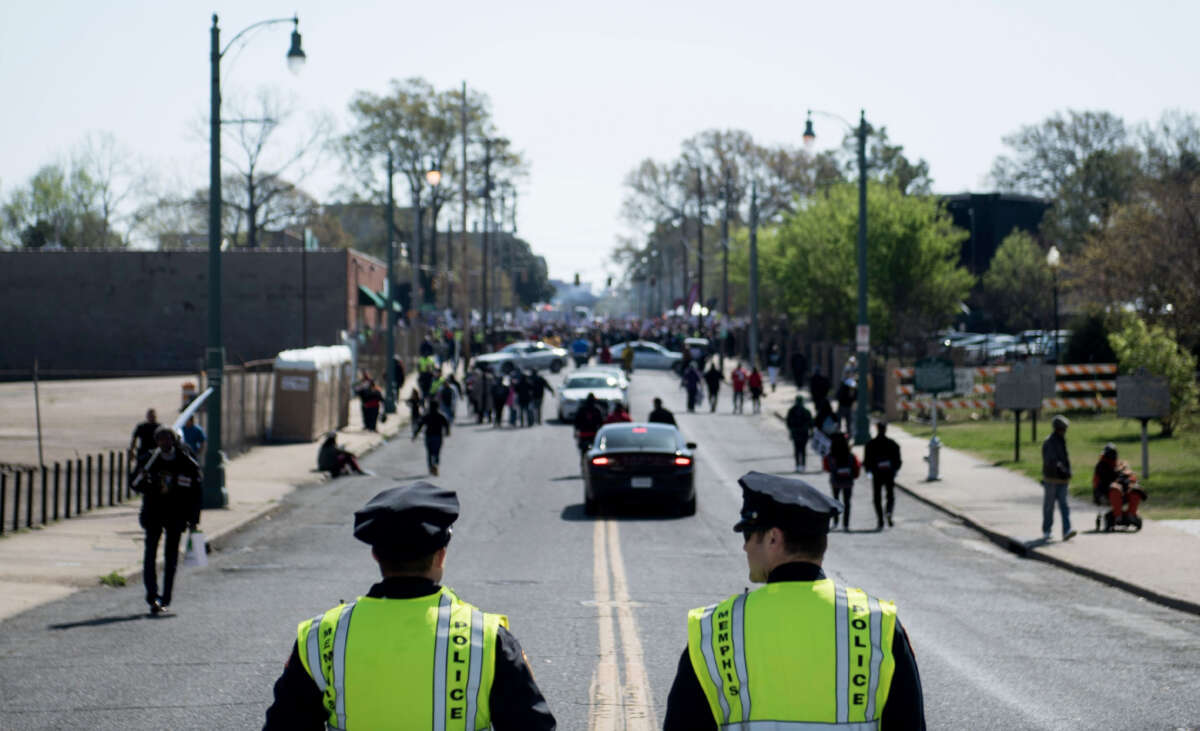
Memphis Police Department’s (MPD) new Juvenile Crime Abatement Program, which was announced on Friday, has been paused for more discussion after community organizations decried the program as a racist attempt to increase the targeting and criminalizing of Black youth by the police in the city’s downtown area.
“I certainly understand the desire for the downtown to be safe, but I’m excited they’ve agreed to pause for more discussion,” said President of the Downtown Memphis Commission Paul Young on Saturday.
The MPD’s public service announcement about the program stated that the program will endeavor to “create an environment primarily for adult patrons after hours, free of unruly juvenile behavior and mischievous activities,” but a leaked internal MPD presentation claimed that the eight-officer unit could target youth for various reasons such as selling candy, handing out flyers for donations, wearing “inappropriate” clothing, playing loud music and even for dancing in the street. The presentation also states that police may target youth downtown for any “other activity deemed inappropriate, or actions that disrupt the harmony of the downtown community.”
MPD’s announcement came just weeks after four ex-Memphis police officers charged with Tyre Nichols’s murder were decertified and the Memphis council voted to postpone extra police reforms backed by the city attorney and police chief.
Cardell Orrin, the executive director of the nonprofit advocacy group Stand for Children, told Commercial Appeal that “When I was younger, and on the East Coast like Philly and New York, walking around with super baggy jeans on was inappropriate because you could be carrying anything in your clothes, or you’d be accused of trying to steal something. It’s just shifted language, which is on the same pathway of how to criminalize mostly Black youth, or Black culture for the youth.”
Orrin emphasized that the Juvenile Abatement Team would use pretextual stops and specialized units that have been criticized after the brutal beating and killing of Tyre Nichols by MPD officers and are currently under investigation by the Justice Department.
“I feel like there’s a major element of danger that is coming [to] youth downtown,” Joshua Adams, a member of Black Lives Matter’s (BLM) Memphis chapter, told WREG-TV News Channel 3, Memphis. “It doesn’t seem to be about safety. It seems more about tormenting and stacking people with charges, whether that’s the youth themselves or their families.”
If this program is put into place, any juvenile that is caught downtown without an adult can be arrested and taken into custody. Additionally, if the child’s parents or guardians do not pick their child up, the police will turn the child over to the Tennessee Department of Children’s Services and charge the parents or guardians with child abandonment.
After the murder of Tyre Nichols, abolition activists have demanded that Memphis city council pass the Data Transparency Ordinance, end the use of pretextual traffic stops, end the practices of unmarked cars and plain clothed police, remove police from traffic enforcement entirely, and dissolve the infamous SCORPION, OCU and MGU task forces. Black Lives Matter and Decarcerate Memphis have succeeded in pushing the city council to pass reforms banning the use of unmarked cars in traffic stops, requiring data collection anytime an officer conducts a traffic stop, and prohibiting police from conducting six of the most common pretextual stops.
The MPD has a history of criminalizing Black residents and was sued in 2017 by the American Civil Liberties Union (ACLU) of Tennessee for spying on political groups. Specifically, the MPD monitored BLM activists for years and created fake Facebook profiles to infiltrate activists’ private social media.
Sen. Raumesh Akbari (D), who represents Memphis, celebrated the pause of the program. “Optically, it’s horrific. In practice, it would be even worse! Our young folks need entertainment options, not criminal records for selling bottles of water, dancing, & loud music,” Akbari said.
25 Years of Truthout: An important fundraising appeal
This September, Truthout is celebrating 25 years of publication. For over two decades, we have been a trusted source for fiercely independent journalism thanks to readers like you.
As we look to the next 25 years, we have launched a special fundraising campaign. This campaign is almost over! We have a goal to raise $19,000 before midnight tonight.
We are asking for your support at this juncture because we face greater threats than ever before in our organizational history. Trump and his MAGA allies are determined to control the information ecosystem, and movement-based organizations are subject to dangerous censorship and scrutiny.
If you can support Truthout with a one-time or monthly donation, you will make a significant impact on our work and our legacy. Anything you can do makes a difference!