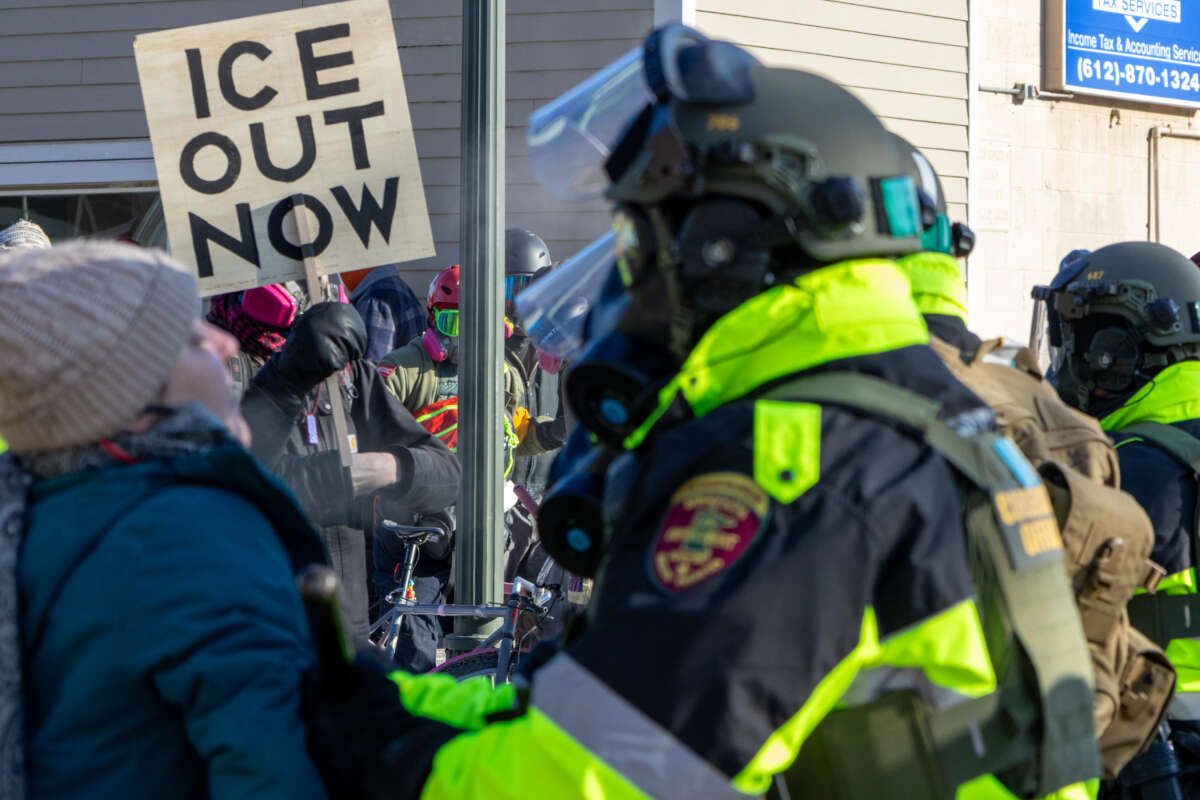
Minneapolis — The air above Nicollet Avenue was filled with tear gas and mist from demonstrators’ breath on the morning of Saturday, January 24, after a group of masked federal agents gunned down 37-year-old Minneapolis resident Alex Pretti, who had stopped to record an arrest in progress.
After the Trump administration sicced thousands of federal immigration agents on the Twin Cities, Pretti’s murder came as little surprise to Minneapolis’s residents. One local told Truthout, “It was only a matter of time before they did it again,” referencing Immigration and Customs Enforcement (ICE) officer Jonathan Ross shooting and killing Renee Nicole Good on January 7, 2026, just over a mile from where agents killed Pretti while pinning him to the ground.
There was little consternation from the Trump administration about Pretti’s death. On Sunday, January 25, Secretary of Homeland Security Kristi Noem said in a press briefing, “This looks like a situation where an individual arrived at the scene to inflict maximum damage on individuals and kill law enforcement.”
Accounts offered by federal officials differ wildly from video evidence and eyewitness accounts. Pretti approached officers holding only his cellphone in his hand, filming their arrest of an unidentified individual. After one of the masked federal agents shoved a woman, Pretti attempted to intervene before agents slammed him to the ground.
According to the Chief of the Minneapolis Police Department (MPD) Brian O’Hara, Pretti held a permit to carry a concealed weapon. Bystander video shot at the scene shows Pretti pinned on the street by a group of at least five officers, with his hands directly in front of him. At one point, an officer reaches into Pretti’s waistband to retrieve what appears to be a pistol, when, less than a second later, shots ring out as at least one officer discharges his weapon, killing Pretti. The 37-year-old ICU nurse was pronounced dead at the scene.
Word of the shooting circulated quickly through rapid response networks in Minneapolis, and less than an hour after Pretti’s killing, Nicollet Avenue had already descended into chaos, exacerbated by the continued presence of federal immigration agents at the scene.

As demonstrators hurled curses and cried “shame” at the agents, officers periodically shot off rounds of “less lethal” munitions, including stun grenades and tear gas. These munitions have been widely documented as having caused significant bodily harm (including permanent blindness) and even death throughout the country.
The message for the ICE officers in Minneapolis was clear: Leave the city, now.
Here in Minneapolis on January 24, by 11 am Central Time, there were hundreds of demonstrators congregating in Whittier, a diverse enclave of south Minneapolis. By then, the Minnesota State Patrol (MSP) was also on the scene, as were armored vehicles.
Sasha, 26, who asked to only be identified by his first name due to fear of retribution for his participation in the protest, said, “I think it’s very powerful to be out here with so many people despite how cold it is. The resilience of our communities is really incredible. It’s insane that we have to keep fighting this, that they’re murdering us out here.”
Minneapolis did what it does best — residents showed up for each other, setting up tables along the streets, passing out handwarmers and hot beverages. More than once, while I was covering the demonstration, a demonstrator asked if I was warm enough or if I would like a handwarmer. There was a sea of fogged-up glasses up and down Nicollet Avenue, and the temperature was low enough to freeze anything exposed to the air for more than a few minutes, including my own hair.
From the first-time demonstrators to the elderly residents who showed up for “complete disgust at what they have done to our city,” as one person articulated, the message for the ICE officers in Minneapolis was clear: Leave the city, now.
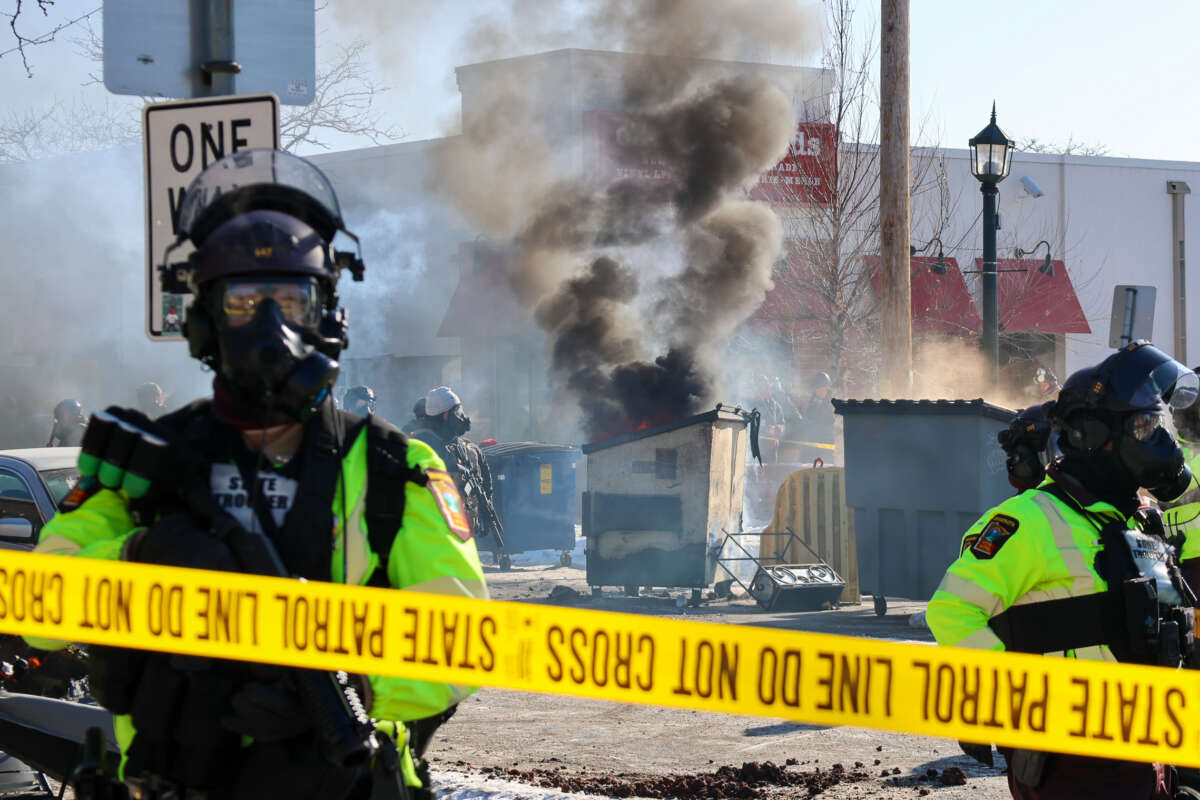
There was a sense on the ground that it was the moment for radical action — that the Trump administration had brought this upon itself (and federal agents) by sending the officers into the city, no matter the cost in blood. Mitch, 27, who also asked to be identified by his first name due to safety concerns, said, “I can’t blame anybody for wanting to fight back against them.”
From time to time, fireworks were shot at the officers still on the scene, including those with the Minnesota State Patrol, whose presence did not appear to calm tensions, as demonstrators approached them, asking, “Whose side are you on? Why are you letting them do this to us?”
Whether or not MSP was there, in the words of the demonstrators, to “protect” the federal immigration agents, the optics were less than ideal, as they stood in reinforced lines in blaze green jackets, with ICE and Customs and Border Protection officers standing behind them.
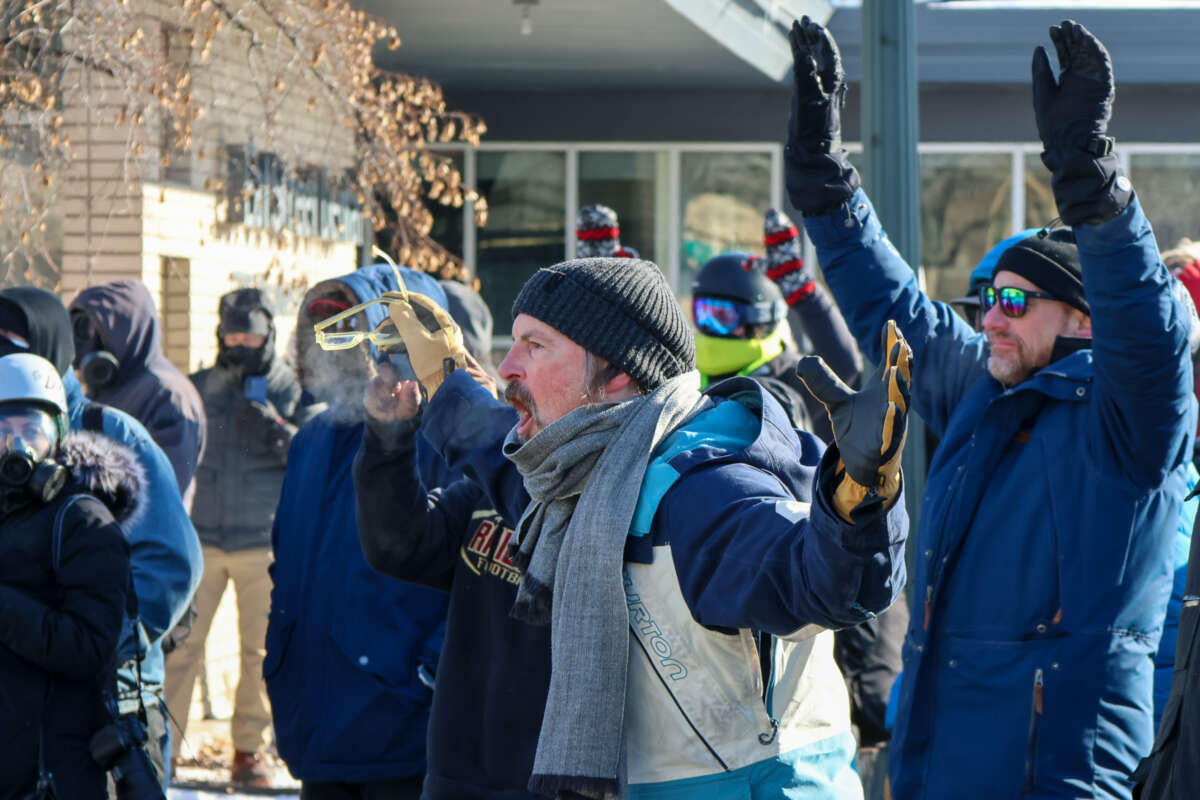
Officers did not hesitate to fire all kinds of chemical agents at the demonstrators. By 12 pm Central Time, the ground was so littered with the refuse of gas canisters that one could hear a constant clanking sound from residents walking over the pulled metal pins.
The MPD had long since declared the demonstration to be an unlawful assembly, as a sergeant with the MPD declared over a bullhorn, but few, if any, residents heeded the warning and fled beyond the bounds of the few-block radius closed off by police.
“People who thought they might never go and knock on their neighbor’s door … now they’re delivering groceries and offering sanctuary rides to kids to get to school safely.”
Instead, demonstrators continued pulling chairs, tables — anything they could find — within a few blocks’ radius to build makeshift barricades to impede the movement of the officers. Gov. Tim Walz responded by activating the National Guard on January 24, in the hopes of staving off a cycle of continued escalation.
Mayor Jacob Frey said in a statement, “We are asking everyone who is currently gathering in the area to leave to ensure public safety.” Walz and Frey are likely concerned that President Donald Trump could use civil unrest in Minneapolis to invoke the Insurrection Act, an idea which he has repeatedly floated on Truth Social.
Residents had little time by the evening of January 24 to process the events of the day, but as they have learned in the nearly eight weeks of “Operation Metro Surge,” the community’s response must be rapid and direct. Cat Salonek Schladt, a community organizer who works with a coalition of immigrant rights organizations in the Twin Cities, told Truthout, “People who thought they might never go and knock on their neighbor’s door … now they’re delivering groceries and offering sanctuary rides to kids to get to school safely. So there’s an incredible sentiment of love and solidarity between community members who maybe never would have met otherwise.”
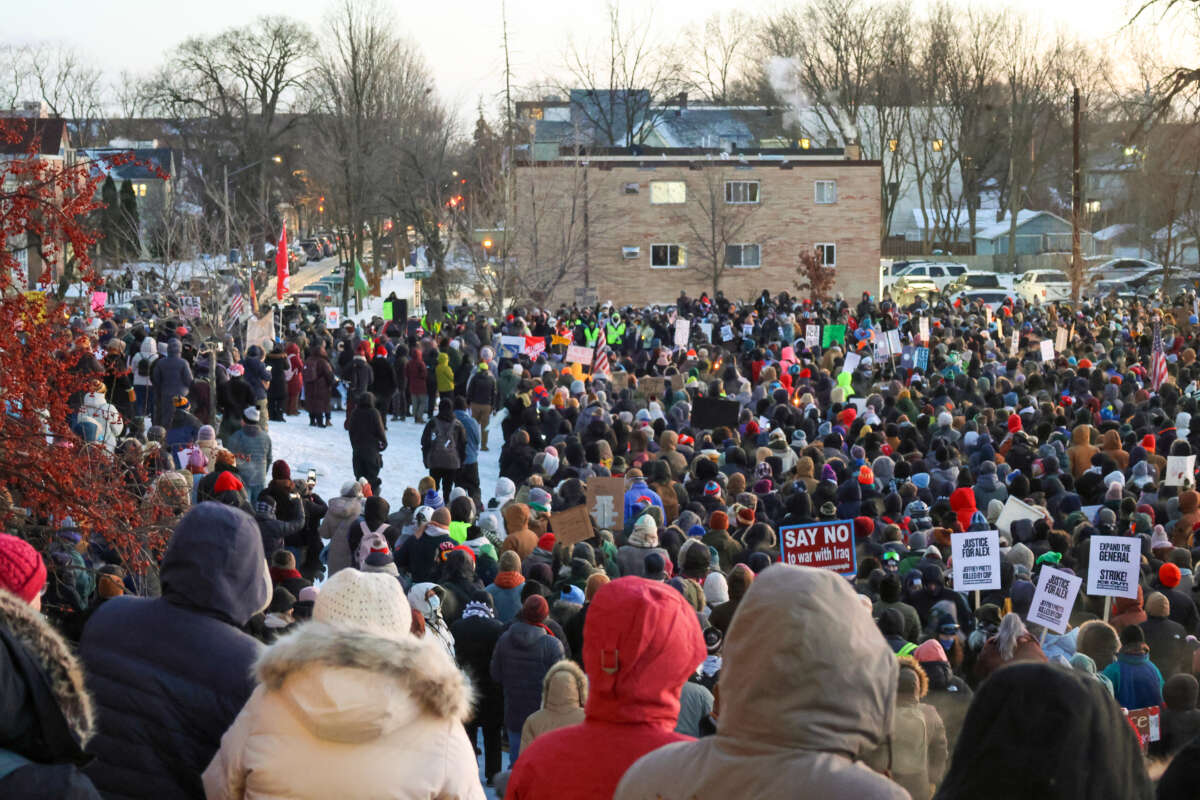
The Minnesota Immigrant Rights Action Committee held a vigil at 5 pm Central Time on January 24 for Pretti at Whittier Park, which was attended by thousands who braved the cold to hold up candles and posters declaring “ICE out now” and “Chinga La Migra.”
“There’s a desperate hope among the average Minnesotan right now that we can do enough to keep our communities safe.”
The site of Pretti’s killing, like that of Renee Good, had been turned into a makeshift memorial, with dozens of bouquets splayed out on the road. While the energy was tense on the ground in Minneapolis, residents appeared above all else to want to show up for one another, no matter the weather or presence of federal agents.
Isavela Lopez, a poet and community organizer who is facing federal charges for observing an ICE operation in June of last year, spoke at the rally: “Every person who is here today has your back. We need to know that, mobilize, and organize, because we are in this together. We need each other. We need to lean on each other. We need to show up for each other.”
Capturing the prevailing sentiment in Minneapolis in the wake of Pretti’s killing, Salonek Schladt said, “There’s a desperate hope among the average Minnesotan right now that we can do enough to keep our communities safe.”
Media that fights fascism
Truthout is funded almost entirely by readers — that’s why we can speak truth to power and cut against the mainstream narrative. But independent journalists at Truthout face mounting political repression under Trump.
We rely on your support to survive McCarthyist censorship. Please make a tax-deductible one-time or monthly donation.