Honest, paywall-free news is rare. Please support our boldly independent journalism with a donation of any size.
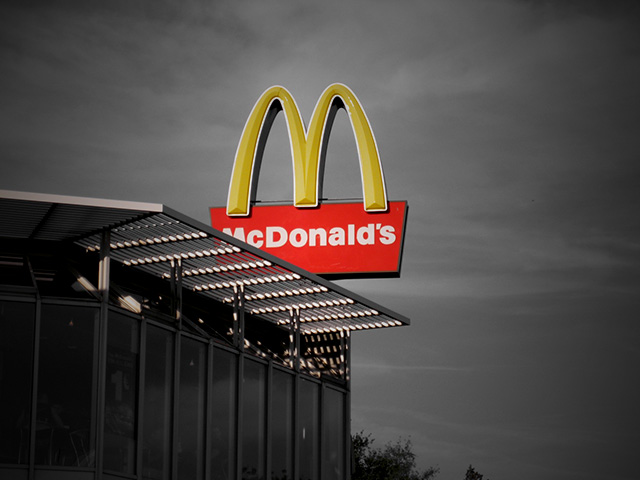
A federal judge in California allowed class action wage theft litigation to proceed against McDonald’s, on the grounds that a jury could find it guilty of negligence.
Judge Richard Seeborg said Tuesday that the lawsuit against the corporation may continue under the “ostensible agency theory.”
The doctrine holds an actor responsible for the fault of another, if victims reasonably believe that the perpetrator committed wrongdoing in the employ of said actor.
The case involves McDonald’s franchise co-owners, Bobby and Carol Haynes, who operate eight restaurants in Northern California. Leading the class are three women who work in one of their Oakland restaurants: Guadalupe Salazar, Judith Zarate, and Genoveva Lopez.
“Looking at the record, there is considerable evidence, albeit subject to dispute, that McDonalds caused plaintiffs reasonably to believe Haynes was acting as its agent,” Seeborg ruled.
“[P]laintiffs submit they sought employment at McDonalds because it ‘is a large corporation with many stores around the world,’ ‘would involve a steady job in a safe environment,’ and ‘would make sure [they were] paid and treated correctly, because it is a large corporation with standardized systems,'” he also said.
Seeborg also noted that the plaintiffs “believed both they and Haynes worked for McDonalds” (emphasis his).
Retail corporations have absolved themselves of much legal responsibility for working conditions they heavily influence by arguing that they are not “joint employers.” They simply oversee a system of franchises and contractors, without directly impacting terms of employment, their lawyers often successfully argue.
Seeborg did say that his ruling came down to a “close call” and dismissed some of the workers’ claims, but one of their attorneys was pleased with the decision, regardless.
“If plaintiffs prevail on our ostensible agency theory at trial, we will have no need to appeal the ruling on our other liability theories,” Michael Rubin told Courthouse News. “And if we do not prevail at trial on ostensible agency, we have very strong grounds for appeal given the many disputed issues of fact that we believe are material to McDonald’s ‘joint employer’ status.”
Rubin is representing McDonalds workers in six class action wage theft lawsuits that were filed in 2014.
Another one of those cases, Ochoa v. McDonalds, is set to go to the trial phase in December, as Courthouse News noted. The case is also being argued in Northern California. It was also permitted under the ostensible agency doctrine.
Important Message: Please Read
For 25 years, Truthout has survived by publishing impactful investigative journalism and analysis; distributing full editions 365 days a year; and building a community of readers who support us with small, hard-earned donations.
Eighty percent of our $3 million yearly budget comes from small donors alone. Of those, 8,000 readers support us with monthly donations. Back in 2018, when Facebook decided to suppress the circulation of posts made by organizations, thereby cutting readers off from seeing many articles shared by the news organizations they had intentionally decided to follow, Truthout’s total traffic declined by 40 percent, as nearly all of our traffic from that platform disappeared.
Now, Google has recently rolled out its AI search bar, providing AI summaries instead of directing readers to our site. Google Search is our single largest source of traffic; it’s the route by which nearly one third of our readers find us. Much like in 2018, a shocking 40 percent of our Google traffic has disappeared overnight.
It will not be easy for Truthout to shoulder this blow. Nor will it be easy for our peers and collaborators — news sites that depend on traffic and aren’t bankrolled by large corporations.
If you can support Truthout with a donation today, you can help us resist the AI onslaught. Please give today.