Did you know that Truthout is a nonprofit and independently funded by readers like you? If you value what we do, please support our work with a donation.
After a winter storm caused record low temperatures and snowfall across the U.S. in February, thousands of residents in Jackson, Mississippi, lost water in their homes. As the city slowly fixes water breaks, some residents are now in their fourth week without water.
Tens of thousands of Jackson’s 160,000 residents went weeks without water after the storm, and the rest of the city was, and still is, under a boil-water advisory. Last week, the city’s public works director Charles Williams said that a quarter of the city, or about 10,000 connections, still lacked water. As of Friday, the city had restored connections to 42,000 customers total and fewer than 5,000 customers still lacked water.
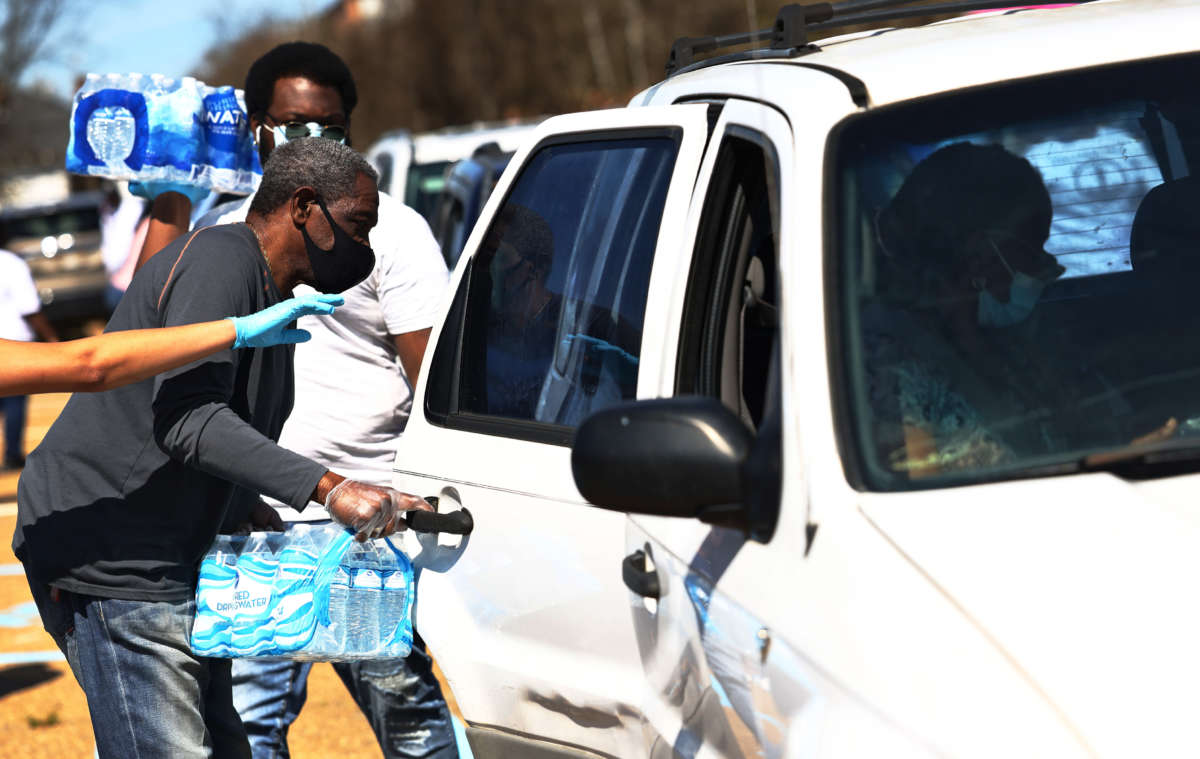
The storm had frozen machinery at the city’s water treatment plant and had caused 101 water main breaks and leaks, at least 70 of which the city had repaired last week, the city said. The National Guard has been assisting in water distribution to the residents of the city, but they’re still waiting for hours in lines to get water bottles or non-potable water for flushing toilets.
There are many residents, however, who can’t access the water that the city is distributing. With over a quarter of the city’s residents in poverty, many people don’t have the time or resources to wait in lines for hours for water.
Many organizers, residents and observers say that part of the reason for the crisis is that the city has a majority Black population, and the city has thus had less funding and support. Over 82 percent of the city is Black, and the city has been losing residents, mostly white ones, for decades. The declining tax revenue as a result of the population loss is just one contributor to the city’s infrastructure problem.
The Mississippi city’s infrastructure has been in poor shape for decades, and the city’s mayor, Chokwe Antar Lumumba, has called Jackson an “aging city with an aging budget.” The city has a budget of about $300 million a year and “a more than $2 billion issue with our infrastructure,” Lumumba said during a press conference last month.
Donna Ladd, editor of The Jackson Free Press and the Mississippi Free Press, said in an article for MSNBC that the state and city’s white supremacist leadership in the past decades has set up Jackson for failure.
“The fact that low-income Jacksonians are living amid the stench of toilets that won’t flush is a direct legacy of white-supremacist thinking at the state level,” wrote Ladd. “It is the state of Mississippi’s role to help fix this problem.” White state-level politicians, Ladd says, have continually made moves to stunt Jackson’s growth, financially and otherwise.
The crisis is also connected to climate catastrophe. The February storm was almost certainly a result of the climate crisis causing unusual weather patterns and increasing the frequency of extreme weather, which Lumumba has acknowledged. The city’s infrastructure, much like the energy infrastructure in Texas, was not ready for the cold temperatures that suddenly hit the state.
“Not only do we need this investment because of the aging infrastructure,” Lumumba said earlier this month, “we need this investment because of the increased pressure that these extreme weather conditions are taking.” Lumumba has requested $47 million in emergency funding from Republican Gov. Tate Reeves for needed water infrastructure updates.
This isn’t the first time that Jackson has experienced issues with their water; the city’s residents have continually experienced service issues over the years, and have grappled with lead pollution crises in the past. The recent water shortages, one local resident told Gizmodo, are just a continuation of environmental racism that Jackson and many other nonwhite communities will continue to face as the climate crisis worsens.
We lost 15 percent of our traffic overnight.
We now have three full months of data since Google changed its search to feature AI results. The numbers are worse than we anticipated. Overall readership that comes to Truthout through Google is down 54 percent against last year. The number of new readers who discover Truthout via Google searches is down 49 percent, and returning users from Google are down 51 percent.
We lost 15 percent of our readership overnight. This was a readership we painstakingly built over decades, and it vanished because Google chose corporate greed over a healthy democracy.
We anticipate a loss of roughly $500,000 in online revenue as a result of this massive traffic plunge in the next year alone.
The only way we can keep publishing is with strong reader support. We are asking you to start a monthly donation to Truthout today — anything you can do, whether $5 or $25, makes a difference.