Part of the Series
Struggle and Solidarity: Writing Toward Palestinian Liberation
Support justice-driven, accurate and transparent news — make a quick donation to Truthout today!
The U.S.-brokered ceasefire agreement in Gaza stipulated the withdrawal of Israeli forces to the so-called “Yellow Line” during the first phase of the ceasefire, which was supposed to be followed by Israel’s complete withdrawal from the occupied Gaza Strip in the second phase of the ceasefire, if — and only if — Hamas decommissioned and handed over its weapons. Yet our lived reality in Gaza unequivocally contradicts the agreement’s claim that Israel would neither occupy nor annex our homes.
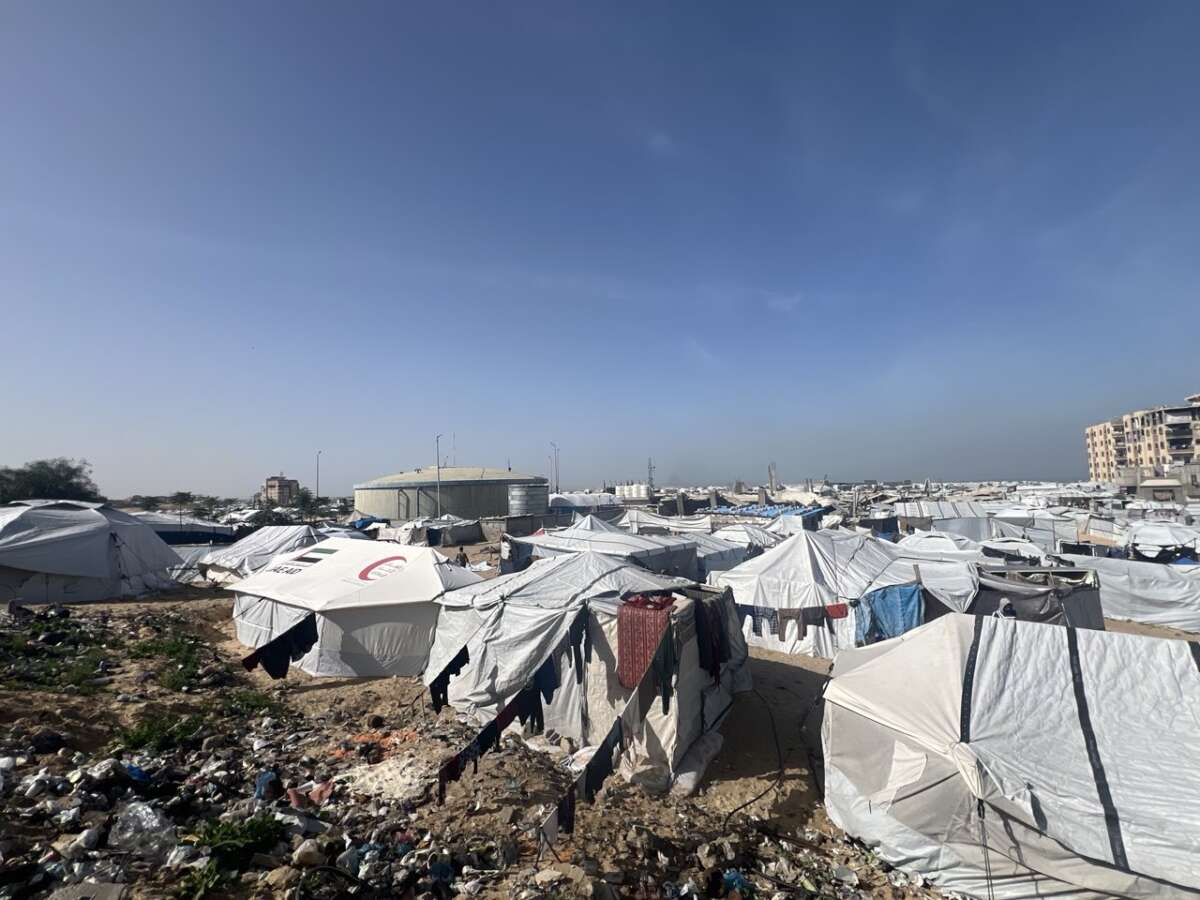
In addition to writing firsthand eyewitness accounts of what I see around me in Gaza, I also work to support humanitarian organizations aimed at reaching as many marginalized and destitute people as possible in order to alleviate their compounded suffering by offering water, a daily meal, blankets, makeshift tents, food parcels, and other life-sustaining essentials. Our efforts are aimed at reaching Gaza’s most neglected areas. Each shelter that we serve is carefully chosen based on the level of need and the vulnerability of the families inside.
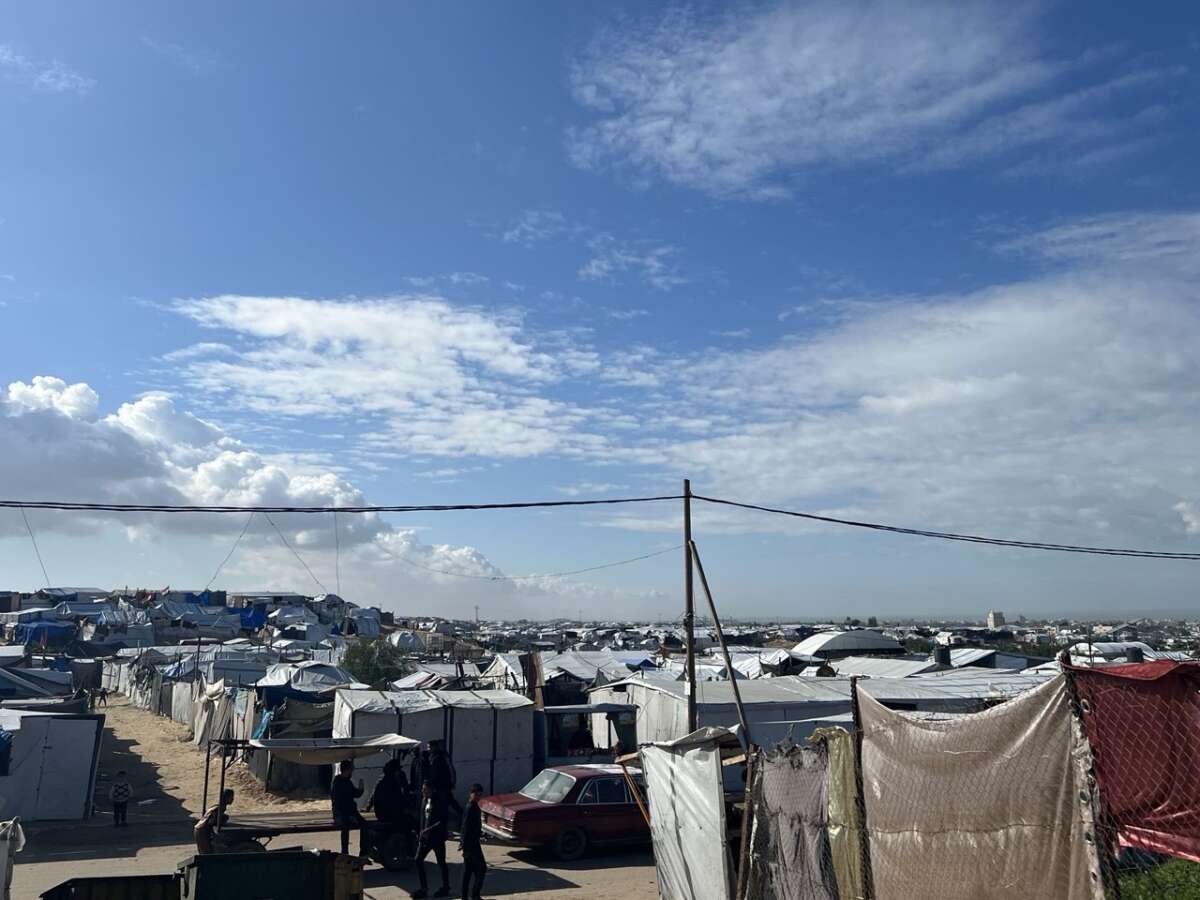
When I started doing this humanitarian work, I knew, deep down, that this work might expose me to other kinds of horror; that I would have to absorb a scale of devastation from which there is no return — to offer solace warmly, to comfort trembling bodies, and to listen, and listen, and listen to never-ending, heart-wrenching, mind-blowing stories while sidelining my own.
Given the brittle ceasefire we are enduring, my co-workers and I realized that doing this humanitarian work would involve placing our lives on the front lines by moving through so many areas in the north, south, and central Gaza, while genocide may resume at any moment. Yet our people’s need for our help outweighed every fear we carried.
We had carried out many missions in Khan Younis before, where the Yellow Line had stretched from the south of northern Gaza, cutting through central areas, passing through Khan Younis, and reaching the outskirts of Rafah. This line has placed 53 percent of Gaza’s land under Israeli control, entrenching Gaza’s demographic and geopolitical division even further.
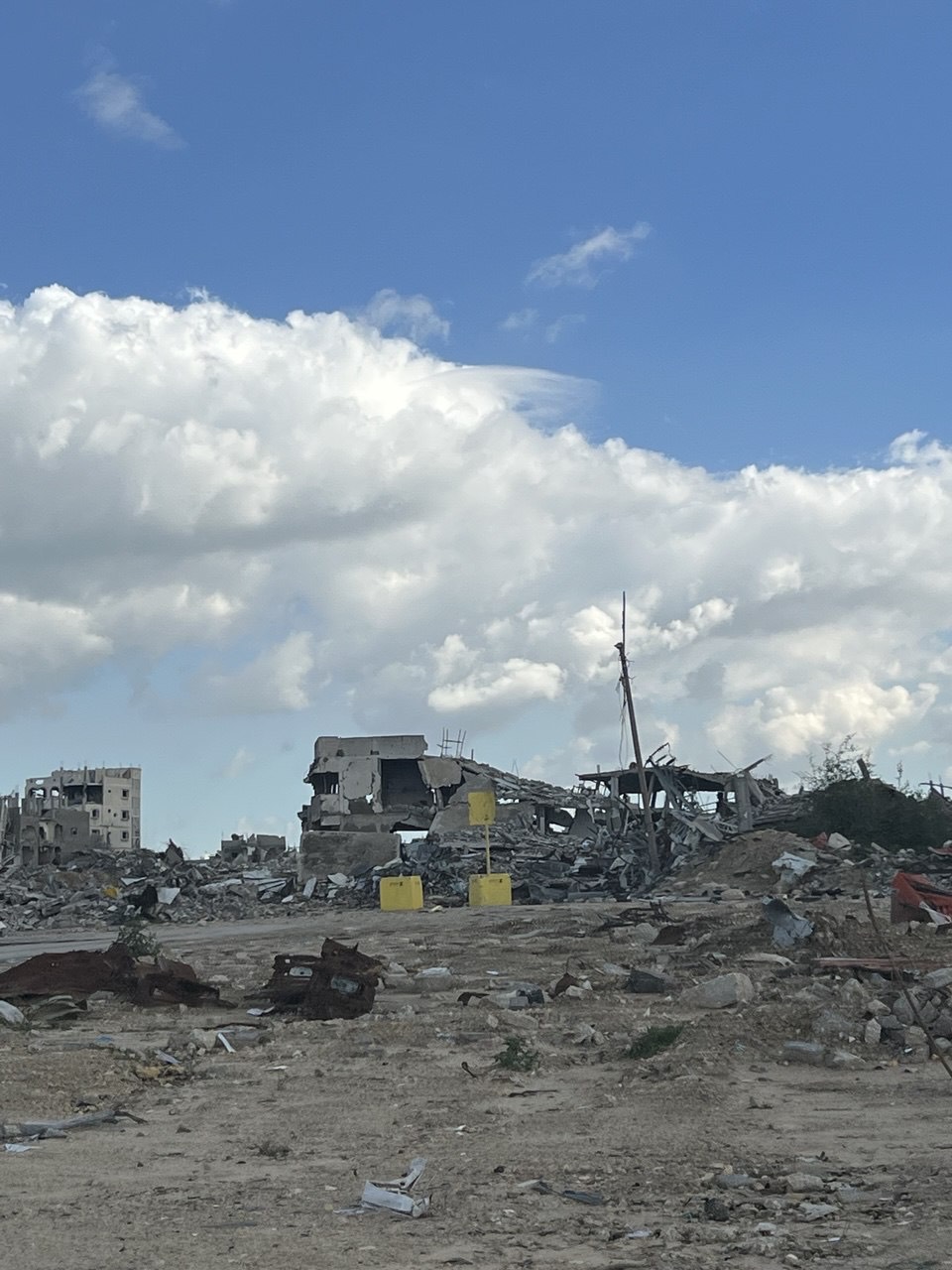
The yellow concrete blocks were planted along our ravaged streets. Our vehicles were only a few kilometers away from them, yet still confined to what was labeled a “safe zone.” It is a lethal boundary, with Israeli forces killing anyone who gets close or crosses it naively.
Each time we, as a team, pass by it to reach our destination — not out of adventure but because we have no other option — I remember all those killed because of the illusion of the Yellow Line and the so-called safe zone. Israel does not comply with distances meant to keep, protect, or spare lives. It keeps increasing its reach, shrinking our area of supposed safety.
We drove down Salah al-Din Road, only to realize that the Yellow Line was ever-shifting, advancing into areas where we had been moving freely and comfortably just days before.
On January 21, 2026, the driver, the group leader, the photographer, the field supervisor, and I set off from our charity kitchen carrying 1,000 meals to distribute in a makeshift shelter in Khan Younis. We drove down Salah al-Din Road, only to realize that the Yellow Line was ever-shifting, advancing into areas where we had been moving freely and comfortably just days before.
At a certain point, we got lost as the Yellow Line became unclear and kept pushing forward, paring away more land. My heart was racing, my mind throbbing. My eyes scanned everything around me, yet I could not recognize a single yellow segment.
Our driver said in a trembling voice, “I’m afraid we may have unknowingly crossed the Yellow Line.” (All of the members of our team asked to remain anonymous in my retelling here for safety and occupational reasons, as Israel has banned 37 humanitarian organizations from working in Gaza.)
What terrified us most was that there was no one around us, but Israeli drones were hovering overhead. We tried to call our colleagues to check the virtual map of the Yellow Line again, but communication was jammed.
While my colleagues in the car advised the driver to keep going and not anticipate the worst, we heard a nearby explosion. It was only minutes before we reached the Bani Suhaila roundabout, which sits dangerously close to the concrete yellow markers that delineate the Yellow Line.
Screeches from afar and frantic gestures from stranded people signaled us to come closer. At first, we thought they were directing us toward another route, but when we arrived, a horrifying scene began to unfold.
A group of terrified people rushed toward our vehicle, shouting, “There are martyrs. There are injured.” They opened our car doors and emptied us from the vehicle. It all happened within seconds.
I was sitting in the seat beside the driver when I looked ahead and saw our bumper collide with the yellow concrete blocks. To the right stood an Israeli outpost, positioned to shoot. To the left, women, elderly people, and young men pleaded with us to save them, to take them away. I froze. I felt that this was it — death was death, inevitable. There was no escape.
The driver recounted, “I could not think properly or react urgently. We were inside a kill zone, where any movement could be a death sentence.”
Our team did not stall. They tried to calm the people and called for an ambulance, yet after countless unheeded calls, we were told, “Sorry, we cannot reach such a dangerous zone, where killing happens with impunity and on sight.”
The ghostly panic on people’s faces was unspeakable. We could not fully grasp what had happened. Our photographer moved around. He later told us, “I was stunned when I stumbled upon an 11-year-old child, lifeless. Another man beside him, lying dead. And a woman gasping slowly, while her wails echoed.”
Then he shouted, “She’s alive. She’s alive.”
I rushed out of the car. We carried the wounded woman inside, and I began administering first aid. The young woman had been shot in the femur.
I rushed out of the car. We carried the wounded woman inside, and I began administering first aid. The young woman had been shot in the femur; her flesh was torn apart, bleeding nonstop.
The photographer later said, “It was an on-the-spot decision dictated by triage.” He continued, “We had to survive ourselves, and we could rescue only one injured person. Just one.”
So, the young woman in her 20s was chosen because she was still alive. We packed our belongings and, miraculously, managed to leave.
To keep the woman conscious, I began asking her what had happened. Barely holding her breath, she said, “I went to pull the young child who was killed so the Israeli troops’ dogs wouldn’t eat him.”
She continued, “I thought that because I’m a woman, they wouldn’t shoot me.”
I asked her why she had crossed the Yellow Line. Breaking into tears, she said, “The Yellow Line kept changing, and all their winter essentials were still inside the schools-turned-shelters, now falling within the Yellow Line. They had gone to bring blankets and jackets. They never returned. They were killed.”
I asked her why she had crossed the Yellow Line. Breaking into tears, she said, “The Yellow Line kept changing, and all their winter essentials were still inside the schools-turned-shelters, now falling within the Yellow Line.”
The streets were overwhelmingly overcrowded — displaced people everywhere, with no right of way even for an urgently-honking car. Our photographer had to run ahead, shouting through the streets that we had an injured person.
We finally reached Nasser Medical Complex, and I managed to stabilize the woman’s condition so she could be taken directly into the operating room.
The nightmare lasted only minutes, but its scars will not vanish in my lifetime. That same day, an airstrike targeted the vehicle of three journalists who were working with the Egyptian Relief Committee, seeking to support our besieged people. They were killed while on their way to carry out humanitarian work.
What happened did not deter us from resuming our mission. Our group leader later remarked, “Through the harrowing time we were stuck in, my thoughts were with those who had been waiting for our meals.”
When we finally reached the shelter, I felt numbness as though my nervous system was shocked that I made it through. “We have survived through the hardest moments; let us not skip this one,” my team told me in reassurance. “Our people need us the most.”
The people there, despite life-challenging conditions, held onto their hospitality. They offered us water and coffee before we left and returned to the central area.
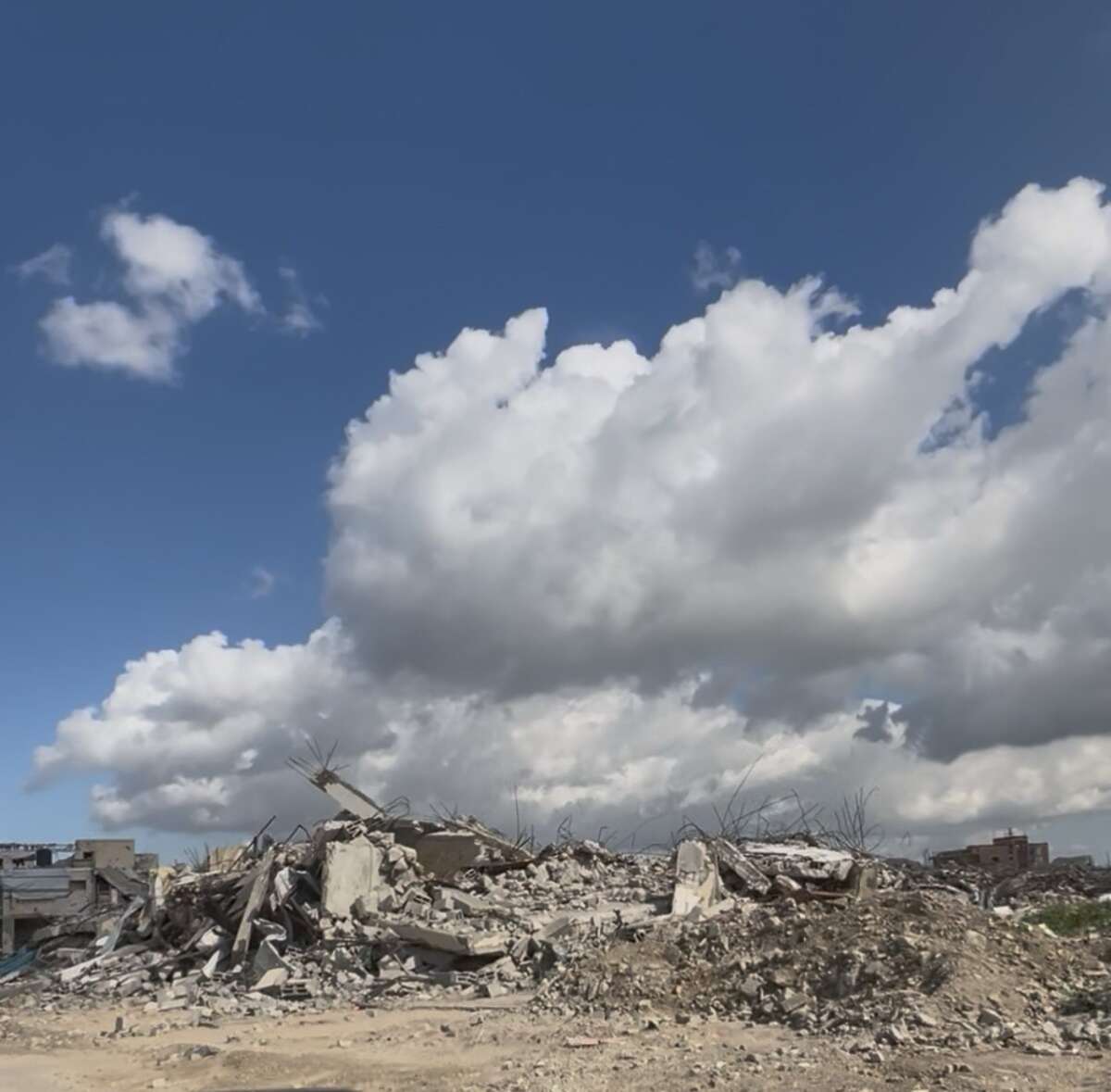
On our way back, we passed through the “Five Street” — a wasteland full of ruins, but at least a few kilometers away from the Yellow Line.
Later in February, another team headed to Khan Younis and witnessed tanks advancing to demolish an entire home, pushing the Yellow Line even farther.
Yet it has become clear that the Yellow Line is designed to be permanent: a so-called defensive barrier and a potential offensive front, as described by the Israeli Chief of General Staff Eyal Zamir.
Later in February, another team headed to Khan Younis and witnessed tanks advancing to demolish an entire home, pushing the Yellow Line even farther.
But this is not surprising. The Israeli tactic behind the Yellow Line had already been used to impose a separation wall in the West Bank. History is repeating itself. Gaza is becoming the West Bank’s mirror, in a more blood-curdling, suffocating way.
Media that fights fascism
Truthout is funded almost entirely by readers — that’s why we can speak truth to power and cut against the mainstream narrative. But independent journalists at Truthout face mounting political repression under Trump.
We rely on your support to survive McCarthyist censorship. Please make a tax-deductible one-time or monthly donation.