Part of the Series
Struggle and Solidarity: Writing Toward Palestinian Liberation
Truthout is a vital news source and a living history of political struggle. If you think our work is valuable, support us with a donation of any size.
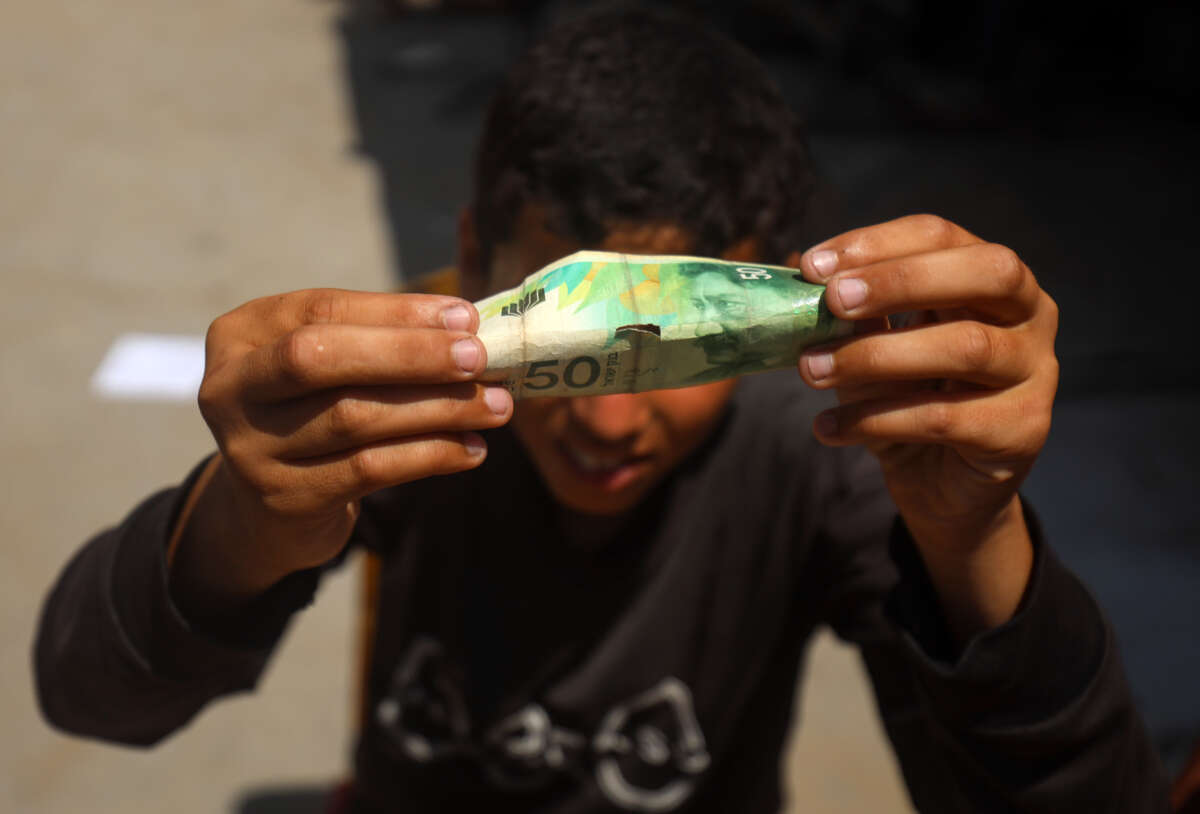
In the sweltering markets of Gaza, or even in the muddy displacement tents where I have lived for months, having money in your bank account means nothing if you can’t scrape together five metal shekels for a pack of bread or even secure your transportation. I stand exhausted after walking miles in search of change, clutching a crumpled 100-shekel note that feels like a cruel joke. Merchants and exploitative money changers (who emerged when Israel banned electronic transactions and collapsed the banking system) offer me only 70 shekels in tattered coins. This is economic apartheid: a deliberate liquidity war designed to turn cash itself into a weapon of attrition, eroding our dignity one humiliating transaction at a time.
In Gaza, our suffering has come not only from the political war between Hamas and Israel but also from the economic war that we have been living with since October 7, 2023.
In the morning, I wake up to the voice of my mother telling my brother, “Did you bring bread for breakfast?” and I hear him say to her, “Where can I get change to buy? I gave the seller a 20 shekel note. He refused to sell to me and told me to bring some change so I could have bread.”
Each morning, our suffering begins with providing bread for breakfast. Due to the scarcity of firewood and gas entering Gaza, baking bread at home has become more expensive than the price of ready-made bread in the bakery. Everyone in Gaza is in this predicament.
The current struggle to access physical cash in 2026 is a direct evolution of the economic strangulation we endured a year ago. While 2025 was defined by soaring inflation and famine, today’s crisis is defined by the literal disappearance of the currency itself and the predatory black market that has filled the void.
One year ago, in April 2025, 200 shekels were equivalent to 20 shekels due to high prices; Gaza was the only place in the whole world where the price of a kilogram of onions rose to $100. The unaffordability was compounded by the fact that exploitative money changers used to sell liquidity for electronic currencies in bank accounts. A person in Gaza would have 1,800 shekels remaining after withdrawing 3,000 shekels from the bank in exchange for cash. This was because the money changers used to charge 40 percent for these worn-out papers. In Gaza, the 10-shekel coin disappeared during the war, and no one agreed to transact with it. Similarly, sellers struggled to accept 20 shekel notes in poor condition.
The real fear is that Gaza will become a digital prison that Israel can control by cutting off the internet and electricity.
I vividly remember those days, wandering through the market with a 20-shekel note in hand, desperately hoping someone would change it for me. Each vendor turned me away with the same excuse: “It’s torn.” But with the complete halt of cash flow into Gaza since October 7, where was I supposed to find fresh, crisp banknotes? Following the merchants’ policy of not accepting worn-out paper, citizens attempted to invent a primitive way to save what little money they had left by setting up stalls specializing in restoring damaged coins. These stalls have become a common sight in the markets, where people sit to re-glue banknotes or reinforce them with adhesives in an attempt to extend their trading life after many merchants refused to accept them due to their deteriorating condition.
On October 19, 2025, the Bank of Palestine was partially reopened in compliance with the ceasefire agreement. The people of Gaza were hopeful that the worsening liquidity crisis would end as a result of this news. However, the shock was that the banks opened their doors to citizens for administrative transactions only, without any cash movement into Gaza. This resulted in the stagnation of life in the Gaza Strip, as well as difficulties in life transactions, because Israel continues to prevent the Palestinian Monetary Authority from bringing liquidity into the Gaza Strip, even after claiming that the war had ended.
Therefore, on January 16, 2026, the Palestinian Chambers of Commerce, the Palestine Monetary Authority, the United Nations Development Program (UNDP), and the United Nations Children’s Fund (UNICEF) collaborated to launch the national campaign “Cash Belzmanash” to support electronic payments in the Gaza Strip. On that day, Dr. Samah Hamad, minister of social development and relief, confirmed that she fully supports the national campaign.
Given the challenging economic circumstances facing the Gaza Strip, this campaign is a significant step in advancing the culture of electronic payment as a secure and efficient substitute for conventional financial transactions. This campaign has lessened the burden on people in Gaza, who are no longer obliged to withdraw 40 percent or even 50 percent of our funds for financial transactions within Gaza. However, the commission on money transfers from outside Gaza made through PayPal brokers cannot be less than 15 percent.
Now, Gazans can buy things from merchants online without paying a fee, but a lot of people, especially older people, have trouble with banking. My grandfather, Ahmed Abo Aisha, who is 83 years old, says, “I don’t trust currencies; how can I pay when I want to hold the paper in my hand?” This is what all the older people in Gaza have to say.
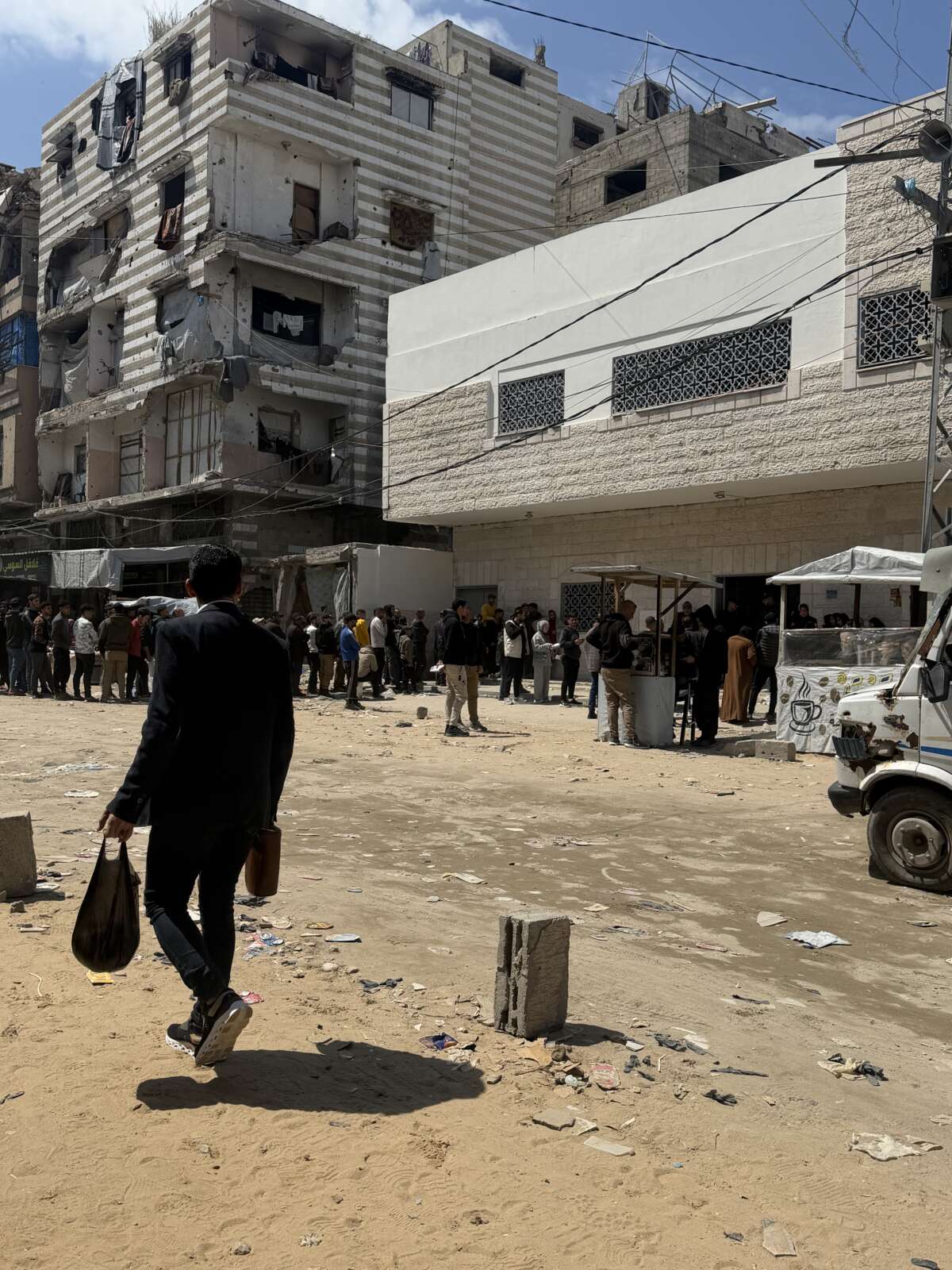
The suffering in Gaza did not end with this campaign; in fact, it got worse. We are going through the worst crisis in Gaza right now. Money is hard to come by because everyone uses electronic payments, and change is hard to come by because the underground market is back and usurers sell every 100 paper shekels without a scratch for 70 shekels of change. In Gaza, you can’t go on without coinage. As a journalist, I have to go every day to a workspace to report the news in a place with stable internet and an office. I have to provide cash for transportation, to keep my energy for work, but I struggle daily and cannot find change, so I have to walk long distances. What is the benefit of my monthly salary in the bank if I am unable to withdraw money? The money did not relieve me of the hardships of life. Here money becomes worthless when I see it and cannot obtain it, as it remains electronic.
Although the economic impact of this never-ending conflict has barely made headlines, it has a greater impact on us than the war itself. Every aspect of life in Gaza is made impossible by systematic politics. We end with the most common question in Gaza: What if we had to use only cryptocurrencies to stay alive in a world where everything is digital? The real fear is that Gaza will become a digital prison that Israel can control by cutting off the internet and electricity, as we have seen happen during periods of total blackout since the war began. In such a prison, we won’t need concrete walls to keep us in. Just disconnecting us would be enough to stop life.
Media that fights fascism
Truthout is funded almost entirely by readers — that’s why we can speak truth to power and cut against the mainstream narrative. But independent journalists at Truthout face mounting political repression under Trump.
We rely on your support to survive McCarthyist censorship. Please make a tax-deductible one-time or monthly donation.