Truthout is a vital news source and a living history of political struggle. If you think our work is valuable, support us with a donation of any size.
Israeli forces fired on two locations in southern Lebanon just hours after a much-vaunted ceasefire agreement began on Wednesday morning, declaring that the southern region is still a military zone.
Lebanon’s news agency reported that Israeli forces opened fire on two journalists in the southern town of Khiam. Both journalists, one working for The Associated Press and the other for Sputnik, were wounded and have been hospitalized for their injuries.
The Syndicate of Lebanese Press Editors head Joseph al-Qassifi confirmed the attack and said that it marked the first violation of the ceasefire agreement.
“We saw people checking on their homes and, at the same time, we were hearing the sounds of tanks withdrawing,” said one of the wounded journalists, Abdelkader Bay, to Agence France-Presse (AFP).
“While we were filming, we realised there were Israeli soldiers in a building and suddenly they shot at us,” Bay said. “It was clear that we were journalists.”
Another journalist, Ali Hachicho, who was not wounded in the attack, said that Israeli soldiers began firing at the group as soon as the reporters began documenting their actions. “When I put the camera to my eye to film them, I started hearing the sound of bullets between our feet,” Hachicho told AFP.
Israeli forces also opened fire on vehicles in south Lebanon after the ceasefire began.
The Israeli military claimed it fired warning shots at the vehicles because they were approaching an area for Israeli military operation, saying that the shots were fired in defense.
According to Lebanon state media, however, Israeli forces actually fired five artillery shells at civilians trying to return to the village of Kfarkela, along the country’s southern border. No casualties were reported from the firing.
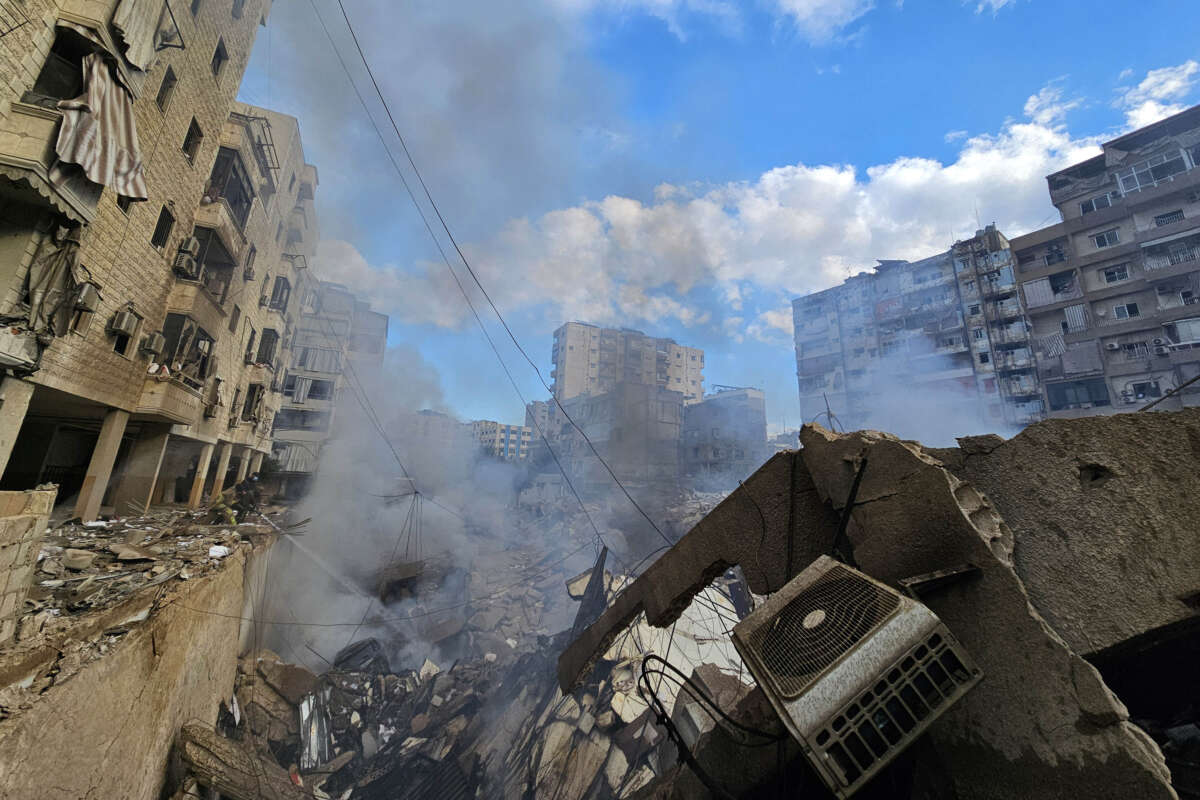
Over 1 million people displaced by Israel’s attacks have been flooding southern Lebanon after 14 months of intense Israeli bombings on the region and two months of a ground invasion, attempting to return to their homes — or what little is left of them after Israel has systematically worked to destroy whole towns in the region.
Lebanese and Israeli officials finalized the ceasefire agreement on Tuesday night, with the truce starting on Wednesday at 4 am local time. Since Israel escalated its aggression against Hezbollah, over 3,800 people have been killed in Lebanon, including over 200 children killed by Israel just over the past two months.
The agreement gives Israeli forces 60 days to withdraw from south Lebanon, while Hezbollah is slated to withdraw to north of the Litani River to be replaced by Lebanese soldiers.
Israeli forces have reportedly declared a curfew in southern Lebanon, saying that it is “absolutely forbidden” for people to travel in southern Lebanon starting from 5 pm on Wednesday to 7 am on Thursday. The army issued a threat to civilians, saying that doing so “exposes you to danger.”
Just before the ceasefire, Israeli forces majorly stepped up their attacks, dropping dozens of bombs on south and east Lebanon and Beirut as the deal was finalized — including an attack in which they bombed at least 20 places in two minutes in Beirut.
Important Message: Please Read
For 25 years, Truthout has survived by publishing impactful investigative journalism and analysis; distributing full editions 365 days a year; and building a community of readers who support us with small, hard-earned donations.
Eighty percent of our $3 million yearly budget comes from small donors alone. Of those, 8,000 readers support us with monthly donations. Back in 2018, when Facebook decided to suppress the circulation of posts made by organizations, thereby cutting readers off from seeing many articles shared by the news organizations they had intentionally decided to follow, Truthout’s total traffic declined by 40 percent, as nearly all of our traffic from that platform disappeared.
Now, Google has recently rolled out its AI search bar, providing AI summaries instead of directing readers to our site. Google Search is our single largest source of traffic; it’s the route by which nearly one third of our readers find us. Much like in 2018, a shocking 40 percent of our Google traffic has disappeared overnight.
It will not be easy for Truthout to shoulder this blow. Nor will it be easy for our peers and collaborators — news sites that depend on traffic and aren’t bankrolled by large corporations.
If you can support Truthout with a donation today, you can help us resist the AI onslaught. Please give today.