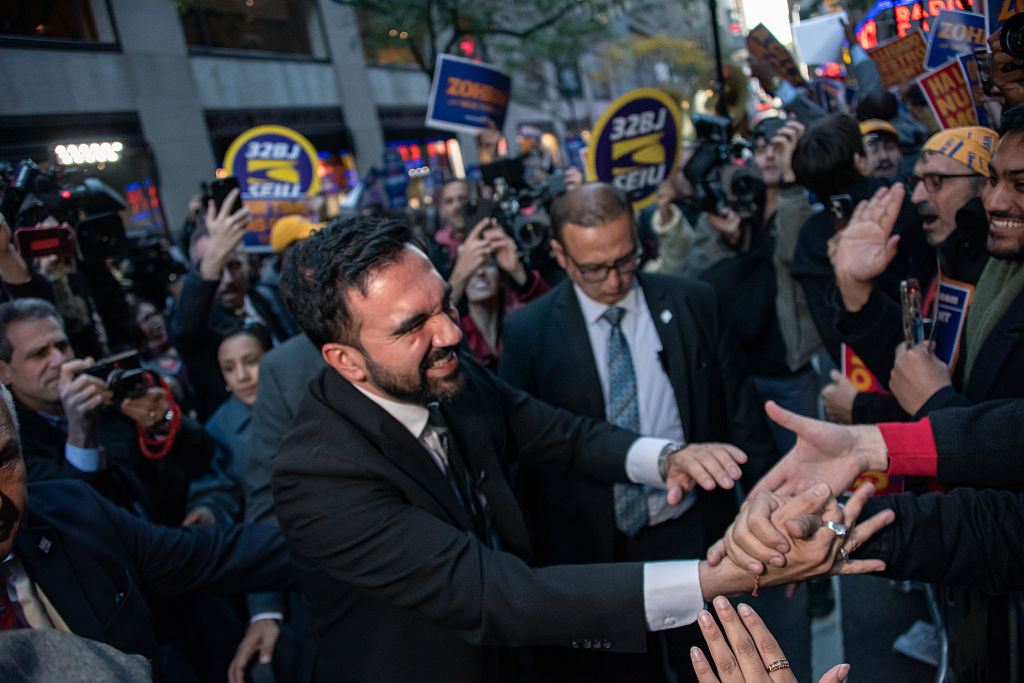
If you had told me in September 2001, when I was a new teacher in Washington, D.C. — the smoke from the 9/11 attacks on the Pentagon still visible from my classroom window — that one day a Muslim socialist would be elected mayor of New York City, I might have thought you cruel for raising my hopes.
I remember the tanks rolling down the street by my house, the flags unfurled from every porch demanding loyalty. The air was thick with fear and vengeance. Islamophobia became the nation’s unofficial religion. The Patriot Act deputized that hatred, giving the government license to spy on Muslims, to entrap them, to raid homes and mosques under the banner of national security. People were beaten in the streets for wearing a hijab, or for simply being perceived as Muslim — Sikh, Arab, South Asian, anyone who fit the script of American fear. In those years, to call oneself a socialist was to invite exile, and to speak of our shared humanity was to stand accused of disloyalty to the nation.
It was not an easy time to believe in human possibility. Being a young Black socialist who wanted to help build a world based on solidarity was widely understood as a dangerous betrayal. But now, take note: The city once believed to be the sole possession of Wall Street — a city steeped in Islamophobic backlash — has elected a Muslim socialist. History, with its sly grin, has once again mocked despair.
Zohran Mamdani’s victory as the new mayor of New York City has awakened a jubilant spirit among working people daring to dream of a better city and a better world. A candidate who ran in support of Palestine, who stood before the world as an unapologetic Muslim, who named himself an open socialist, and who named the mega-rich as the primary barrier to justice, has accomplished something that once seemed impossible.
Mamdani didn’t just promise relief; he named the forces that made life unaffordable and offered a plan to take them on.
Yet his victory was not a miracle — it was a mandate. In a city where the rent is too damn high and billionaires build empty towers while working families sleep in shelters, Mamdani didn’t just promise relief; he named the forces that made life unaffordable and offered a plan to take them on. He won because tenants believed him, because workers recognized themselves in his campaign, and because the grassroots movement led by the Democratic Socialists of America organized one of the most disciplined, door-to-door mobilizations in New York’s modern history.
His victory also marked a clear rebuke to Donald Trump — and the rising tide of fascism he represents. In an age of fear and manufactured division, New Yorkers chose solidarity over scapegoating. That spirit of resistance did not stop at the city limits. It echoed the defiance of Gaza, where steadfastness amid genocide has awakened the conscience of the world — what Palestinian journalist Bisan Owda calls “the Gaza effect,” the contagion of courage that crosses borders.
The elation surrounding Mamdani’s victory is heightened by the joy that accompanies the fall of Andrew Cuomo — a shill for the 1 percent whose record of protecting the powerful was matched only by his record of sexual harassment and abuse. His defeat marks not just the end of a man, but also the crumbling of a political order that mistook cruelty for competence.
A Campaign Against Elite Capture
Many have found hope in the historic firsts that occasionally punctuate our politics — individuals whose presence has diversified the halls of power and widened the story of who counts as American. There’s no doubt representation can expand the horizons of who sees themselves as included and what people imagine possible. Yet when representation is detached from strategies for collective liberation, it risks becoming another tool of the very order we seek to challenge. The system has learned to decorate itself with diversity while leaving its foundations of inequality intact. This is what Olúfẹ́mi Táíwò calls elite capture: when the language of justice is emptied out and repurposed to serve those already in power.
Mamdani’s victory is something else entirely. He did not run to become only a symbol; he ran to change the conditions of people’s lives. His campaign refused the comfort of representation without redistribution. He called for taxing luxury real estate to fund social housing, canceling medical debt, and placing renewable energy under public ownership. He promised fare-free public transit and publicly owned grocery stores to end food deserts and corporate price gouging. He pledged to increase support for mental health care and proposed a Department of Community Safety to expand our understanding of public safety beyond policing.
This is not elite capture; it was a campaign about reclaiming power from the elites.
Power Concedes Nothing Gracefully
Once we have taken some time to revel in the fact that a new political portal has opened — pried open by years of socialist organizing and struggle made visible in Mamdani’s victory — we must roll up our sleeves and walk through it. Zohran Mamdani, brilliant and skilled as he is, will not be able to save us. His victory can widen the field of struggle, opening space for organizing and for social movements to flourish. But that promise will only be realized if he leans into it — if he gets to work turning the office of the mayor from its traditional role as a pedestal into a springboard for mass political participation. Only we — the collective power of our organized communities, workplaces, and campuses — can save ourselves.
While the architects of racial capitalism, and the state that serves it, have understood well the value of keeping the political representatives of the rich in power, they also built contingency plans for the moments when their money failed to buy an election.
I wish the key to achieving social justice — to dismantling systems of racism and oppression, to guaranteeing housing for all, health care as a right, living wages, and true democracy — lay in winning a few key elections: mayors, members of Congress, even the presidency. I wish the rich white enslavers who designed our political system, and the billionaires who have maintained it, hadn’t anticipated ordinary people might one day elect leaders who honored the needs of the working class. But while the architects of racial capitalism, and the state that serves it, have understood well the value of keeping the political representatives of the rich in power, they also built contingency plans for the moments when their money failed to buy an election.
Even now, the richest people in the world are preparing their attack. Wall Street’s arsenal extends far beyond campaign donations: When workers organize and, against all odds, manage to elect representatives who serve their interests, capital can go on strike — halting investment, withholding credit, and manufacturing scarcity until attempts at democracy kneel before financial elites. Power concedes nothing gracefully. City Hall may be at the podium, but true power has always resided in the boardrooms, the banks, and the back rooms where the economy is directed and policy is quietly strangled.
We’ve seen this playbook before. During New York City’s 1975 fiscal crisis, developers and financiers staged what David Harvey called “a coup by the financial institutions against the democratically elected government of New York City.” Pressured by the Black freedom struggle and other social movements of the 1960s and ’70s, New York’s mayors and city council expanded investments in housing, education, and health care. Those in power — liberals like Mayor John Lindsay, a Republican-turned-Democrat who sought to calm unrest with reform — were not radicals, but they had been forced, by the political fire of the era, to spend public money in ways that advanced racial and economic justice. That brief experiment was met with swift retribution. Wall Street launched a capital strike, refusing to finance the city, dumping its bonds, and using the manufactured fear of insolvency to impose its will. Moody’s twice downgraded the city’s credit rating, locking it out of the bond market and forcing austerity. The federal government soon stepped in — on Wall Street’s terms. Thousands of teachers, firefighters, and municipal workers were fired, and public services were gutted. Union power was broken, and the city’s social contract was rewritten in the language of austerity. The crisis, Harvey argued, was as decisive for the rise of neoliberalism as the 1973 coup in Chile that toppled Salvador Allende’s socialist government — a reminder that markets can enforce their will as ruthlessly as armies.
If Capital Strikes, the People Must Strike Back
That history is not past; it is prelude. The same forces that once strangled a city daring to invest in racial and economic justice are preparing their assault again. The moment Mamdani begins taxing the rich, expanding rent control, or putting essential services under public ownership, that machinery will roar to life. Trump’s threat to withhold federal funding from New York is only the blunt edge of that power. The sharper, quieter blade belongs to capital itself.
Whether or not Trump ever acts, corporate power already knows how to make cities bleed. Developers can threaten to halt construction — holding the city’s housing supply hostage to protect their profits, and manufacturing scarcity to make solidarity look like failure. Hedge funds whispering “instability” can send investment fleeing, tank the local economy, and turn hope into panic. The bond-rating agencies — those unelected high priests of austerity — can punish redistributive policy by downgrading the city’s credit, making it more expensive to borrow and forcing cuts to schools, transit, and housing in the name of “fiscal responsibility.” The business press will rediscover “fiscal realism,” declaring the experiment of a government daring to serve its people a failure before it has even begun. The police, too, have their tricks: the sudden spike in crime numbers, the nightly theater of fear, the orchestration of panic that keeps justice at bay. The system was designed by the wealthy so that even if the working-class majority won elections, they would still control the real levers of decision-making — credit, investment, and employment — ensuring escape routes for the 1 percent whenever democracy threatened to become real.
Elected socialists can challenge capital through legislation and public leadership, but organized workers can confront it at its source.
Yet difficulty is not defeat. We have learned, across generations, that when organized people confront organized money, when truth walks shoulder to shoulder with courage, even the most unyielding walls begin to crack. If capital strikes, the people must strike back. Elected socialists can challenge capital through legislation and public leadership, but organized workers can confront it at its source. Workers make life itself — driving the buses, teaching the children, healing the sick, building the homes, and producing the food and energy that sustain us all. Only through unions and collective organization can people gain control over the production and distribution of life’s essentials. Politicians can be constrained or replaced, but a mobilized working class can keep the city running when markets try to shut it down.
These are not fantasies; they are precedents. In the depths of the Great Depression, workers in 1934 led general strikes in Minneapolis, Toledo, and San Francisco that shut down entire cities and forced the federal government to recognize industrial unions. Their victories paved the way for the era’s greatest reforms — from collective bargaining rights to Social Security and unemployment insurance.
The rebellious spirit of 1934 is not confined to the past—it rises whenever workers unite to claim what is theirs. In 2018, West Virginia teachers — among the lowest-paid in the nation — shut down every public school in the state. They fed students from makeshift kitchens, rallied their communities, and refused to return until they’d won. Their wildcat strike sparked the “Red State Revolt” that spread across Oklahoma, Arizona, and beyond — proving that even in conservative strongholds, mass strikes can defeat austerity.
In 2023, the United Auto Workers revived that spirit with their “stand-up strike,” rotating walkouts to keep corporations off balance while turning picket lines into a national classroom on inequality. When it ended, they’d won historic gains — and reminded the country that the real economy runs on those who turn the wheels, not those who own the stock.
The real economy runs on those who turn the wheels, not those who own the stock.
Elections matter. Socialist campaigns can turn ideals into concrete demands, win reforms that improve people’s lives, and expose the greed of the ruling class. But the ballot box is not the beating heart of democracy — the workplace is. Our task is not only to win elections but also to organize workers, tenants, and students into the kind of power that no legislature can ignore or co-opt. And that organizing must reach across every line that capital uses to divide us — race, gender, sexuality, nationality, ability, and more — building a multiracial working-class movement with the collective power needed to create a society based on human need, not profit.
Beyond the Ballot Box: Building a Multiracial Working-Class Movement
Mamdani will need these kinds of movements at his back — not just cheering from the sidelines, but flooding the streets, organizing tenants, defending workers, and building the kind of pressure that makes retreat impossible. We are beginning to see the faint outline of a new political imagination — one that asks not how to make peace with power, but how to dismantle it and rebuild something humane in its place.
The ballot box is not the beating heart of democracy — the workplace is.
Mamdani cannot carry that vision alone. As Howard Zinn taught us, history is not the story of great individuals but of “countless small actions of unknown people,” and that “Democracy does not come from the top. Democracy comes from ordinary people…. They protest together, they demand things together, they form a movement — and that is how change takes place.” James Baldwin reminded us, “Freedom is not something that anybody can be given. Freedom is something people take, and people are as free as they want to be.” He did not mean that oppression is a choice, but that liberation begins when people refuse to wait for permission to be free. The great victories of labor, civil rights, feminism, and abolition were never gifts from the powerful; they were won by people whose collective power was the decisive factor in making material gains for their communities.
If the dream of a democratized economy and of a city free of white supremacy and greed is to live, it will require more than the charisma of leaders — it will require the collective determination of the people.
A New Dawn
I have lived long enough to see what once seemed set in the dried concrete of the impossible turn out to be planted in fertile soil; when given the sunlight of struggle and watered by hope, it could still bloom.
Mamdani declared in his victory speech, “Thank you, my friends. The sun may have set over our city this evening, but as Eugene Debs once said, ‘I can see the dawn of a better day for humanity.’” The line comes from a speech Debs gave in 1918, just before he was sentenced to prison for opposing World War I. A labor organizer and socialist, Debs stood shoulder to shoulder with the working class — leading strikes, organizing across color and creed, and even running for president from his jail cell, earning nearly a million votes. In the final lines of the speech Mamdani referenced, Debs continued with words that further explain our moment and our task today: “As the midnight approaches, the southern cross begins to bend, the whirling worlds change their places, and with starry finger-points the Almighty marks the passage of time upon the dial of the universe … Let the people everywhere take heart of hope, for the cross is bending, the midnight is passing, and joy cometh with the morning.”
If this moment reveals anything, it’s that we must let our imagination rise like the sun — radiating strategies for the full illumination of our humanity: electoral, no doubt, but also rooted in culture and artistic endeavors, in the power of unions and workplace struggles, and in community and campus organizing. The future will belong to those who dare to see beyond the boundaries of what power calls possible — those who know that another world can be built by our own hands.
As the great Afrofuturist composer Sun Ra once said, “The possible has been tried and failed. Now it’s time to try the impossible.”
Trump is silencing political dissent. We appeal for your support.
Progressive nonprofits are the latest target caught in Trump’s crosshairs. With the aim of eliminating political opposition, Trump and his sycophants are working to curb government funding, constrain private foundations, and even cut tax-exempt status from organizations he dislikes.
We’re concerned, because Truthout is not immune to such bad-faith attacks.
We can only resist Trump’s attacks by cultivating a strong base of support. The right-wing mediasphere is funded comfortably by billionaire owners and venture capitalist philanthropists. At Truthout, we have you.
Truthout has launched a fundraiser to raise $34,000 in the next 5 days. Please take a meaningful action in the fight against authoritarianism: make a one-time or monthly donation to Truthout. If you have the means, please dig deep.