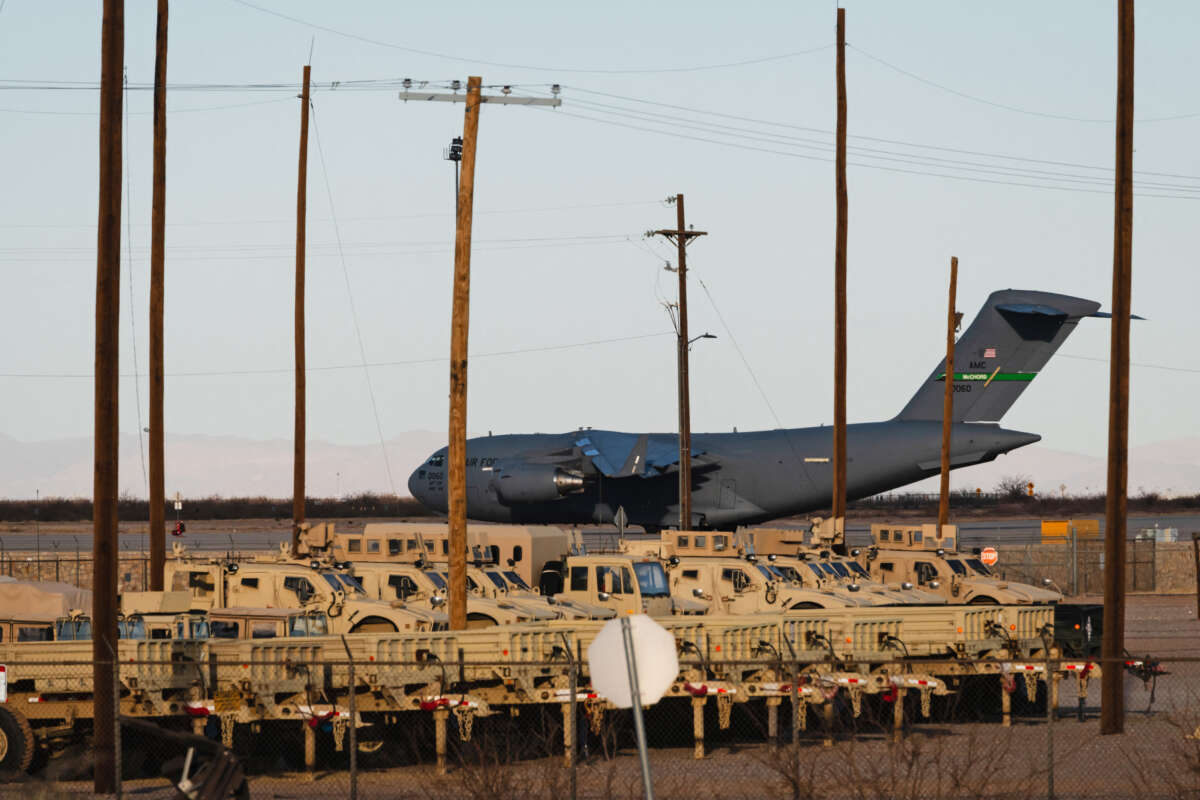
Immigrant rights advocates and elected Democrats are calling on the Department of Homeland Security (DHS) to shut down an immigrant jail outside of El Paso, Texas. New evidence calls into question the official narratives about the recent deaths of two men held at Camp East Montana, a sprawling tent city at the Fort Bliss Army base in West Texas. Geraldo Lunas Campos and Victor Manuel Diaz are among the 38 people whose deaths have been documented while in custody at jails and prisons run by Immigration and Customs Enforcement (ICE) and its contractors since President Donald Trump took office.
On December 8, before the two men died, a coalition of civil and human rights groups sent a letter to acting ICE Director Todd Lyons and other top Trump administration officials warning about “alarming” conditions at Camp East Montana. The facility had just reported the death of an immigrant, Francisco Gaspar-Andrés, the first person to die at the camp since its opening less than four months earlier. The groups said additional deaths were imminent if the camp continued to operate.
The letter reported that people arrested on immigration violations and shipped to Fort Bliss from across the United States had reported inedible food, medical neglect, solitary confinement, physical coercion, and “abusive sexual contact” by Camp East Montana’s staff of private contractors. Groups of detainees have said they were driven an hour away to the border and ordered to self-deport by “jumping” into Mexico despite not being Mexican; some have reported beatings by the masked officers after refusing.
ICE has said the deaths remain under investigation, but referred to Victor Manuel Diaz’s death as a suspected suicide and Geraldo Lunas Campos’s death as an attempted suicide in statements to the media. With both deaths, Fort Bliss is quickly becoming the poster child for a dangerous network of incarceration looming behind Trump’s deadly immigration policing operations in Minnesota and beyond.
The controversy over the deaths at Fort Bliss — and growing fear among attorneys, family members, and neighbors for the people snatched by ICE agents during chaotic raids and incarcerated — comes as Senate Democrats threaten to hold up legislation needed to fund the government over the killing of U.S. citizens by federal immigration officers in Minnesota. Like the deaths of Renee Nicole Good and Alex Pretti, the two Minneapolis residents among the 12 people shot and six killed by federal officers during chaotic immigration raids since Trump took office, DHS officials have consistently denied responsibility when people die in their custody.
“The government knew of the horrors at Fort Bliss,” said Charlotte Weiss, a staff attorney at the Texas Civil Rights Project, in a statement to Truthout. “Now, we bear witness to the result of their reckless inaction and to the tragic and preventable loss of three sacred lives.”
Fort Bliss has long been associated with abuses of marginalized populations. The military base held some of the more than 100,000 Japanese Americans incarcerated during World War II. Now, Camp East Montana is run by private contractors after its hasty construction last year.
Attached to the letter sent to Trump administration officials in December were dozens of statements made by people recently held at the facility under pseudonyms to avoid retaliation, including “Isaac,” who said that Camp East Montana “seems designed to wear you down.”
“There is no consistent schedule for going outside. I have gone multiple weeks at times without going outside,” Isaac told investigators, adding that guards sometimes only let them out after the sun goes down and desert temperatures plummet. “The lack of time outdoors really hurts the functioning of our internal cycles and how we feel mentally.”
Isaac said he has high blood pressure but did not receive medication for a month after arriving at the camp. Other detainees had similar problems, Isaac said, including one man who said he was assaulted by guards after reporting feeling unwell and had so much coagulated blood that “it looked like his arm was going to pop.”
On January 3, less than a month after these warnings were sent to Lyons and Maj. Gen. Curtis Taylor, the top commander at Fort Bliss, a detention officer made an emergency 911 call to report an “apparent suicide” at Camp East Montana. ICE officials later claimed that Geraldo Lunas Campos, a 55-year-old father and longtime U.S. resident from Cuba, tried to take his own life and died in the struggle as guards attempted to protect him from himself.
However, a witness and fellow detainee told The Washington Post he saw guards choking Lunas Campos, who repeatedly said “I can’t breathe” in Spanish. Last week, the El Paso County Office of the Medical Examiner released an autopsy listing the death as a homicide caused by “asphyxia due to neck and torso compression.” The Campos family is filing a wrongful death lawsuit and petitioned a federal court to block the Trump administration from deporting witnesses who would be called to testify. A federal judge is scheduled to hear arguments over the petition on January 27.
“He was being abused and beaten and choked to death,” said Jeanette Pagan Lopez, the mother of two of Lunas Campos’s children, in an interview with The New York Times.
On January 18, ICE reported another death at Camp East Montana. Victor Manuel Diaz, a 36-year-old man from Nicaragua who was recently arrested in Minnesota and transferred to Fort Bliss, was found “unconscious and unresponsive in his room,” according to ICE. The agency called the death a “presumed suicide” in its mandated report but said the official cause is still under investigation. Diaz’s brother, Yorlan Diaz, said he doesn’t believe the official story.
“I don’t believe he took his life,” Yorlan Diaz told ABC News. “He was not a criminal; he was looking for a better life and he wanted to help our mother.”
Geraldo Lunas Campos and Victor Manuel Diaz and were the second and third people to die after being held at Camp East Montana since December 3, when Francisco Gaspar-Andrés, 48, was taken to the hospital and died of “natural” liver failure, according to ICE. At least six people have died so far this year at various ICE jails and prisons across the country, and at least 32 people died in 2025 as Trump ramped up his brutal mass deportation campaign.
“Reoccurring deaths over such a short period of time in this facility raise serious concerns about the conditions, medical care, and oversight at Fort Bliss,” Weiss said. “But these worries are not new. These tragedies are part of a broader pattern of documented abuses and systemic failures within detention facilities operated or funded by the Department of Homeland Security.”
DHS is required by law to provide detailed reports on deaths in ICE custody to Congress, but a recent investigation by Zeteo found the Trump administration has failed to do so in at least eight cases since February 2025.
ICE consistently claims in the media that someone incarcerated while awaiting hearings on immigration violations — a civil offense, not criminal — receives a medical evaluation within 12 hours of arriving and has access to emergency medical care, often at whatever emergency room is nearest to the facility. However, ICE has failed to pay contractors that provide medical care inside its prisons and jails since October despite ample funding. Independent research analyzing deaths that took place during the first Trump administration suggests that the vast majority are likely preventable.
Jeremy Jong, a staff attorney for the immigrant rights group Al Otro Lado, said the problem extends far beyond Camp East Montana at Fort Bliss. Long has represented multiple families in lawsuits over deaths in ICE custody and said the agency relies on an ever-expanding maze of profit-hungry prison companies and private contractors to keep Trump’s mass deportation machine running.
“If you detain more people, more people are going to die,” Jong said in an interview. “These are not places that are set up to give anywhere near a decent level of health care.”
Rep. Veronica Escobar, a Democrat from El Paso, has been warning federal officials about conditions at the Fort Bliss camp for months. Like other Democrats, Escobar took ICE to court after being blocked from conducting oversight inspections of Camp East Montana. She was finally able to enter and visit with incarcerated women in late November.
“Issues persist with rotten food, inconsistent access to necessary medications, lack of regular access to recreational areas, and inconsistent laundry and cleaning services for uniforms,” Escobar wrote to Lyons and DHS Secretary Kristi Noem in December.
After the county medical examiner ruled the death of Lunas Campos a homicide, Escobar issued a statement calling on Noem to testify about the deaths at Camp East Montana before Congress and for the facility to be shut down. Under pressure from Republicans and Democrats alike after the fatal shooting of Good and Pretti in Minneapolis, Noem is expected to testify before the Senate Judiciary Committee on March 3.
“Secretary Noem and Director Lyons have an obligation to provide Congress with a thorough briefing on the circumstances of the confirmed murder of a detainee at Camp East Montana,” Escobar said in a statement on January 22.
Meanwhile, DHS and ICE are preparing to build another massive migrant jail near El Paso. The camp at Fort Bliss is designed to hold up to 5,000 people, and more than 2,000 people are held there on any given day. The new facility, which would be paid for using funds from the GOP budget bill passed last year, would hold up to 8,500 people, according to El Paso Matters.
“Imagine what people must be suffering behind closed doors, when we can see so clearly the violence they are inflicting on the streets,” said Setareh Ghandehari, advocacy director at the Detention Watch Network, in an email. “Mr. Campos and his loved ones deserved so much better as did all the people who have died or suffered trauma at the hands of these agencies.”
Media that fights fascism
Truthout is funded almost entirely by readers — that’s why we can speak truth to power and cut against the mainstream narrative. But independent journalists at Truthout face mounting political repression under Trump.
We rely on your support to survive McCarthyist censorship. Please make a tax-deductible one-time or monthly donation.