Part of the Series
Struggle and Solidarity: Writing Toward Palestinian Liberation
Truthout is an indispensable resource for activists, movement leaders and workers everywhere. Please make this work possible with a quick donation.
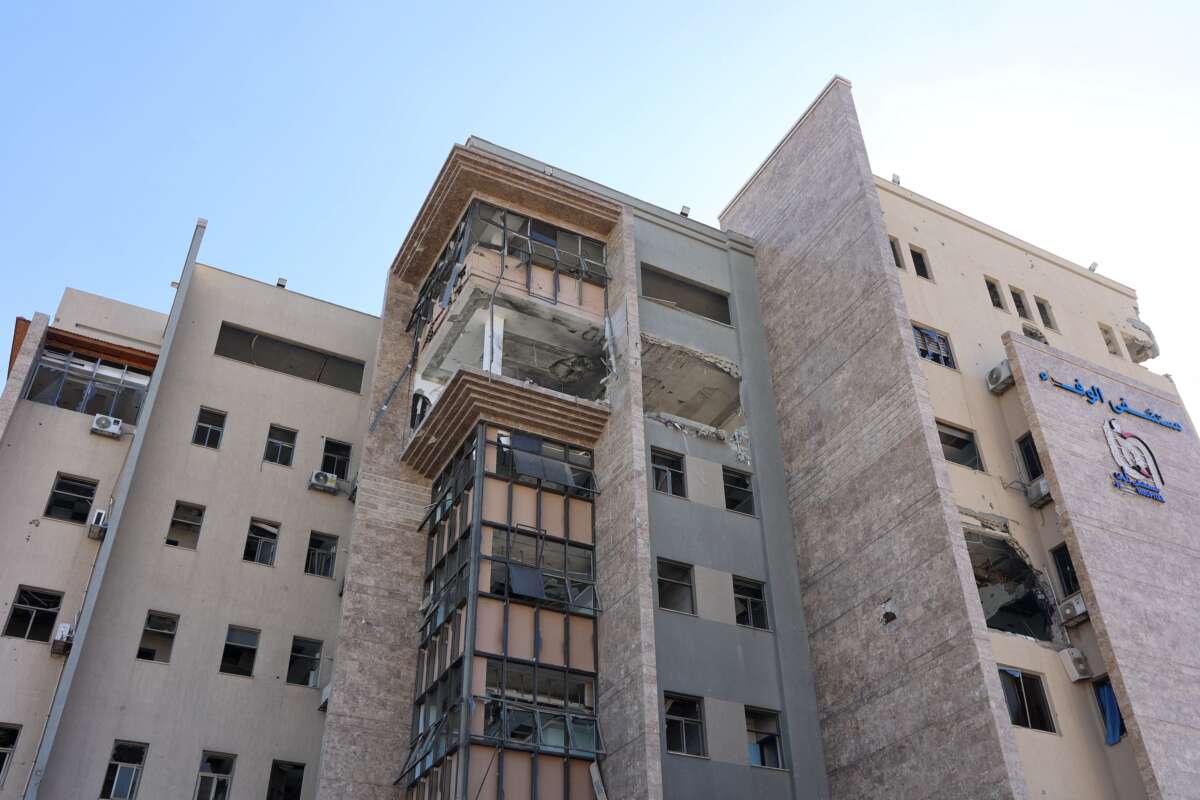
In the heart of a city at war, al-Wafa Rehabilitation Hospital struggles to survive. This site of healing and recovery has now been transformed into a place overwhelmed by cruel suffering.
Please don’t be fooled by the Israeli military propaganda that has asserted that this “building does not currently serve as a hospital” — an assertion conveniently circulated by The Jerusalem Post in December 2024, as the Israeli military sought to deflect criticism of its decision to bomb the hospital. Many credible sources verify how ludicrous that claim is, from the images that Getty’s photojournalists took following that bombing, to the World Health Organization’s appeal for an end to Israel’s attacks on this and other hospitals in Gaza.
From March to May 2025, I lived within the hospital’s walls as a caregiver to my mother. I witnessed how al-Wafa held so much pain in its rooms and corners. From children to the elderly, each patient carries their own devastating injury. When I returned to the hospital three months later as a guest, I observed how much more crowded it had become, with a massive number of patients seeking treatment. I interviewed the medical team and injured patients. This is the story of a hospital pushed to its extreme limits, and of the patients who continue to resist and survive inside it.
The hospital atmosphere now is more suffocating than before. Everywhere you look, you will see someone suffering. Hospital beds are full of tiny bodies of different ages and genders. No one can walk, all are sitting in their wheelchairs due to injuries that left them paralyzed. Being able to walk while everyone around you cannot is emotionally distressing and isolating.
“We cannot offer the bare minimum for the patients,” said Dr. Wael Khalif, director of al-Wafa hospital. The hospital is running out of nearly all medical equipment, from needles to surgical devices. Dr. Khalif described the overwhelming situation, with a massive number of patients on the waitlist to have care from the only rehabilitation hospital still functioning in Gaza, “There are 100 top urgent [patients] needing a bed, while another 400 to 500 patients are also waiting to be admitted,” the hospital director said.
The hospital is running out of nearly all medical equipment, from needles to surgical devices.
Dr. Khalif shed light on the catastrophic consequences of starvation inside the hospital. “Even healthy people are struggling to endure hunger and lack of proper nutrition, so imagine what’s happening for patients suffering from serious illnesses,” he said. Many patients are unable to receive even one meal per day. “Since the starvation period has begun, we are helpless to provide food for our patients,” he added.
And it’s not just the patients facing starvation; the medical staff also cannot endure more suffering. They are exhausted, overwhelmed, and unable to afford services for their patients. “Many of the nursing staff are struggling with dizziness during their duties at the hospital,” said Dr. Khalif.
This disaster is deeply impacting nursing staff. Their hearts are breaking into a million pieces watching their patients dying of hunger and lack of proper care. “I wish I could offer food for my patients. I cannot offer even the smallest amount of food for them,” said Wesam Al-Shawa, 26, a nurse at al-Wafa hospital. She looked completely helpless, and I noticed the exhaustion in her eyes as she spoke.
The hospital’s physical therapist is also working under immense pressure. “We receive approximately 60 to 75 patients per day,” said Dr. Samah Awida, a physical therapist at al-Wafa. This huge number of patients seeking physical therapy sessions has taken a serious toll on the medical team as the situation continues to worsens.
“Many of the nursing staff are struggling with dizziness during their duties at the hospital.”
To make conditions even more unbearable, patients who reach the final stage of recovery are likely going to live in a tent with nothing more than an uninhabitable floor and a small space to sleep in, and, if they are lucky, access to a bathroom. “Our efforts go to waste when patients end up living in a tent,” Dr. Samah said, her tired eyes telling me everything.
Amid these collapsing systems, there is a girl with a story that should never have to be told: Dania Amara.
Five-year-old Dania is among the injured patients. She was wounded while playing with other children on July 7, 2025. “Her body was full of blood,” Dania’s mother recalled. Dania had injuries all over; small shrapnel tore at her small body and caused a paralysis of the limbs. “Why did Israel attack me? I was just playing around,” Dania asked her mother as I was interviewing her.
August 18, when I spoke to her, was Dania’s 40th day in the hospital. She dreams of going home to her siblings, walking again, painting, and enjoying proper meals. “My daughter is now disabled because of one piece of shrapnel,” her mother said.
Dania is just like any other child — full of innocence and life — but Israel has stolen that normalcy and turned her world upside down.
“She hits her legs and begs them to walk like before,” her mother said, tears filling her eyes. Dania’s injury has changed her life forever, and she is just one of thousands suffering as she does, most without documentation or recognition.
Only in Gaza’s hospitals can you watch childhood be stolen by war crimes.
Beyond physical rehabilitation, the occupational therapy department is facing its own obstacles in silence.
While the physical therapy sessions help patients to recover and potentially walk again, occupational rehabilitation helps them to live again. This department helps patients to be completely independent, hold spoons, brush their hair, dress themselves independently, and attend to other needs without assistance. “We do our utmost effort to give back life to our patients,” said Basam Alwan, a therapist in the department.
Hadeel Qriaqa, 27, is one of the many patients struggling to rebuild her life at al-Wafa. She sustained severe head trauma during an attack on her home in March 2025. Since then, she has lost much of her memory and the ability to speak.
Now, she attends occasional occupational therapy sessions with Dr. Alwan aimed at helping her relearn basic daily skills and regain some independence.
Al-Wafa rehabilitation hospital and its medical staff have displayed immense resilience amid the war. Despite all difficulties facing them, they are still fighting to keep their work alive two years into a genocide. The world must not continue to ignore their suffering.
A terrifying moment. We appeal for your support.
In the last weeks, we have witnessed an authoritarian assault on communities in Minnesota and across the nation.
The need for truthful, grassroots reporting is urgent at this cataclysmic historical moment. Yet, Trump-aligned billionaires and other allies have taken over many legacy media outlets — the culmination of a decades-long campaign to place control of the narrative into the hands of the political right.
We refuse to let Trump’s blatant propaganda machine go unchecked. Untethered to corporate ownership or advertisers, Truthout remains fearless in our reporting and our determination to use journalism as a tool for justice.
But we need your help just to fund our basic expenses. Over 80 percent of Truthout’s funding comes from small individual donations from our community of readers, and over a third of our total budget is supported by recurring monthly donors.
Truthout’s fundraiser ends tonight! We have a goal to add 130 new monthly donors before midnight. Whether you can make a small monthly donation or a larger one-time gift, Truthout only works with your support.