Truthout is an indispensable resource for activists, movement leaders and workers everywhere. Please make this work possible with a quick donation.
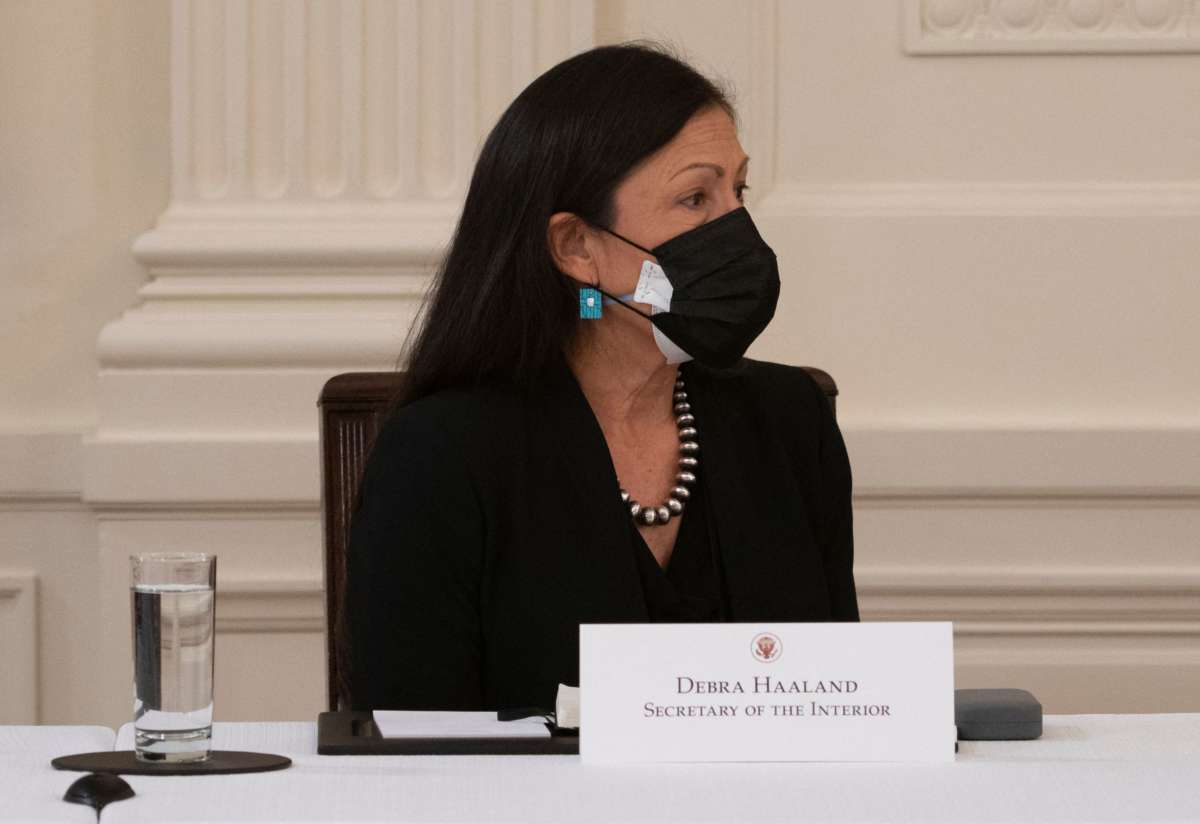
Human rights defenders on Friday applauded the announcement by U.S. Interior Secretary Deb Haaland that the Bureau of Indian Affairs will establish a unit tasked with investigating missing and murdered Indigenous people.
The Interior Department said in a statement Thursday that “approximately 1,500 American Indian and Alaska Native missing persons have been entered into the National Crime Information Center throughout the U.S., and approximately 2,700 cases of murder and nonnegligent homicide offenses have been reported to the federal government’s Uniform Crime Reporting program.”
The agency said that the new Missing & Murdered Unit (MMU) “will help put the full weight of the federal government into investigating these cases and marshal law enforcement resources across federal agencies and throughout Indian country.”
The MMU will build on the work of Operation Lady Justice, a task force on missing and murdered Indigenous people launched in 2019.
“Investigations remain unsolved often due to a lack of investigative resources available to identify new information from witness testimony, re-examine new or retained material evidence, and review fresh activities of suspects,” the Interior Department statement said. “The MMU, in addition to reviewing unsolved cases, will immediately begin working with tribal, BIA, and FBI investigators on active missing and murdered investigations.”
In the United States…re #MMIWG
How are we doing in Canada @GCIndigenous @JustinTrudeau @CrownIndigenous ? https://t.co/y1fwRw1frp
— Canadian Femicide Observatory (@CAN_Femicide) April 2, 2021
Haaland — the first Native American Cabinet secretary in U.S. history — said Thursday that “violence against Indigenous peoples is a crisis that has been underfunded for decades. Far too often, murders and missing persons cases in Indian country go unsolved and unaddressed, leaving families and communities devastated.”
“The new MMU unit will provide the resources and leadership to prioritize these cases and coordinate resources to hold people accountable, keep our communities safe, and provide closure for families,” Haaland continued. “Whether it’s a missing family member or a homicide investigation, these efforts will be all hands on deck.”
“We are fully committed to assisting tribal communities with these investigations, and the MMU will leverage every resource available to be a force-multiplier in preventing these cases from becoming cold case investigations,” she added.
According to the Coalition to Stop Violence Against Native Women, Indigenous women are murdered at 10 times the national average. Statistics from the U.S. Centers for Disease Control and Prevention show homicide is the third-leading cause of death among American Indian and Alaska Native girls and women ages 10 to 24 and the fifth-leading cause of death for those between the ages of 25 and 34.
A 2016 National Institute of Justice report (pdf) found that 84% of Indigenous women have experienced violence in their lifetimes, 41% had been physically injured by intimate partners, and 67% were concerned for their safety.
Two years later, a survey (pdf) published by the Seattle-based Urban Indian Health Institute reported 5,712 cases of missing and murdered Indigenous girls in 2016, of which only 116 were logged in the U.S. Department of Justice’s federal missing persons database.
🚨 ACTION ALERT 🚨 SIGN ON NOW! Join us in support of declaring a National Day of Awareness for Missing and Murdered Native Women and Girls on May 5th. Sign on: https://t.co/p7Y9S5QiJj.
Please circulate widely! #MMIWG #MMIWGActionNow #NoMoreStolenSisters pic.twitter.com/ESwlerOTjQ
— National Indigenous Women's Resource Center (@niwrc) March 29, 2021
May 5 is National Day of Awareness for missing and murdered Native women and girls.
Important Message: Please Read
For 25 years, Truthout has survived by publishing impactful investigative journalism and analysis; distributing full editions 365 days a year; and building a community of readers who support us with small, hard-earned donations.
Eighty percent of our $3 million yearly budget comes from small donors alone. Of those, 8,000 readers support us with monthly donations. Back in 2018, when Facebook decided to suppress the circulation of posts made by organizations, thereby cutting readers off from seeing many articles shared by the news organizations they had intentionally decided to follow, Truthout’s total traffic declined by 40 percent, as nearly all of our traffic from that platform disappeared.
Now, Google has recently rolled out its AI search bar, providing AI summaries instead of directing readers to our site. Google Search is our single largest source of traffic; it’s the route by which nearly one third of our readers find us. Much like in 2018, a shocking 40 percent of our Google traffic has disappeared overnight.
It will not be easy for Truthout to shoulder this blow. Nor will it be easy for our peers and collaborators — news sites that depend on traffic and aren’t bankrolled by large corporations.
If you can support Truthout with a donation today, you can help us resist the AI onslaught. Please give today.