Support justice-driven, accurate and transparent news — make a quick donation to Truthout today!
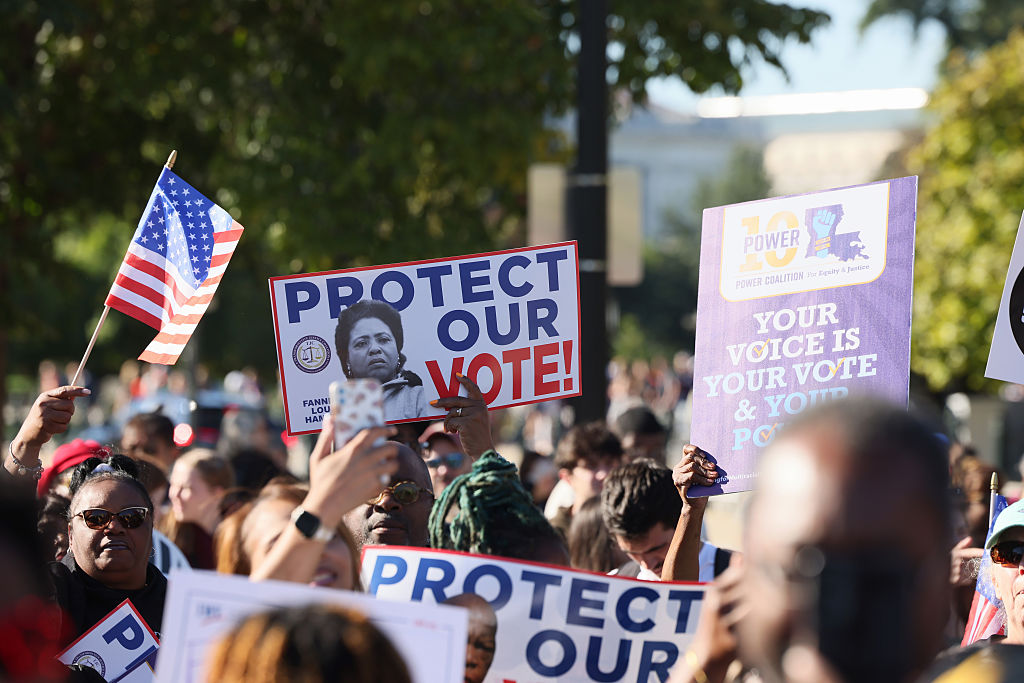
Republicans could gain nearly 200 state legislative seats across the South if the U.S. Supreme Court guts a key provision of the federal Voting Rights Act, a new analysis finds.
The bulk of the gains would be concentrated in 10 GOP-controlled state legislatures in Southern states, according to the analysis, produced by Fair Fight Action, a Georgia-based progressive voting rights group, in partnership with Black Voters Matter Fund, which advocates on behalf of Black voters.
The analysis, featured in a report released by the groups on Monday, underscores the alarm among progressives over the potential consequences of the Supreme Court’s looming decision in a case known as Louisiana v. Callais. While the case centers on the constitutionality of Louisiana’s congressional map, the effects of the decision could extend into statehouses across the country.
The Supreme Court’s conservative majority appears likely to severely weaken Section 2 of the Voting Rights Act, a landmark 1965 civil rights law that bans racial discrimination in voting access. Section 2 restricts racial gerrymandering, and until now has limited the power of lawmakers to draw districts that dilute the voting power of racial minority voters.
A sweeping decision by the court could give state lawmakers a freer hand to draw congressional and state legislative districts that dilute the power of minority voters — as well as districts for local governments, such as county commissions, city councils and school boards. The justices held oral arguments in October; a decision could come at any time.
At the state legislative level, a court ruling that strikes down Section 2 could lead to Democrats losing about 191 seats, according to the analysis, which examined how state legislative districts could be redrawn if Section 2 is no longer in place. Most of those seats are currently held by Black lawmakers in districts where minority voters make up a majority of residents.
“What that is doing is providing a fatal blow to Black representation in the South,” Fair Fight Action CEO Lauren Groh-Wargo said in an interview.
The total number of state legislative districts in 10 Southern states where Black or Hispanic voters comprise a majority could fall from 342 to 202. Those states are Alabama, Arkansas, Florida, Georgia, Louisiana, Mississippi, North Carolina, South Carolina, Tennessee and Texas.
Some Republican states argue that courts have interpreted Section 2’s protections too broadly and in the process wrongly restrained the ability of lawmakers to draw favorable maps.
Alabama and 13 other GOP states said in a brief filed with the Supreme Court earlier this year that Section 2 has been turned into “the proverbial golden hammer, wielded by plaintiffs and courts in a never-ending search for a nail.”
If the Supreme Court weakens the Voting Rights Act, it’s unclear whether state legislatures would pursue mid-decade redraws of state legislative districts. Redistricting typically occurs every 10 years following the census.
At the federal level, a previous analysis by Fair Fight Action and Black Voters Matter Fund projected Republicans could draw an additional 19 U.S. House seats if Section 2 protections were removed.
While a few states have passed new congressional maps already this year, those efforts have proven highly controversial. Some states, such as Indiana and Kansas, have abandoned or rejected them for now.
Stateline is part of States Newsroom, a nonprofit news network supported by grants and a coalition of donors as a 501c(3) public charity. Stateline maintains editorial independence. Contact Editor Scott S. Greenberger for questions: info@stateline.org.
Press freedom is under attack
As Trump cracks down on political speech, independent media is increasingly necessary.
Truthout produces reporting you won’t see in the mainstream: journalism from the frontlines of global conflict, interviews with grassroots movement leaders, high-quality legal analysis and more.
Our work is possible thanks to reader support. Help Truthout catalyze change and social justice — make a tax-deductible monthly or one-time donation today.