Part of the Series
Struggle and Solidarity: Writing Toward Palestinian Liberation
Honest, paywall-free news is rare. Please support our boldly independent journalism with a donation of any size.
For the third consecutive year, Christmas will pass in Gaza without lights and without fanfare. Bells will not ring, and decorations that once briefly softened the Strip’s pain will be absent from streets long familiar with loss.
In 2023, Christmas arrived in Gaza under the weight of fear and terror, at a time when the war had been ongoing for only two months. Back then, many Palestinians — Muslims and Christians alike — believed it was impossible for a new year to begin while the war was still underway. There was a shared sense of hope that 2024 would bring the war to an end.
I clearly remember how Israeli Prime Minister Benjamin Netanyahu’s statement — declaring that 2024 would be “a year of war” — was met with disbelief and mockery. The assumption was that the world would not allow such a reality to unfold. What followed, however, surpassed even our darkest expectations.
Now, after more than two years, Gaza faces the end of 2025, and Christmas — which some Palestinian Christians observe on December 25, while many others observe in January, in accordance with the Greek Orthodox and Armenian Apostolic Church calendars — arrives after a so-called end to the war. Yet the reality on the ground raises disturbing questions about what this “ceasefire” truly means.
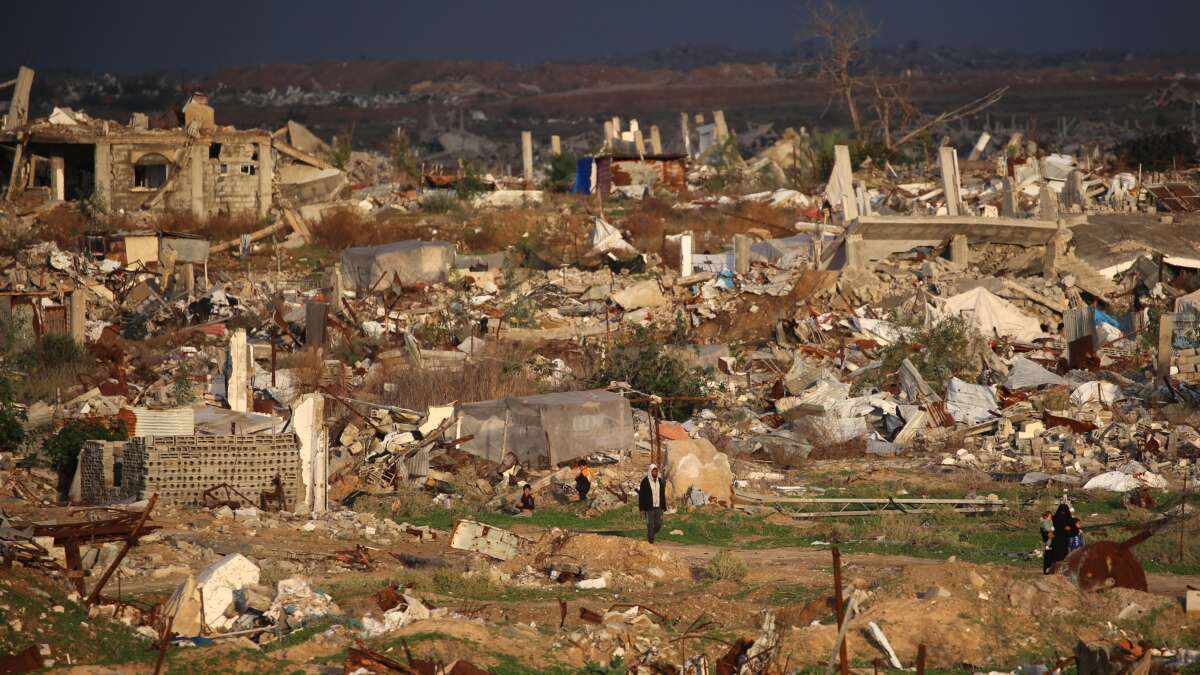
Infants have frozen to death, acute malnutrition is pervasive, and many are living in tents that flood during storms.
The streets that have gone undecorated for the third year in a row are darker and more devastated than ever. While the pace of mass killing has slowed, the consequences of war remain deeply embedded in our daily lives: Infants have frozen to death, acute malnutrition is pervasive, and many are living in tents that flood during storms.
What does this season mean for Gaza’s Christian community, who once marked Christmas with faith and resilience? And what does it mean for Muslim Palestinians, who were accustomed to sharing this moment — to see the Christmas tree lit, and to witness our neighbors’ joy?
In Gaza, Christmas will arrive without lights, without warmth, and burdened by a war that has not truly ended, even if its cessation has been officially announced.
I recently spoke with my father’s Christian friend, Tawfiq Al-Amash, who lived through the genocide and famine and continues to suffer alongside us. I asked him how he saw Christmas this year.
In Gaza, Christmas will arrive without lights, without warmth, and burdened by a war that has not truly ended, even if its cessation has been officially announced.
He answered, with pain in his voice: “What can I say to you? What can I say?”
I felt ashamed for asking, knowing the depth of the suffering we all face on the threshold of 2026.
Al-Amash then went on to tell me about why he rejected the idea of trying to put up Christmas trees in Gaza this year when a Muslim friend who works with him at the Gaza Municipality called and suggested trying to do so.
“I rejected the idea,” Al-Amash told me. “I asked him why, and how Christmas would even be possible now?”
Al-Amash went on to reflect on what Christmas used to be like in Gaza before the genocide. In the past, most shops in Gaza were decorated for the winter holiday, he told me, and Christians in Gaza remember how the streets used to shine, beautiful and welcoming for Christmas. He reminisced about how his community used to decorate the Christian Youth Association (where many activities took place, such as celebrations, sporting events, and other gatherings for both Christians and Muslims) to gather and celebrate together.
He told me:
We, as Christians, would visit one another, planning nights to stay up, enjoy, and celebrate together. And of course, there were the gifts we would distribute to our Muslim neighbors — chocolates shaped like Santa Claus. One of the greatest joys was the chance to travel to Bethlehem [which is located in the West Bank]. Before the war, the Israeli occupation coordinated visits so we could go to Bethlehem and pray in its churches.
But now? None of that is possible. All we can do is attend the Holy Mass. That is all. We decided, however, to do something small for our children: We arranged for a company to distribute simple gifts to our children in the church square.
So this is what Christmas will look like for my Christian neighbors: no celebration, only prayer, and painful remembrance of their beautiful past celebrations. And how much more painful it is that for more than two years, the Israeli occupation has stopped coordinating visits to Bethlehem.
I know firsthand what Christians in Gaza endured during the genocidal war. Many of them were killed, and they lived exactly as we Muslims did, for the war targeted every living thing in Gaza: humans, animals, plants — even the stones were not spared by the occupation.
When I think of the suffering of Christians in Gaza, I immediately think of our family friend, Tareq Al-Souri, a prominent businessman and well-known merchant, a man of great reputation and deeply beloved in Gaza, whose family was erased from the civil registry at the start of that genocide.
On October 20, 2023, funerals were held for the 17 Christians, most of them children and women, who perished in an Israeli airstrike on the church where dozens of families had sought refuge after their homes were destroyed or evacuated in search of safety.
The bells of mourning rang that day as the Al-Souri family and other Christian families were laid to rest: Yara Jreis Al-Amash, Viola Jreis Al-Amash, Abdelnour Sami Al-Souri, Tareq Sami Al-Souri, Liza Walid Al-Souri, Suhail Ramez Al-Souri, Majed Ramez Al-Souri, Julie Ramez Al-Souri, Ellen Helmy Terzi, Marwan Salim Terzi, Nahed Terzi, Suleiman Jamil Terzi, Sanaa Attallah Al-Amash, Alya Abdelnour Al-Souri, Issa Tareq Al-Souri, Juliette Sobhi Al-Souri, and George Sobhi Al-Souri. Prayers were held for them in the courtyard of the Greek Orthodox Church.
I remember how unbearably difficult that day was, especially since Christians had never faced these kinds of massacres during Israel’s previous assaults on Gaza.
Recently I listened to an interview on Al Jazeera with some of the Christians living in Gaza. Among them was Faten Al-Safliti, who recounted how she lost her husband and son to shelling and bombardments of the church.
In the same interview, a young girl named Maryam Tarzi said, “We still hear the shelling every day, even after the war has ended!” Meanwhile, a Christian man in Gaza named Edward Anton recalled how he used to spend the holiday at his family home, but he told Al Jazeera that this year he mourns the loss of his mother and sister, who were killed by an Israeli sniper while seeking refuge in a church.
I tried to contact Edward Anton’s brother, Issa Anton, who is a family friend of mine, but received no response. I hesitated to call him again, not wanting to be a burden amid the heavy grief and difficult circumstances he is enduring.
Happiness has become a distant dream for the people of Gaza. Memories and continuous loss have stripped us of the joy of life. Everything that has passed was filled with suffering, and everything that is to come seems bound to the same pain.
The holy month of Ramadan approaches in February, and all of us who are Muslim ask ourselves: What will it be like this year? Especially since the Eid holiday follows immediately after. This is Gaza — a place where the suffering inflicted by Israel robs religious celebrations of joy from everyone, without exception.
A terrifying moment. We appeal for your support.
In the last weeks, we have witnessed an authoritarian assault on communities in Minnesota and across the nation.
The need for truthful, grassroots reporting is urgent at this cataclysmic historical moment. Yet, Trump-aligned billionaires and other allies have taken over many legacy media outlets — the culmination of a decades-long campaign to place control of the narrative into the hands of the political right.
We refuse to let Trump’s blatant propaganda machine go unchecked. Untethered to corporate ownership or advertisers, Truthout remains fearless in our reporting and our determination to use journalism as a tool for justice.
But we need your help just to fund our basic expenses. Over 80 percent of Truthout’s funding comes from small individual donations from our community of readers, and over a third of our total budget is supported by recurring monthly donors.
Truthout has launched a fundraiser to add 500 new monthly donors in the next 9 days. Whether you can make a small monthly donation or a larger one-time gift, Truthout only works with your support.