
Honest, paywall-free news is rare. Please support our boldly independent journalism with a donation of any size.
Kenneth Butler, an inside-outside prison education training coach who grew up in the Watts neighborhood of Los Angeles, spent 15 years incarcerated prior to his release from prison in June 2021. He’s since implemented reentry programs and conducted recidivism research in Uganda while on a Fulbright Fellowship, and he has served as a mentor to formerly incarcerated youth and young adults in Southern California.
Before all that, Butler was part of the incarcerated cohort that came up with the idea of starting a B.A. program through Pitzer College inside the California Rehabilitation Center (CRC), a men’s state prison in Norco, California.
Butler, who is also a graduate of Norco College’s prison education program — known now as the Rising Scholars Program — told me in an interview earlier this year that he initially enrolled in Pitzer courses inside the CRC without earning any credentials. He and about 15 others successfully advocated for what became Pitzer’s Inside-Out Pathway-to-BA program.
That was a little more than five years ago. Butler, who is now in his early fifties, earned his bachelor’s degree. He took classes that counted toward the degree while in the CRC, and he finished his final semester on campus at Pitzer, which is part of the Southern California-based Claremont Colleges network.
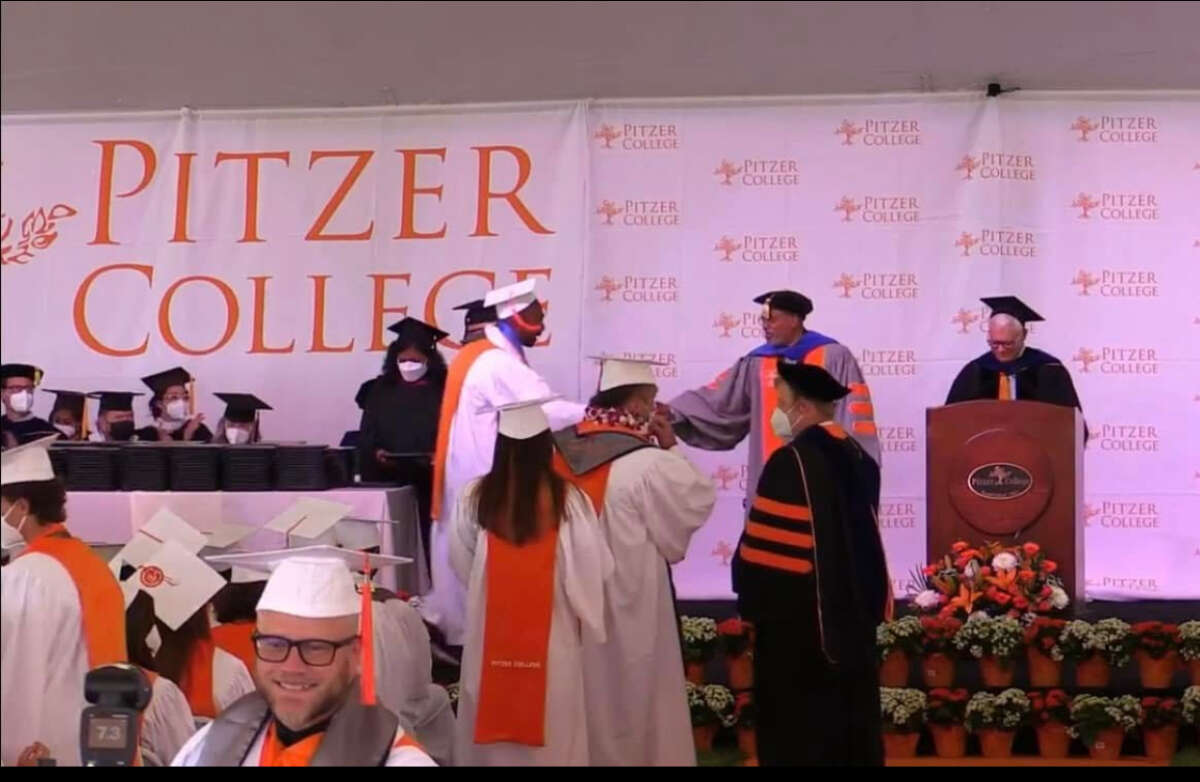
Prior to his release from prison, Butler and his fellow incarcerated scholars relied on support from one another to persevere, excel academically, and transform themselves and their relations with others. The long-held tradition of mutual aid among imprisoned people was a critical part of their educational experience.
Butler said he and other students focused on “being there for each other” while pursuing degrees. “We created study groups,” he said. “And actually, we even created a senator position at the school.”
The “senator position” Butler was referring to was made possible by the fact that incarcerated people who were enrolled in the Inside-Out program won representation in the Pitzer student senate, thereby getting to participate in undergraduate self-governance.
Incarcerated students also meet college students from outside the prison in person as part of the Inside-Out curriculum.
“So that’s a game changer,” Butler said. “Being able to sit in the classroom with traditional college students and realizing that you’re as smart, if not smarter, than some of these college students, I think that gave us a boost and morale to see that we were able to hold our own inside [a] traditional college class.”
I taught a class inside the California Rehabilitation Center back in 2019 within what was at that time called the Norco College Prison Education Program. In writing this article I reached out to some of my former students from that class in addition to other interviewees to hear more about the culture of mutual aid among incarcerated students.
Romarilyn Ralston, founding senior director for the Justice Education Center for Claremount Colleges, taught inside the CRC and also observed the dynamic firsthand. During an interview over the phone earlier this year, she told me the imprisoned undergraduates she teaches are “not only a cohort of intellectuals … They are a brotherhood, and they refer to themselves as a brotherhood.”
The diverse group will often meet outside of class to work on assignments and discuss course material, she said. Some live in the same dormitory inside the prison and can talk regularly, while others connect when they meet in spaces like the recreation field.
“They are ambassadors for the program,” Ralston said about incarcerated students. “They talk the program up. They share the information that they’re learning. They share books. It’s really sweet that they love learning, and they may have a cellie or bunkie or someone that they know in another dorm that they feel would benefit from the materials and the education that they’re receiving, and they share that. I think that’s one of the most beautiful [forms] of mutual aid — but also I think [it’s] a way to encourage others to see higher education as a transformative practice, and inform folks about abolition. And abolition is praxis.”
The CRC is slated to close in the fall of 2026 and become the fifth prison in California to close in recent years, and abolitionists are organizing to see more facilities in the state shuttered. It’s not yet clear what will happen with the Inside-Out program or the UCR LIFTED program after the prison closes.
Testimony from educators and imprisoned men echoes the observations Ralston made, describing a culture of care and communal support inside prison walls that is a less publicly visible aspect of abolitionist praxis — a pedagogical tradition that remains an integral part of the liberatory co-learning experience of incarcerated intellectuals.
Incarcerated Students Educate Each Other
In his astronomy class inside what was then San Quentin State Prison — now the San Quentin Rehabilitation Center — Brian Lenardo, who was a volunteer educator affiliated with the Mt. Tamalpais College (MTC) program, tried to do a flipped classroom approach one term with his instructor team several years ago. With that approach, he recalled, students did readings outside of class and then worked on problem sets and activities in the classroom.
“It was designed around the idea that we would break the students into groups and they would sort of work together, and we would supervise,” he told me back in October 2022. “But there was a lot of teaching of each other going on, and I think we had a great experience. … The more advanced students were really happy to work with the less advanced students and sort of bring people up to speed.”
In the MTC program, according to Lenardo, advanced students could become teaching assistants for classes and assist fellow incarcerated scholars in an official capacity, enriching the educational process for themselves and others. However he said he does not know what, if anything, they received in compensation for that TA work.
Rallie Murray, an academic in California who no longer volunteers for MTC but was once one of Lenardo’s colleagues in San Quentin, said she saw older students encouraging younger ones to go to study hall for help with coursework and to go see tutors.
“I saw peer tutoring happen when there weren’t enough tutors,” Murray, who used to assist students in the Friday morning MTC study hall, said in an interview in October 2022. “I saw some instances where students would fudge the signups so somebody who needed more than 20 minutes could have it. [They would] write their name down underneath the [name of the] person who actually needed it and then, like, just not be there intentionally — because you can spend more time with a person if the one you’re supposed to be meeting with next is late.”
Tu Tran, who is still incarcerated inside San Quentin, shared several years ago that classes in MTC helped him “stay away from all the negativity,” which led to him assisting other students.
“I even volunteer to be a math TA helping others [who also use] education to change their [lives],” Tran added in correspondence circa summer 2022, recounting how he also walked around his building tutoring students during the COVID pandemic lockdown.
Assignments in classes like math, business calculus, and accounting proved challenging for some men enrolled in what was then the higher education program offered by Norco, the local community college, inside the CRC, according to Raymond Luke, who took classes inside the CRC several years ago. Public speaking courses could be hard too, he said, requiring self-expression in a class full of people.
“We helped each other out as much as we could and did a lot of what I want to call ‘mock speeches,’ or ‘mock interviews’…. I may [have] asked somebody to read my paper to see if it doesn’t sound right. ‘Is there anything that I’m missing? Or do I need to add anything?’ We’ll get that feedback like that,” Luke said during a phone interview in early 2023.
Creative Displays of Mutual Aid
While still incarcerated in the California Substance Abuse Treatment Facility and State Prison in Corcoran, Damon Anderson said he and a fellow prisoner realized they had enrolled in the same college class.
“We actually worked together on creating a small business plan for a Domino’s pizza franchise,” Anderson told me on the phone back in 2023.
To lessen the burden that would’ve otherwise resulted if each relied on friends and family on the outside to assist with all the research required, Anderson said he asked his family to research just a portion, and his fellow student asked his family to research the other portion, before the two imprisoned intellectuals sat down together to write the business plan.
Not only do college students in prison share books and course materials with each other, they also do so in coordinated ways under difficult conditions, as Anderson could attest.
When enrolled in a political science class, he said, the prison “cops” were “playing games” and would not issue him his books for the course or provide him with the required college handbook.
“I actually had to have a friend of mine that was doing the same class come over, and I had to go photocopy his handbook, just so I was able to get started on the class and not fall behind,” said Anderson. “Everybody that’s actually taking the time to participate in the college program, we’re all — honestly, no matter what your race, color, creed, I mean — we’re all there to help each other out.”
Collectively Overcoming Barriers to Academic Progress
Persistence is necessary in the face of correctional officers (COs) impeding the higher education goals of incarcerated students, Anderson explained. He added that getting certified as a paralegal was “the best thing” he could have done because he’s used what he learned from that coursework to not only fight for his own rights in prison but for the rights of other incarcerated people as well.
In effect, Anderson became part of the tradition of emancipatory “jailhouse lawyers,” as prisoners who pursue pro se litigation and practice critical legal pedagogy. That tradition includes the late Martin Sostre, an anarchist and prisoner labor union organizer who won landmark cases pertaining to censorship, solitary confinement and due process for those inside while he was incarcerated in the early seventies. More recently, Jailhouse Lawyers Speak, a prisoner-led abolitionist organization, has taken up the mantle of promoting prisoner self-empowerment through collective resistance and liberatory co-education in the arena of law.
Anderson also offered advice for incarcerated students.
“Don’t listen to what they [say] because they’re gonna try to steer you wrong or get you to stop or make it frustrating by not giving you books,” he said, referring to staff within the California Department of Corrections and Rehabilitation (CDCR). “Just be persistent and don’t be afraid to ask for help from other people in your community.”
Drawing on his experience in the community college program inside the CRC a few years ago, Jason Mascio explained that in order to achieve passing grades, prisoners put forth extra effort and found ways to be accountable to each other, cooperatively working around obstacles constructed by CDCR and the penal environment.
“They make it a crooked game,” Mascio wrote in a June 2022 letter in regard to the prison system, adding that some students have to find creative solutions to the obstacles prison creates.
For example, incarcerated students commandeer supplies to complete assignments through “a network of underground activity,” he wrote. That underground network might be just the tip of the iceberg. Luke, who attended classes in the CRC at the same time Mascio did, said men inside referred to “The Community” when he was taking Norco College classes. It was, perhaps, an early iteration of “the brotherhood” of men Ralston came to know in Pitzer’s Inside-Out program.
Ralston said the everyday uncertainty of life in prison presents unique challenges that students have had to overcome. Whether it’s a lockdown that precludes visitors coming in from outside, or someone taking a student’s course materials — and just “not knowing what the prison regime is going to do, from minute to minute,” as she put it — incarcerated scholars face obstacles that are utterly foreign to most students outside.
“It’s scary, because when you enjoy a class, and you’re invested in a class, and you’re building community and trust in these classes, and you want to continue your education on the outside, these classes really become a lifeline,” she said.
Butler, the Inside-Out program alum, said it can seem like the COs and CDCR “are trying to keep their foot on our neck” and don’t want prisoners to be educated.
“The more ignorant people are, the more job security they have,” said Butler, who’s now pursuing a master’s degree at Cal Poly Pomona, where he works as a peer mentor with Project Rebound, an organization that supports higher education pathways for current and formerly incarcerated students. “So that was always the case. They would lock gates while we’re walking to class and try to disrupt the program in any way possible.”
Amos Lee, a founding co-director of UCR LIFTED, a two-year program building on existing community college opportunities to offer students incarcerated in the CRC a BA in Education, Society and Human Development from the nearby University of California, Riverside, shared that one time a course being offered got canceled after the prison went on a multi-day lockdown. Something wholly unrelated to education, like a reportedly missing item from the CRC kitchen, can derail a semester for students inside.
Despite or perhaps because of the challenges, LIFTED students routinely share information and knowledge with each other, Lee noted during a March 2025 interview over the phone.
“If somebody gets a FAFSA form,” he said, referring to the Free Application for Federal Student Aid, the person will then “share that with somebody else to see if they got something similar, just to make sure that they’re all on the same page.”
“They also support a lot of people who are not in the program, who want to get into the program,” Lee added. “They’re giving all this advice all the time to everybody around them, and that’s what I find here.”
Luke, the source quoted above who took classes inside the CRC through Norco College’s program prior to his release from prison, said when COs would confiscate someone’s syllabus or a book for a course, another student in the same class would often share his syllabus or his book.
“We were helping each other out because we wanted to see each other succeed, man,” Luke said in correspondence from a few years ago. “I was able to get to this part where I’m at now, because of going to college,” he told me, noting that his original release date was December 2026. He added that his ability to be released earlier than that was “because of college, because guys have done it for me, gave me work that I needed to see or let me use a book or calculator or notes, or [a] dictionary — many different resources that helped me pass classes in order to get the time off.”
Building Bridges
Individuals enduring segregation also engage in transformative learning together with people not ensnared by the carceral system.
“We’re building this bridge of sorts,” between those outside prison and “people who, some of them have never even touched another human being aside from a CO in violence or a medical person, which sometimes is also super violent, some of them for like 20 years,” Murray said back in 2023.
Constructing that bridge might involve examining a text about prison and engaging in dialogue that compares and contrasts how the students and faculty who aren’t incarcerated understand it with how the prisoner-scholars say they actually experience it, she explained.
“That’s part of how the 2013 and 2011 prisoner hunger strikes kind of came into being … there was convivial learning and there was discussion between an outside university class and inside class,” she said with reference to the collective refusal of sustenance initiated by men in solitary confinement inside the Pelican Bay State Prison Secure Housing Unit. “That created different ideas where people worked together.”
A Subterranean Culture of Care and Community Support
Oftentimes, solidarity and organizing among incarcerated people operates through less overt means than hunger strikes, even as it might create conditions of possibility for future collective action.
Overt and militant collective action “lead to officers writing disciplinary reports,” Michael Baker, a prisoner-scholar, shared from inside the SATF-CSP in Corcoran a couple of years ago.
If he were to engage in it, the parole board would have cause to designate him and the associated organizing gang-affiliated. “I’d never go home,” Baker lamented to me in a June 2023 JPay e-message.
But Baker also acknowledged that “no type of resistance exists without adverse consequences,” and he underscored the under-the-radar ethic of solidarity that, often unbeknownst to authorities and people outside, frequently permeates prisons and communities inside, especially communities of imprisoned scholars.
“[You] would be surprised to know that a separate culture exists in here where we all help one another when it comes to college,” Baker commented. Textbooks and supplies are treated like part of their educational commons.
Since his release, Butler has been working with other formerly incarcerated men from that first cohort to graduate from the Pitzer program to form a mutual aid organization geared toward helping formerly incarcerated people find housing and resources so they can get back on their feet. At the public polytechnic university where he’s pursuing his graduate degree, he and others are also able to assist fellow system-impacted scholars in ways not possible at Pitzer.
Butler and others are working to continue the freedom tradition they became part of before securing their own personal freedom from the carceral system.
“We have our own space,” he said. “When guys come out, they’re able to come here and study, and we help them enroll in schools and things like that to continue their education.”
Urgent Appeal for Your Support
Truthout relies on individual donations to publish independent journalism, free from political and corporate influence. In fact, we’re almost entirely funded by readers like you.
Unfortunately, donations are down. At a moment when independent journalism is urgently needed, we are struggling to meet our operational costs due to increasing political censorship.
Truthout may end this month in the red without additional help. We still need to raise $7,000. Please make a tax-deductible one-time or monthly donation if you can.