Did you know that Truthout is a nonprofit and independently funded by readers like you? If you value what we do, please support our work with a donation.
It’s devastatingly clear that there will be no seat at the table for the youth of Gaza to take part in the negotiations over “Gaza’s future” currently being held by U.S. and Israeli officials.
As U.S. and Israeli officials discuss whether to move forward with the second phase of the ceasefire and draw Gaza’s fate and future on paper — or whether to announce the collapse of the talks and a return to war amid daily violations of the truce — they are not in conversation with youth like my brother Mohammed and me: We embody a future that is being deliberately ignored.
There is no engagement with the youth who studied under bombardment, no voice for the high school students whose determination defied the arrogance of war.
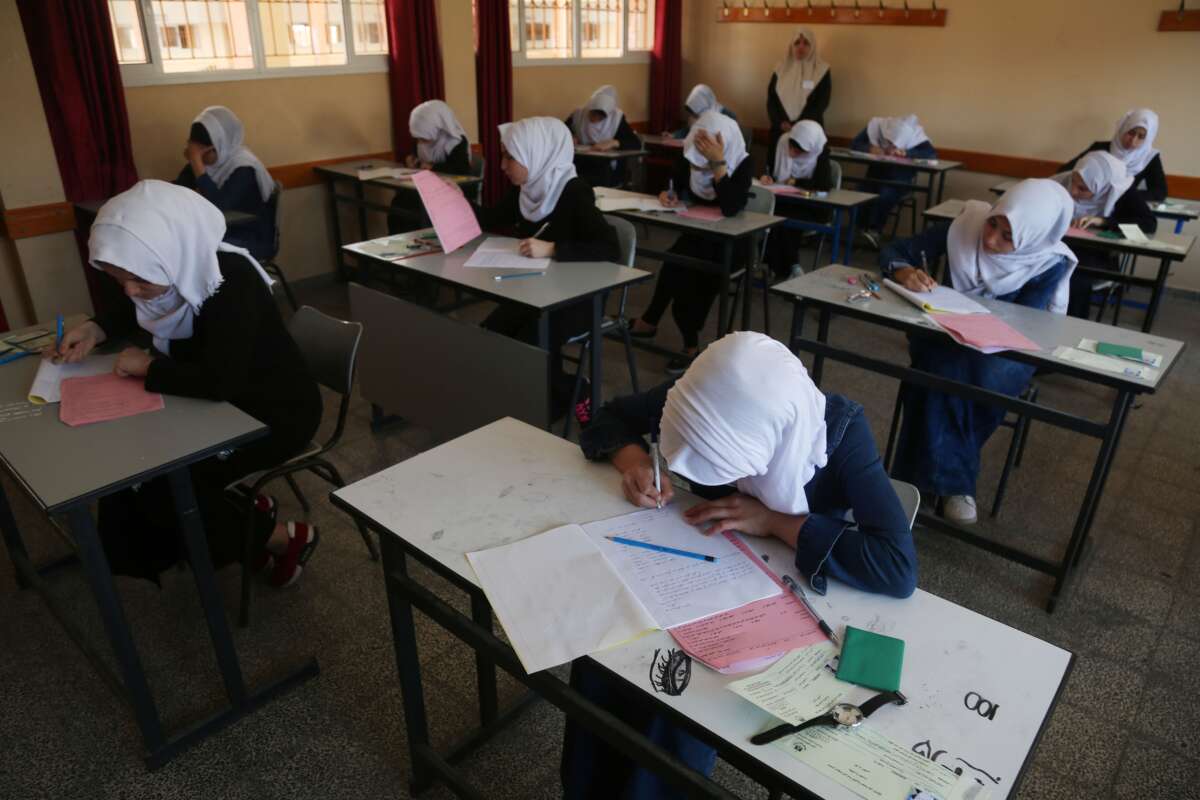
Here in Gaza, where schools have been turned into piles of rubble, young people are rewriting the story of resilience: a story of education practiced as an act of resistance, and hope rising from beneath the ruins.
My brother Mohammed recently managed to achieve one of the highest scores in the high school exams after two years of siege and famine. His story is not just a personal success — it is a testimony to a generation that refuses to surrender, and a call for the world to reconsider the “future of Gaza” now being decided in closed rooms.
Since the morning of October 7, 2023, students across Gaza have been denied their right to education. Schools turned from places of learning into shelters for the displaced — and frequent targets. According to the UN, more than 97 percent of Gaza’s schools have now been destroyed, including those run by UNRWA.
Mohammed, born in 2006, entered his final school year with a sense of hope that felt almost childlike. He and his classmates dreamed of graduation day, of choosing university majors, of a future that once seemed so near — until Israel decided to redraw that future by force.
Mohammed’s dream of earning a high score was replaced by a food aid card and the daily struggle to survive. He once told me: “I study without purpose. It feels meaningless. Have you ever seen a student preparing for high school exams without a school, without a teacher, or even without knowing when the exams will start?”

He watches graduation ceremonies from around the world, and his heart aches. Even the most ordinary things have become impossible in Gaza.
The year 2023 ended, followed by 2024, with no glimmer of hope. Mohammed sank into deep depression, hopelessness, and uncertainty. Nothing reminded him that he was a student — except his torn books, some of which he burned to make fire for cooking. But the hardest moment of all was when his friend Ahmad — a brilliant student who dreamed of being among the top achievers in Palestine — was killed. Mohammed collapsed, tears filling his eyes. He sat alone, crying silently so no one could see.
Ahmad used to review his lessons under the sound of explosions, defying fear and hunger, but the Israeli missile was faster than his dreams. His small body, big dreams, and bright future all were struck down by war — leaving behind a notebook full of equations and a grieving family staring at his books in disbelief. According to the Palestinian Ministry of Education, more than 16,802 students have been killed and over 26,000 have been injured since the war began. It is a genocide that has not only taken lives but also destroyed the dreams of every student who saw education as a window to a better life.
It wasn’t only Mohammed’s generation that lost the dream of graduation — so did the 2007 generation, including my cousin Heba, who was preparing for her final high school year. Heba and her family fled to Rafah when it was overcrowded with displaced people, before the Israeli army invaded it. They lived in a tent that protected them neither from the summer heat nor the winter cold. The air was thick with humidity and smoke, stray dogs barked at night, and strange insects crawled inside their tent. Heba told me: “I wanted to study, but fear, exhaustion, and hunger made it impossible to focus. I stopped thinking about the future — my only thought was: how will we survive today?”
At that time, the Ministry of Education hadn’t yet announced what would happen to students from the 2006 and 2007 classes, leaving them suspended between a devouring present and an uncertain future. Months later, at the end of August, the ministry finally announced that high school exams would take place in September. Despite the enormous challenges, that announcement was a spark of hope — a way to pull students out of despair and isolation.
Mohammed, Heba, and their friends studied through famine: waking at 5:00 am with no milk, no coffee, no gas to heat water, and barely any food — only lentils and pasta cooked over a weak flame. With no electricity, they studied by the light of their phones, under the sound of drones and explosions, with the smell of smoke filling the air.
Most students were homeless, walking long distances to find an internet connection or a lesson at an educational center. Heba recalled sadly: “The hardest thing about studying for the Tawjihi [General Secondary Education Certificate] exams is when you’re focused on a lesson — and suddenly a shell hits nearby. Once, I was attending a class in a building’s ground floor when a missile hit the upper floors. After that, the center closed, and I couldn’t bring myself to go back.”
Her friend Iman lost her home — “my only homeland” — and then her father, just a month before the exams.
“I lost everything. I lived through the worst conditions imaginable. I wished things wouldn’t get worse, but Israel stole even my last sense of safety. Still, I insisted on studying and taking the exams.”
The exams were held amid fears of airstrikes and internet outages. Despite poor connectivity, Mohammed and more than 27,000 Gazan students sat for their tests one by one, their hearts racing and fingers trembling over the mouse.
On October 14, 2025, the results were announced: 94 percent! Mohammed passed with distinction, ranking among the top students and dreaming of studying medicine. We hugged him and cried — not only out of joy for the score, but because something beautiful had finally triumphed over all this darkness.
It was only the second moment of joy we had experienced — after the ceasefire announced on October 9. But as always, Israel stood between us and our dreams: Despite the truce, it resumed attacks on populated areas, calling them “temporary escalations.”
Today, as international negotiations continue over “who will govern Gaza tomorrow,” the voices of Gazans — especially the youth who are Gaza’s future — remain excluded. The Rafah crossing is still closed, Gaza’s only gate to the world, and the universities here lie in ruins, making online study nearly impossible. Mohammed wants to continue his education abroad, to live the true university experience.
Mohammed and his peers — the brilliant students of Gaza — are calling on international institutions and universities that support our cause: Pay attention to them, provide scholarships.
They studied while deprived of the most basic human needs: home, income, safety, family warmth.
They have rewritten the old saying “Seek knowledge even if you must go to China” into a new one: “Seek knowledge — even if you are in Gaza.”
An urgent fundraising appeal: 9 Days to raise $50,000
Thank you for reading Truthout today. We have a brief message before you go —
Unfortunately, donations are down for Truthout at a time when media is under immense pressure. Trump is arresting journalists, Big Tech is censoring independent news, and economic conditions for media have been worsening for years.
Simultaneously, movement media is vital in the fight against Trump’s authoritarian reign. Our mandate to tell the truth, share strategies for resistance, and speak against fascism is ever more urgent in this deluge of political censorship. Yet, we are struggling to meet our publishing costs when our work is so urgently needed.
If you can support Truthout with a one-time or monthly donation, you will make a significant impact on our work. Please give today during our fundraiser (9 days left).