Honest, paywall-free news is rare. Please support our boldly independent journalism with a donation of any size.
Republican lawmakers in Florida have submitted legislation that would ban abortion after 15 weeks of pregnancy, a measure similar to a near-total abortion ban in Mississippi that is currently being upheld by the U.S. Supreme Court.
The ban, which was introduced on Tuesday by State Sen. Kelli Stargell (R) and Rep. Erin Grall (R), contains no exceptions for rape or incest. Individuals would only be allowed to get an abortion after the 15-week mark if their pregnancy puts them at risk of serious injury or death, or if the fetus has a fatal abnormality.
If passed, the measure would create one of the most restrictive abortion bans in the country. Florida currently bans most abortions after 24 weeks of pregnancy.
The proposal, which was submitted on the first day of the Florida legislature’s 2022 session, was inserted quietly into another bill meant to revise the state’s tobacco education and prevention program. In addition to restricting abortion access, the legislation would require medical facilities to report “the number of infants born alive or alive immediately after an attempted abortion” – a measure that gives undue weight to a false narrative pushed by anti-abortion activists.
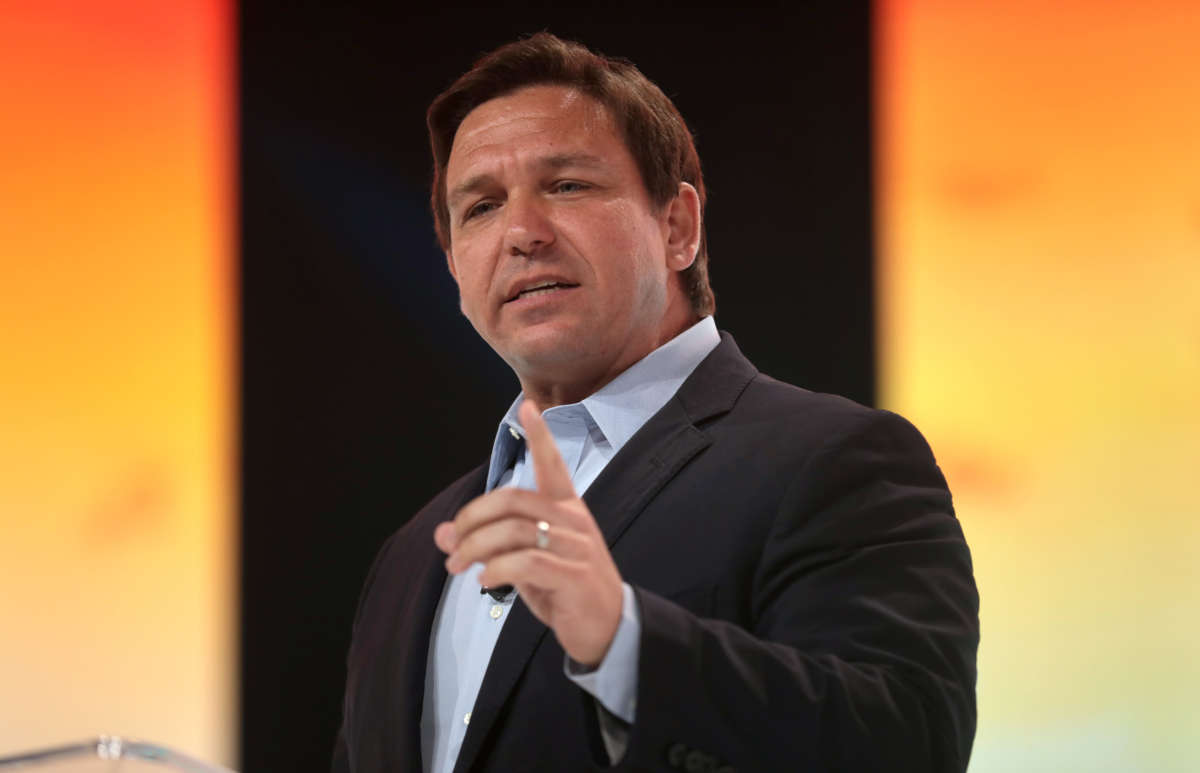
On Wednesday, Florida Gov. Ron DeSantis (R) indicated that he would sign the legislation into law if it landed on his desk. This position was condemned by Democrats, who noted the irony of DeSantis proclaiming Florida to be the “freest” state in the nation during his State of the State speech earlier this year.
“If Florida is truly a free state, free our women and leave them the hell alone,” said Sen. Shevrin Jones (D).
State Rep. Anna Eskamani noted that if the legislation were to pass, the nearest abortion facility for many Florida residents would be two states away, in North Carolina.
“And when you get to North Carolina, you have to go through their 72-hour wait period. So, you can imagine the cost associated with that,” Eskamani said.
The ban would undoubtedly violate the precedent set in Roe v. Wade, the landmark Supreme Court ruling that established abortion access protections throughout the U.S. But the current 6-3 conservative-led Court may be poised to upend those precedents if statements during recent hearings are any indication.
The issue of reproductive justice will likely play a significant role in the 2022 midterms, particularly if the Court makes abrupt changes to the abortion precedent that has been in place for nearly five decades. Most Americans support keeping Roe intact, with an ABC News/Washington Post poll last fall showing that 60 percent of voters supported the ruling, while only 27 percent wanted the ruling overturned.
An urgent appeal for your support: 72 Hours to raise $24,000
Truthout relies on individual donations to publish independent journalism, free from political and corporate influence. In fact, we’re almost entirely funded by readers like you.
Unfortunately, donations are down. At a moment when independent journalism is urgently needed, we are struggling to meet our operational costs due to increasing political censorship.
Truthout may end this month in the red without additional help, so we’ve launched a fundraiser. We have 72 hours to hit our $24,000 goal. Please make a tax-deductible one-time or monthly donation if you can.