
Honest, paywall-free news is rare. Please support our boldly independent journalism with a donation of any size.
The bulk of the money Missouri gives to its crisis pregnancy centers comes from federal funds meant to assist families experiencing poverty with basic necessities and child care, Republican Rep. Jason Smith said on the U.S. House floor in January.
As many as $3 of every $4 for pregnancy centers in Missouri was from the federal Temporary Assistance for Needy Families program in 2024, and in the 2026 fiscal year, it will be $2 out of $3. The amount of TANF funding has steadily increased since 2022, from $4.3 million then to $10.3 million in fiscal year 2026.
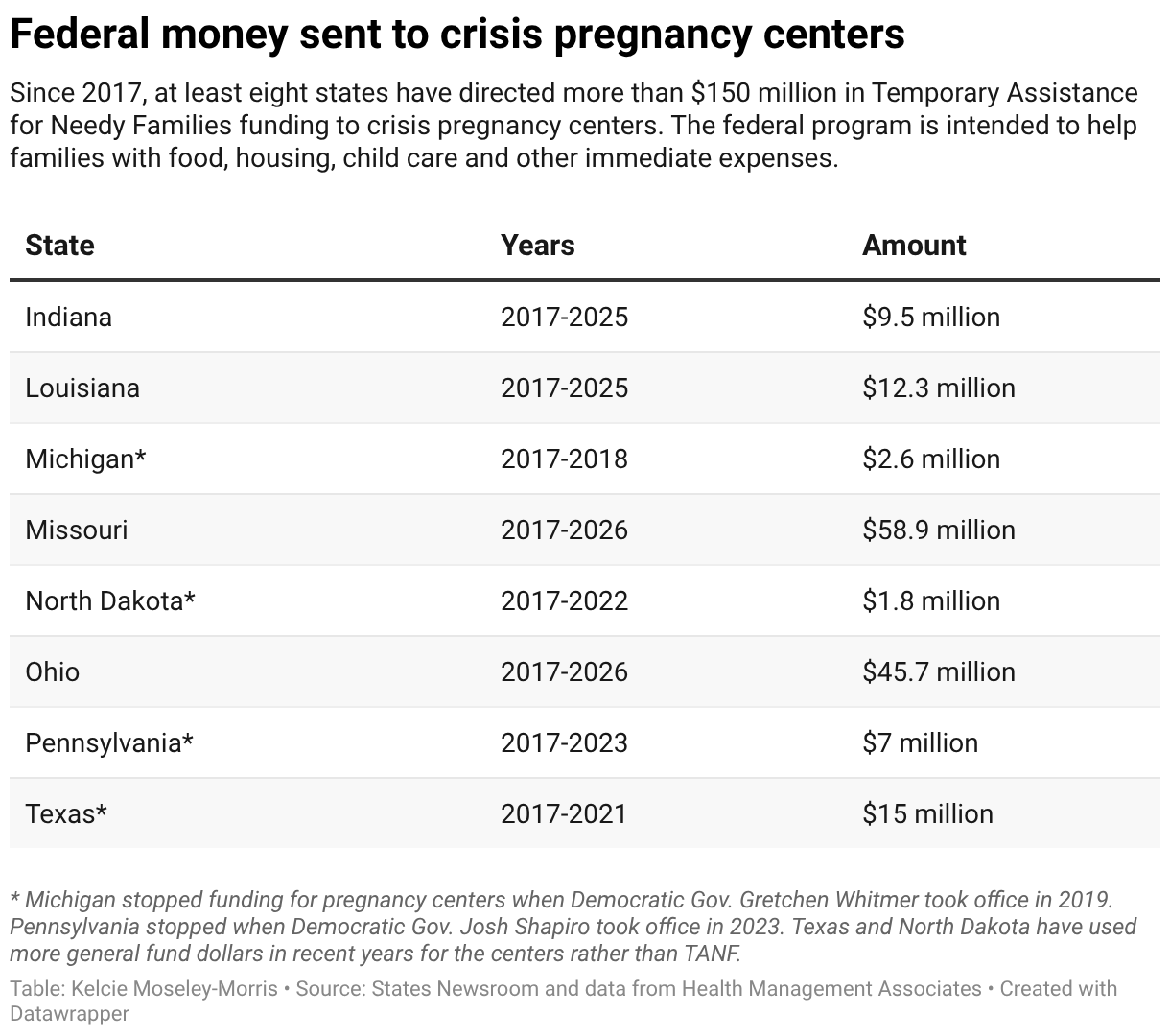
At least eight states have given TANF funds to crisis pregnancy centers in recent years, even before the U.S. Supreme Court overturned federal protections for abortion rights in 2022. According to data from the consulting firm Health Management Associates, more than $102 million from TANF went to the centers in those eight states between 2017 and 2023, including $22.5 million in Ohio, $11.75 million in Indiana and $12 million in Texas.
The federal government gives TANF funds to each state as a lump sum, and states get to decide how to spend it. There are broad rules for how the funds can be used, but federal law specifies they should assist with facilitating housing or employment; prevent and reduce “out-of-wedlock pregnancies”; and help form and maintain two-parent families. The U.S. House passed a bill in January that would explicitly lay out that crisis pregnancy centers can be a recipient of the funds. It hasn’t been taken up by the Senate yet.
Diana Rodin, associate principal at Health Management Associates, said block grants like the ones associated with TANF can be used broadly, and there isn’t much oversight after the funds are distributed.
“You have some states that might say in their state plan, ‘We are spending this much on our Alternatives to Abortion program,’ but there’s some states where it’s going to them (crisis pregnancy centers), but there’s nothing you can find,” Rodin said.
Conservative advocacy groups and lawmakers say anti-abortion crisis pregnancy centers provide many free goods and services and are deserving of TANF funds.
Former Democratic President Joe Biden’s administration proposed regulatory changes that would have required states to show how allocations to pregnancy centers accomplished the purpose of TANF but withdrew them in early January 2025, shortly before Republican President Donald Trump was sworn in.
On the House floor, Smith said that if the Biden administration had been successful, it would have been detrimental. Yet most crisis pregnancy centers do not provide any medical services beyond nondiagnostic ultrasounds and do not provide prenatal care from physicians.
“Think of what would’ve happened to maternal care in this country,” Smith said. “One of the few places women can get care and support would have been closed.”
More Money on the Way
Crisis pregnancy centers are nonprofit organizations, often affiliated with religious groups, that have a mission of preventing people from terminating a pregnancy. A nationwide States Newsroom analysis found that 21 states funneled nearly a half-billion dollars in public money to crisis pregnancy center organizations between 2022 and 2025, and more in the form of tax credit programs. That figure did not include the millions in TANF distributions allocated by those eight states.
More pregnancy centers are also tapping into federal sources, such as grants for abstinence-only education programs, teen pregnancy prevention, and U.S. Housing and Urban Development funds.
Medical organizations, including the American College of Obstetricians and Gynecologists, object to the misleading and deceptive practices of many pregnancy centers. Federal audits have also shown that some are not properly managing the public funds they receive.
Two centers in California and Washington identified in States Newsroom’s analysis doubled the amount of grants received for abstinence-focused sex education programs in the past two years, according to federal records. In Louisiana, the Department of Children and Family Services shifted $2.26 million in TANF funds to its pregnancy center grant program for fiscal year 2026 after lawmakers cut the program’s state funding by the same amount because more than two-thirds of it went unused, according to a recent state audit.
Millions more in federal dollars are likely to be accessible if the Trump administration changes rules for Title X family planning funding, as it did during the first term in 2019, allowing organizations to receive funds without offering birth control. Under current rules, Title X requires clinics to prescribe birth control and provide other family planning services to low-income populations for free or at low cost. Most pregnancy centers do not prescribe or refer for birth control, which is considered an essential aspect of reproductive health care by the medical community.
Clare Coleman, president and CEO of the National Family Planning and Reproductive Health Association, said she and her staff are prepared for the administration to propose a rule change that would allow providers to not offer or refer for birth control, abortion or other family planning services as a condition of receiving the funding.
“We’re expecting it any day now,” she said.
Crisis pregnancy centers and other anti-birth control organizations will be better prepared to apply for the funding if the change is adopted, Coleman said. “And that’s not something our folks really had to deal with before, so we’re quite concerned.”
Audit Finds Mismanagement
Federal records show millions of federal dollars flow to crisis pregnancy centers under the Title V Sexual Risk Avoidance Education program, which focuses on abstinence and relationship development for teens. Some states apply for the grant dollars, but individual organizations can also apply for a portion of the funding in a competitive award process.
A major recipient is The Obria Group and its affiliates, including RealOptions in California. Obria, a chain of pregnancy centers that offers some medical services like testing and treatment for sexually transmitted infections, operates largely in states with strong protections for reproductive rights. Those states typically do not provide state funding for pregnancy centers, but the centers have tapped into federal funding. Under the first Trump administration, Obria received a $1.7 million grant from the Title X program, with the possibility of two more years of funding for a total of $5.1 million, despite Obria’s unwillingness to provide birth control.
Obria did not respond to a request for comment from States Newsroom.
RealOptions has received nearly $4 million in Title V funding for an abstinence-only education program since 2020, federal records show, including $900,000 in 2024 and 2025 — double the amount received in prior years.
A routine federal audit published in October found RealOptions had placed more than $127,000 of the funding in the wrong budget year. The company did not have adequate policies and procedures for ensuring federal awards were tracked, according to the audit, and RealOptions also failed to complete a form detailing how grant funds were spent as required by law.
In their findings, auditors said the lack of sufficient oversight on the funds created a “high risk” that the company would be out of compliance with federal regulations, and the errors would not be caught or corrected in a timely manner.
RealOptions did not respond to questions from States Newsroom about the audit.
Sex Ed Funding
In Washington state, a crisis pregnancy center called Life Choices of Yakima runs a program with abstinence-focused funding called Think Twice Yakima. It has received at least $335,000 per year in Title V federal funding for the program since 2019, and partners with several local schools to administer the curriculum. In early December, the website included the logo of the Washington State Department of Children, Youth & Families in a list of its partners.
When States Newsroom reached out to the state agency to ask about the partnership, spokesperson Nancy Gutierrez said it was not a partner, and the organization was asked to remove the logo, which it did.
Life Choices of Yakima did not respond to a request for comment from States Newsroom.
Like many of the abstinence programs, Life Choices uses a curriculum from the Dibble Institute, a nonprofit organization in Berkeley, California, that provides a spectrum of sex education materials for licensing. Kay Reed, president and executive director of the institute, said clients include Planned Parenthood and centers like Life Choices, as well as various universities and colleges. The Dibble Institute recently released an abstinence-only curriculum to align with executive orders from the Trump administration.
The funding, Reed said, dates back to former President George H.W. Bush, a Republican.
“It’s been around a long time, and it’s part of the push and pull between Republicans and Democrats,” she said.
But the curriculum has grown more restrictive now than with prior administrations, Reed said, pushing for abstinence only “until marriage.”
Federal Housing Dollars
Other crisis pregnancy center groups are moving into less common areas of federal funding. Georgia Wellness Group received $450,000 from U.S. Housing and Urban Development block grant funds in July to help build a maternity home in the Atlanta area. County commissioners approved the grant despite vocal opposition from community members, who called it a fake clinic and alleged it deceives people about its true anti-abortion intentions.
At a public hearing in August, Georgia Wellness CEO Robin Mauck said the grant will be used to purchase a residential home to accommodate up to six women and their children for up to eight months after birth. In January, the group applied for nearly $636,000 in new HUD grant funding for the 2026 cycle, which is under consideration by the county.
The organization used to be affiliated with The Obria Group, a national chain of crisis pregnancy centers that has been criticized for its practices, including by a former leader of the organization. Mauck said at the August hearing that it was a relationship they used to help them “transition to prenatal care.”
In addition to the HUD dollars, Georgia Wellness Group received more than $1.27 million from the Title V Sexual Risk Avoidance Education program between 2021 and 2023, and another $445,000 in 2024. U.S. Rep. Lucy McBath, a Georgia Democrat, helped the organization apply for the federal funding that year with a letter of support, when it was still affiliated with Obria Medical Clinics. The program received another grant of the same amount in 2025.
Attorneys for Georgia Wellness Group sent cease-and-desist letters to people for tying them to Obria during public hearings and for saying the group misleads patients about the services they provide. One of those letters was sent to Allison Glass, state campaign director for the Amplify Georgia Collaborative, a group of reproductive rights advocacy organizations. She shared a copy with States Newsroom.
“There’s a huge housing need in Georgia, and especially around Atlanta, for affordable housing, but that should not come with the shame and deception,” Glass said. “They are so good at being so deceptive about who they are and truly what kind of services they provide and what credentials they have, that they really have unfortunately been able to really dupe a lot of stakeholders and decision-makers in Georgia.”
Glass said this is the first time she and other advocates know of in which a crisis pregnancy center has received HUD funding.
Mauck did not respond to a request for comment from States Newsroom.
The group is one of few crisis pregnancy centers that says it has medical professionals who are fully licensed and overseen by a board-certified OB-GYN, offering many more health services, including breast and cervical cancer screenings, sexually transmitted infection testing and treatment, and prenatal care. But Georgia Wellness does not list birth control as an offered service, only IUD removal.
A former medical director for the organization, Dr. Marc Jean-Gilles, has said the clinic is misleading people about its ability to provide obstetrical care, because it does not have admitting privileges and patients are told to seek emergency services elsewhere when they are in labor. He also said surrounding hospitals refuse to coordinate care with the organization because of alleged unethical practices. Those statements were read aloud at the August public hearing to approve the first installment of HUD funding.
Jean-Gilles told States Newsroom in February that he has no problem with the organization receiving HUD funding if they are using it to shelter people, but from a patient safety standpoint, he said all clinics providing prenatal care should be able to coordinate with local hospitals.
“My whole take is, it doesn’t matter if you’re a crisis pregnancy center or not. I think when you delve into the realm of prenatal care and delivery, if you can’t provide a provider who’s going to deliver … then you’re doing a disservice to the patients,” Jean-Gilles said.
Grant Adams, a staff member at Georgia Wellness, said any allegations that the organization misleads anyone about its clinical capabilities are false, as are claims that the youth outreach program is “abstinence only.” During the August public hearing, Adams, who teaches the program to Atlanta-area middle and high school students, said the curriculum includes “medically accurate information about contraception” and tells young people about the risks of early sexual activity so they can make healthy decisions.
“It doesn’t matter how loud a claim is made, that doesn’t make it true. It doesn’t matter how often a claim is made, that doesn’t make it true,” he said.
Stateline reporter Anna Claire Vollers contributed to this report.
This story is part of a reporting fellowship sponsored by the Association of Health Care Journalists and supported by the Commonwealth Fund.
Media that fights fascism
Truthout is funded almost entirely by readers — that’s why we can speak truth to power and cut against the mainstream narrative. But independent journalists at Truthout face mounting political repression under Trump.
We rely on your support to survive McCarthyist censorship. Please make a tax-deductible one-time or monthly donation.