Support justice-driven, accurate and transparent news — make a quick donation to Truthout today!
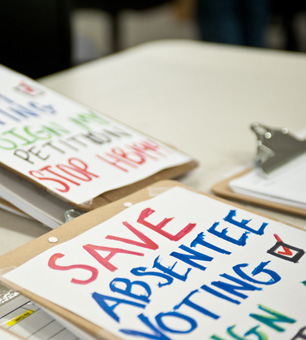
A unanimous panel of the United States Court of Appeals for the Sixth Circuit affirmed a lower court’s decision striking down Ohio’s recent law limiting early voting. Although the panel divided on its reasoning, all three judges concluded that the law has serious constitutional deficiencies. The majority opinion was written by Judge Eric Clay, a Clinton appointee, and joined by Judge Joseph Hood, a George H.W. Bush appointee.
As the facts of this case demonstrated, cutting off early voting will endanger many voters’ ability to cast a vote:
Plaintiffs introduced extensive evidence that a significant number of Ohio voters will in fact be precluded from voting without the additional three days of in-person early voting. The district court credited statistical studies that estimated approximately 100,000 Ohio voters would choose to vote during the three-day period before Election Day, and that these voters are disproportionately “women, older, and of lower income and education attainment.” The district court concluded that the burden on Plaintiffs was “particularly high” because their members, supporters, and constituents represent a large percentage of those who participated in early voting in past elections. The State did not dispute the evidence presented by Plaintiffs, nor did it offer any evidence to contradict the district court’s findings of fact. Plaintiffs did not need to show that they were legally prohibited from voting, but only that “burdened voters have few alternate means of access to the ballot.”
The State argues that the burden on non-military voters is slight because they have “ample” other means to cast their ballots, including by requesting and mailing an absentee ballot, voting in person prior to the final weekend before Election Day, or on Election Day itself. However, the district court concluded that because early voters have disproportionately lower incomes and less education than election day voters, and because all evening and weekend voting hours prior to the final weekend were eliminated by Directive 2012-35, “thousands of voters who would have voted during those three days will not be able to exercise their right to cast a vote in person.”
If the state chooses to appeal this decision, it may appeal either to the full Sixth Circuit or to the Supreme Court. Currently, Republican appointed active judges outnumber Democratic appointees 10-6 on this court (although one of the Bush appointees is the product of a deal with Democratic senators), and the Sixth Circuit does have a record of handing down ideologically divided decisions in cases that could impact presidential elections. Judge Hood, the Bush appointee who joined today’s opinion, is a district court judge on temporary designation to the appeals court and would not join the full panel of judges should it be convened.
Nevertheless, there is one reason why the Sixth Circuit’s judges may stay their hand if the state asks for the case to be heard by a larger panel. In 2008, the court divided almost entirely on partisan lines to side with an Ohio Republican Party effort that could have prevented as many as 200,000 registered voters from having their votes counted. That decision was smacked down by the Supreme Court just three days later.
Disclosure: The author of this post clerked for Judge Clay in 2007–08.
A terrifying moment. We appeal for your support.
In the last weeks, we have witnessed an authoritarian assault on communities in Minnesota and across the nation.
The need for truthful, grassroots reporting is urgent at this cataclysmic historical moment. Yet, Trump-aligned billionaires and other allies have taken over many legacy media outlets — the culmination of a decades-long campaign to place control of the narrative into the hands of the political right.
We refuse to let Trump’s blatant propaganda machine go unchecked. Untethered to corporate ownership or advertisers, Truthout remains fearless in our reporting and our determination to use journalism as a tool for justice.
But we need your help just to fund our basic expenses. Over 80 percent of Truthout’s funding comes from small individual donations from our community of readers, and over a third of our total budget is supported by recurring monthly donors.
Truthout has launched a fundraiser, and we have a goal to add 182 new monthly donors in the next 24 hours. Whether you can make a small monthly donation or a larger one-time gift, Truthout only works with your support.