Honest, paywall-free news is rare. Please support our boldly independent journalism with a donation of any size.
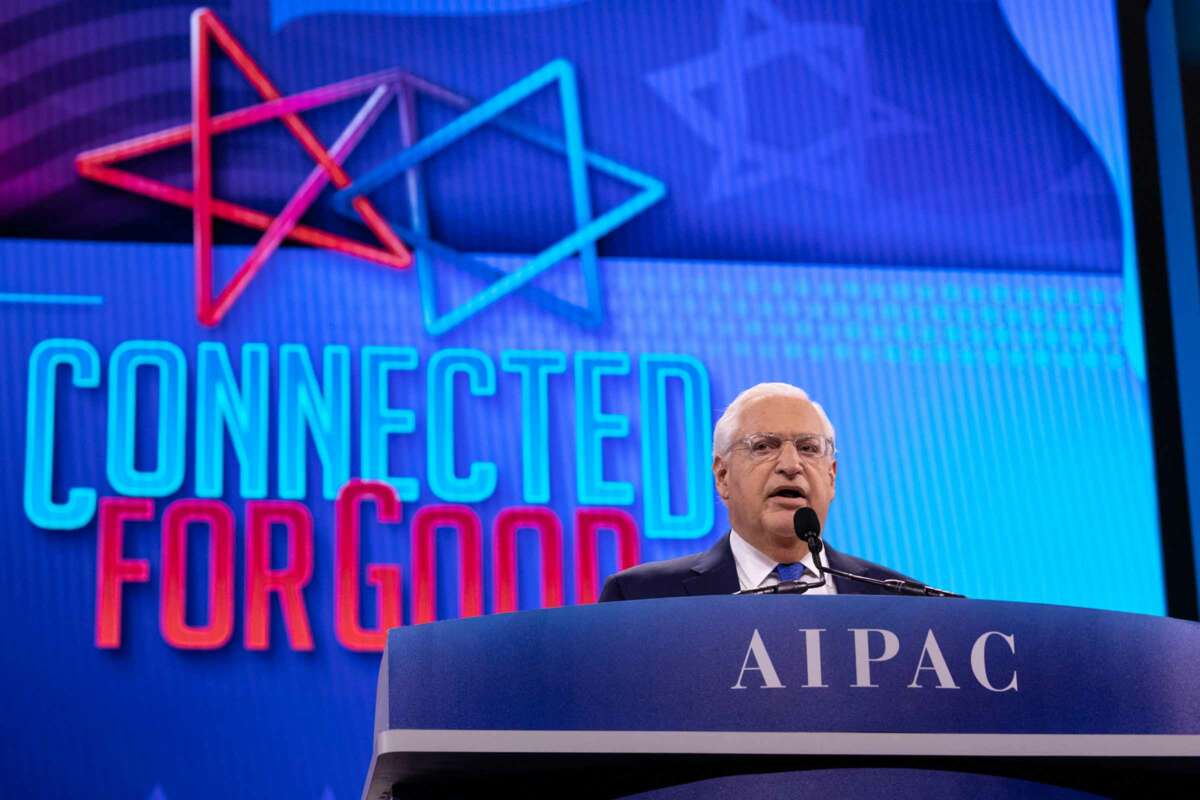
The American Israel Public Affairs Committee delivered more than $3.7 million in November to the campaigns of U.S. lawmakers, the most it has ever doled out in a single month, according to a new filing with the Federal Election Commission.
The American Israel Public Affairs Committee (AIPAC) has been working to convince members of the U.S. Congress to send more aid to Israel for its war against Hamas and to support primary challengers against representatives and senators who it sees as not sufficiently supportive of Israel’s response to the October 7 Hamas attack.
The largest recipient of AIPAC’s campaign support in November, which came by way of its PAC, was New York Democrat Rep. Ritchie Torres, who was profiled by the New York Times in November as an example of a young Democratic politician who has sided firmly with Israel, as opposed to those in the so-called “squad” of progressives who have spoken critically of the country’s military actions. AIPAC sent Torres more than $201,000 in donations from its PAC in November, according to the filing.
Torres was one of 22 Democrats who voted with Republicans to endorse a resolution censuring squad member Rep. Rashida Tlaib (D-Mich.) for “promoting false narratives” about the October 7 Hamas attack and “calling for the destruction of the state of Israel.” About a third of Torres’ November haul from AIPAC was received by his campaign the day after he voted for the resolution.
AIPAC’s donations were made through its political action committee, which functions as a conduit for the group’s backers. Individual donors use AIPAC’s PAC to earmark portions of their funds to particular campaigns. This arrangement allows AIPAC to make PAC donations to campaigns that are far larger than the $5,000 per election limit that most PACs must abide by under federal guidelines.
Several other Democrats who voted to censure Tlaib were among the top recipients of AIPAC funds in November, including Florida Rep. Debbie Wasserman Schultz ($141,058), New Jersey Rep. Josh Gottheimer ($61,176), and Florida Rep. Lois Frankel ($33,050).
The second-largest recipient in November of AIPAC donations was House Minority Leader Rep. Hakeem Jeffries (D-N.Y.), an ally to Israel. Jeffries has rejected the idea of conditioning how Israel can use the $4 billion in aid it receives annually from the U.S., even as the country moved to reform its judiciary system in ways that critics label undemocratic. Jeffries has repeatedly emphasized his support for Israel throughout its military response in Gaza, saying at a November rally, “Congress will continue to support, in a bipartisan way, the state of Israel and Israel’s unequivocal right to exist as a Jewish and democratic state, always and forever.” AIPAC sent Jeffries just more than $200,000 in November.
Many Republicans also benefited from AIPAC’s donations in November. Among the top recipients were California Republican Rep. Ken Calvert ($99,226), the Speaker of the House Rep. Mike Johnson ($98,336), and Texas Republican Michael McCaul ($98,026), who is chairman of the House Committee on Foreign Affairs. Alabama Republican Mike Rogers, the chairman of the House Armed Services Committee, received over $52,000.
In early November, the House of Representatives passed a Republican bill that would provide Israel with $14.3 billion in aid, with the funding coming from a rescission of the Internal Revenue Service’s budget. On November 14, the Senate voted to table a Republican attempt to vote on the House bill. In early December, the Senate failed to advance a $110 billion package of funding for Israel and Ukraine. Last week, the Biden administration bypassed congressional approval of a $147 million weapons sale to Israel, the second time it had taken such a step that month.
AIPAC’s PAC has already made more than $18 million in campaign contributions in the 2023-2024 campaign cycle, according to the Federal Election Commission. The lobbying group made its first direct contributions to campaigns in late January 2022, although other organizations with ties to AIPAC, such as the Democratic Majority for Israel super PAC, had been spending money to influence elections.
In addition to PAC donations, AIPAC launched a super PAC in 2022 called United Democracy Project that has spent millions of dollars opposing Democrats who it views as not sufficiently pro-Israel and backing those who it considers reliable allies. According to a recent report by Slate, unnamed “close watchers” expect AIPAC to spend at least $100 million in 2024 Democratic primaries, with much of the spending focused on challenging squad representatives.
Important Message: Please Read
For 25 years, Truthout has survived by publishing impactful investigative journalism and analysis; distributing full editions 365 days a year; and building a community of readers who support us with small, hard-earned donations.
Eighty percent of our $3 million yearly budget comes from small donors alone. Of those, 8,000 readers support us with monthly donations. Back in 2018, when Facebook decided to suppress the circulation of posts made by organizations, thereby cutting readers off from seeing many articles shared by the news organizations they had intentionally decided to follow, Truthout’s total traffic declined by 40 percent, as nearly all of our traffic from that platform disappeared.
Now, Google has recently rolled out its AI search bar, providing AI summaries instead of directing readers to our site. Google Search is our single largest source of traffic; it’s the route by which nearly one third of our readers find us. Much like in 2018, a shocking 40 percent of our Google traffic has disappeared overnight.
It will not be easy for Truthout to shoulder this blow. Nor will it be easy for our peers and collaborators — news sites that depend on traffic and aren’t bankrolled by large corporations.
If you can support Truthout with a donation today, you can help us resist the AI onslaught. Please give today.