Did you know that Truthout is a nonprofit and independently funded by readers like you? If you value what we do, please support our work with a donation.
When another concrete batch plant was proposed a few years ago in Aldine, Texas, local environmental organizers drew more than a hundred people to a state environmental agency’s public meeting to oppose the polluting plant. Concrete production is clustered around Aldine, a north Houston neighborhood. For decades, the industrial process has blanketed the community with harmful dust that can cause heart and respiratory issues or exacerbate conditions like asthma. Heavy-duty trucks bring even more fumes and noise pollution to the nearby neighborhoods.
Despite the crowd, initially almost no one wanted to register to voice their opposition and be in the spotlight, said Leticia Gutierrez, the government relations and community outreach director for environmental justice nonprofit Air Alliance Houston. A sign-up sheet, asking for names and addresses, was enough to cause fears among the predominantly Hispanic community about Immigration and Customs Enforcement (ICE) being able to track down undocumented family members.
So Gutierrez took to the microphone and announced in Spanish, “I’m an immigrant, too. I know you’re scared, I know it’s difficult,” Gutierrez said she told the attendees. “But if you don’t sign up to speak, the people here will genuinely think you’re in favor of this permit.”
Finally, residents started lining up to register, with the line wrapping around the podium. As they began providing public testimony about the impacts of pollution from the plant, the company realized that it had lost the battle for public opinion. It pulled its permit application in the middle of the meeting.
“Everybody started cheering,” Gutierrez told Prism. “It showed us the power that we have.”
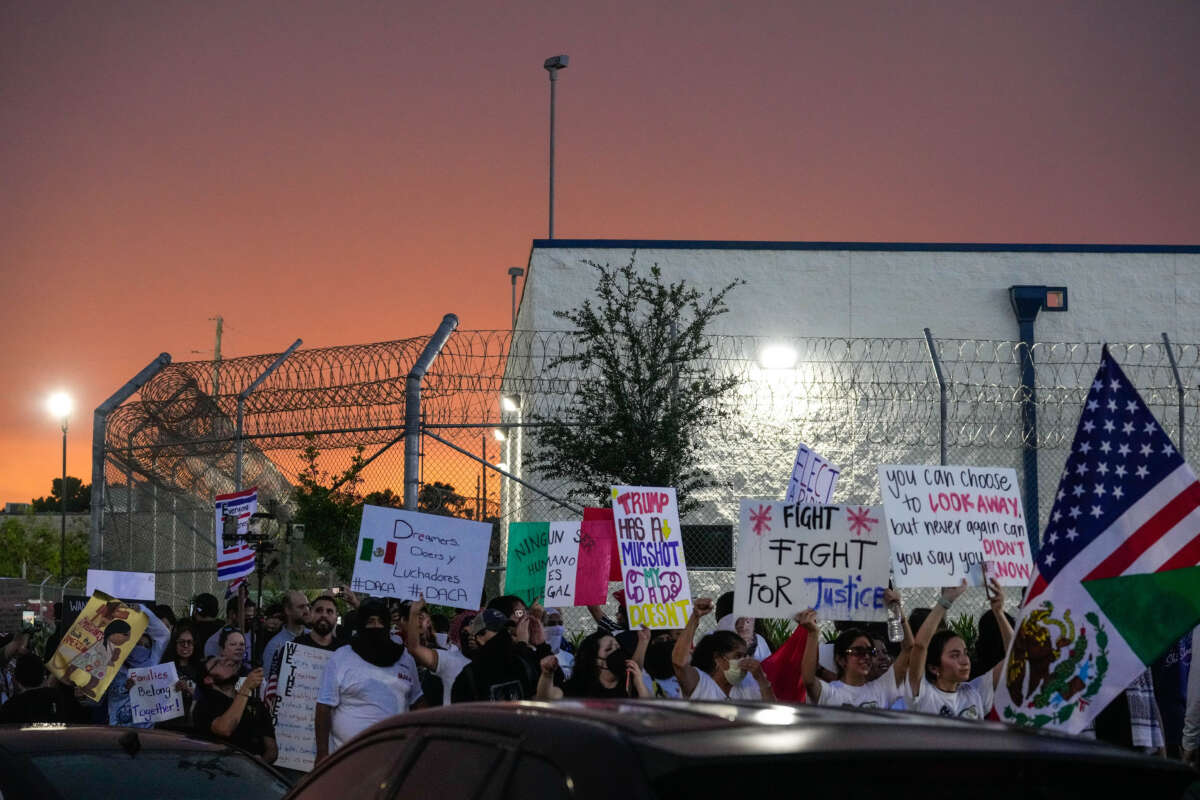
But years later, months into the second Trump administration, that energy has noticeably waned, Gutierrez said. Immigrant communities once again face deep-seated fears about being harassed, detained, or deported by ICE as thousands are caught in the net of Trump’s promise of “mass deportations.” Meanwhile, the Trump administration has also rolled back crucial air pollution standards and climate policies in recent weeks, a move that will create savings for power plant operators and other polluters, while directly harming the health of people living closest to those plants. But now, noncitizens may no longer feel safe showing up to fight these policies even through the small-scale, day-to-day battles of permit hearings and county or city meetings.
This spring, as it has for the past few years, Air Alliance organized an advocacy day at the state Capitol, which is in session. Two years ago, approximately 120 people attended, taking a bus from Houston to Austin. This year, turnout was lower.
“We saw a lot of pushback from the Hispanic community. It was just, ‘No, we’re not going to put ourselves in a situation where there are armed guards at the Capitol,’” Gutierrez said.
It was disappointing for the organization, she said, since showing up in numbers at the Capitol has provided more leverage in past years. “Our representatives know it’s not just me speaking, it’s the other 150 people that I brought last week.”
In recent months, immigration agents, often masked, have arrested and detained undocumented people at court hearings, school drop-offs, and in one case, shortly after a mother gave birth. The agency has, under many administrations, separated children from their parents, and denied people contact with lawyers and family members.
And some high-profile cases seem politically motivated, as well: In early March, ICE agents arrested Mahmoud Khalil, a graduate student at Columbia University who had become the face of the campus’ Palestine activism. In Washington State, a well-known farmworker advocate and union organizer, Alfredo Lelo Juarez Zeferino, was arrested during a traffic stop that same month.
“Someone cannot be punished for making a comment at a meeting,” said Veronica Garcia, an attorney with Immigrant Legal Resource Center (ILRC). She’s held a series of “Know Your Rights” trainings in California, and organizers from a broad swath of fields have expressed concerns about safety and the risks that people might face if they show up at a public meeting. “Everything happening at the [federal level] is an intentional tactic to create this fear, so that people stop participating in things,” she said.
Long before the Trump administration ramped up ICE raids, it has always been an uphill battle to make public processes accessible and engage immigrants.
“A lot of people have mixed status families; maybe their aunt is a citizen but their uncle isn’t,” said Dominic Chacón, an environmental organizer with Texas Campaign for the Environment, who grew up in El Paso. Polluting industries are concentrated in lower-income, predominantly Spanish-speaking neighborhoods in the city.
Grassroots campaigns often rely on tactics such as block-walking and door-knocking so that organizers can meet residents and educate or notify them about policy issues affecting them. But for years, getting someone to open the door was nearly impossible in neighborhoods in border towns, Chacon said. “The assumption is that if you’re showing up, you could be ICE or Border Patrol.”
In Austin, grassroots group Go Austin/Vamos Austin (GAVA) has found ways to incorporate vulnerable immigrant voices in its organizing efforts around issues such as climate resilience, displacement, and food justice in predominantly Latino neighborhoods.
GAVA collects testimony on behalf of community members who can’t show up to city hall or county hearings — due to work schedules, for example — and plays audio or video at hearings. Sometimes, volunteers or neighbors will read the comments, too.
“It’s a tactic to keep those voices elevated when people can’t or don’t feel comfortable coming,” said the group’s executive director, Carmen Llanes. “We’ve always had to be adaptable to support representation. We’ve had to organize really hard for things like language access in public meetings, for remote access during COVID, and even after.”
Barriers to public engagement have recently emerged. There’s an increased security presence at Austin City Hall, which now requires people to sign in at the front desk, citing concerns about crime downtown.
“Nobody wants to go through that if they feel like they will be profiled,” Llanes said.
Austin Mayor Kirk Watson has also implemented new rules that limit civil disobedience, Llanes said. “We used to stand behind people to support them, because it’s scary when you’re up there talking. And now, the mayor won’t allow people to do that.” Advocates have also been barred from holding up signs unless they stand in the back of the room, Llanes said, limiting the ability to create strong visual protests that don’t thrust a specific person into the spotlight.
“These aren’t rules, they are customs,” she said. City officials should implement policies that reduce fear around public participation instead of exacerbating them, she said.
A spokesperson for the City of Austin told Prism in an email that the mayor “often reminds speakers and others in attendance that they cannot hold signs up in front of other members of the public and, if standing, must congregate at the back only so as not to block the view of other participants.” City ordinances only outline general prohibitions, such as threats, violence, or blocking entrances to meeting rooms.
At the state level, Gutierrez said that agencies shouldn’t ask for more information than necessary. “There’s no law that says you have to fill out your address. They don’t need your full name,” she said. “They can take a zip code if they want to know that you live in the vicinity, and how this impacts you.”
Garcia, the lawyer from ILRC, said there is no requirement for anyone to disclose immigration status in order to provide public comments. If someone is asked about it directly, they should exercise their right to silence, she said. Garcia also advised organizers to think carefully about the documents or information they carry with them on their phones and laptops. “You can’t be compelled to open your phone and give access, there is a process for that. But maybe if you’re traveling, you don’t carry those devices with you,” she said.
Despite the newfound challenges, environmental justice groups know they must continue on, with greater awareness of their communities’ needs.
“As an organization, we have to find ways to ensure that our communities don’t lose hope. That’s when we lose,” said Genesis Granados, an advocate with Air Alliance. “The harder it is for communities to participate, the easier it is to side with the industry.”
Prism is an independent and nonprofit newsroom led by journalists of color. We report from the ground up and at the intersections of injustice.
An urgent appeal for your support: We Have Until Midnight to raise $10,000
Truthout relies on individual donations to publish independent journalism, free from political and corporate influence. In fact, we’re almost entirely funded by readers like you.
Unfortunately, donations are down. At a moment when independent journalism is urgently needed, we are struggling to meet our operational costs due to increasing political censorship.
Truthout may end this month in the red without additional help, so we launched a fundraiser. We have until midnight tonight to hit our $10,000 goal. Please make a tax-deductible one-time or monthly donation if you can.