Honest, paywall-free news is rare. Please support our boldly independent journalism with a donation of any size.
Alan Cowell had an interesting piece in The New York Times on Nov. 14 contrasting public attitudes toward austerity now with attitudes toward the austerity that was the norm in postwar Britain — and beautifully described by the late Tony Judt. As Mr. Cowell notes, one major difference is that back then the sacrifice was shared: “Before he died of Lou Gehrig’s disease in 2010, the historian Tony Judt recalled childhood days just after World War II in a debilitated Britain that was slowly ceding its empire and its pre-eminence. ‘Clothes were rationed until 1949, cheap and simple “utility furniture” until 1952, food until 1954,’ he wrote in a memoir, concluding that austerity in ‘that bare-bones age’ was ‘not just an economic condition: it aspired to a public ethic.’ ”
Mr. Cowell continued: “As it confronts its massive debt problem … Europe seems to have lost sight of the fact that it has been there before; that the baby boom generation found its roots in postwar hardship; that, as Mr. Judt suggested, the huge affluence of more recent years could barely have been imagined as people struggled to shake off the gloom of war.”
But there are some other differences, arguably even more crucial.
First, postwar Britain had rationing; material consumption was depressed; but it had full employment, according to British historical statistics. This is enormously important. All the evidence I’ve seen says that the psychological cost of unemployment is much greater than the loss of income. (And I know people who are comfortably fixed for money, but deeply depressed over their inability to find a job.) That’s why it’s so dumb to say, as some do, that things aren’t so bad in the United States right now because per-capita consumption is still high by historical standards.
Second, postwar austerity in Britain was driven by real, obvious limits on resources. In particular, foreign exchange was in short supply. At a basic level, people knew why things were rationed: Britain had spent heavily on the war, so it had to scrimp to pay its bills.
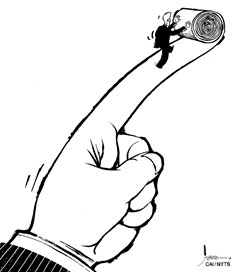
Today, by contrast, austerity is being imposed because men in suits say that it’s necessary to satisfy the invisible gods of the financial market.
It’s understandable that the public is beginning to have its doubts, and not just because those invisible gods somehow demand sacrifices only from workers, never from the wealthy. For the fact is that those men in suits have no idea what they’re doing — a fact that was apparent to some of us early on, but is now becoming common knowledge.
And so if you want to contrast the stoicism of the postwar populace with the anger and confusion of today’s voters, don’t blame consumerism; blame our leaders, who have imposed gratuitous, unfair pain on their constituents — and their constituents are finally starting to figure it out.
Truthout has licensed this content. It may not be reproduced by any other source and is not covered by our Creative Commons license.
Paul Krugman joined The New York Times in 1999 as a columnist on the Op-Ed page and continues as a professor of economics and international affairs at Princeton University. He was awarded the Nobel in economic science in 2008.
Mr Krugman is the author or editor of 20 books and more than 200 papers in professional journals and edited volumes, including “The Return of Depression Economics” (2008) and “The Conscience of a Liberal” (2007). Copyright 2011 The New York Times.
Media that fights fascism
Truthout is funded almost entirely by readers — that’s why we can speak truth to power and cut against the mainstream narrative. But independent journalists at Truthout face mounting political repression under Trump.
We rely on your support to survive McCarthyist censorship. Please make a tax-deductible one-time or monthly donation.