Democrats in Congress Need to Go Bolder, Not Backwards
The just unveiled “Better Deal” agenda features a job-training proposal that demands less from CEOs than the job-training proposal Bill Clinton ran on.
House Minority Leader Nancy Pelosi answers questions with US Sen. Bernie Sanders, Senate Minority Leader Chuck Schumer and Rep. John Yarmouth during a press conference at the US Capitol May 23, 2017, in Washington, DC. (Photo: Win McNamee / Getty Images)
Support justice-driven, accurate and transparent news — make a quick donation to Truthout today!
House Minority Leader Nancy Pelosi answers questions with US Sen. Bernie Sanders, Senate Minority Leader Chuck Schumer and Rep. John Yarmouth during a press conference at the US Capitol May 23, 2017, in Washington, DC. (Photo: Win McNamee / Getty Images)
The Democratic Party’s congressional leadership has just unveiled a new slogan — and set of policy proposals — to help the party prep for the 2018 midterm elections
The slogan — “A Better Deal” — has underwhelmed just about everyone outside of the Democratic Party’s congressional leadership. The actual policy piece has fared only a little bit better.
This policy piece includes three initial specific policy prescriptions, and all three arguably take “the side of working people,” the goal the Senate’s top Democrat, New York’s Chuck Schumer, has spelled out for the “Better Deal” effort. Average Americans would without question be better off if Congress made pharmaceuticals cheaper, expanded on-the-job training, and cracked down on corporate mergers that pad the pockets of investors and raise prices for everyone else.
Few Americans are going to oppose policies like these. But the release of the “Better Deal” seems to have few Americans up and cheering either. One media outlet has already dubbed the new policy set’s launch a “box-office dud.”
Why so little enthusiasm around this “Better Deal”? The timidity of the package may be one reason. Take the “Better Deal” position on job-training, for instance. The “Better Deal” plan proposes tax credits for businesses that create new training opportunities. Nothing particularly exciting here.
In fact, Democrats a quarter-century ago campaigned on a much bolder approach to job training. In 1992, Bill Clinton ran for President on a policy platform — “Putting People First” — that proposed making companies that employ over 50 people spend at least 1.5 percent of their payroll on training.
Clinton, once elected, never made much of a move to advance the “Putting People First” agenda into law. That left the political momentum with right-wingers. They derided ideas like the job-training mandate as “absurd.” Businesses don’t need regulatory mandates to do the right thing, as the conservative Chicago Tribune argued. “Farsighted companies,” the paper went on, will spend more on worker job training and prosper. “Shortsighted companies” will spend less and fail.
That smug, right-wing line prevailed, and today, 25 years later, the absurdity of this conservative stance could hardly be plainer. “Farsighted companies” seem to have largely vanished off the US corporate scene. “Shortsighted companies” — those that underinvest in the job training and R & D that leave corporations more productive — now dominate Corporate America.
Trump’s Worst Colluding?
These “shortsighted companies” are registering record profits, not despite but because they’re shortchanging tomorrow. The dollars they could be investing in making enterprises more effective and efficient over the long haul are instead going for high-finance gimmicks like share buybacks, a maneuver designed to artificially jack up corporate stock prices and enrich corporate execs in the process.
Many of these same executives have been busy pushing the mergers that the “Better Deal” so rightfully denounces. And still other top execs, those who lord over the pharmaceutical industry, have been pushing the unconscionable prescription drug price hikes the “Better Deal” also blasts.
But the “Better Deal” never links all these phenomena, never zeroes in on the greed grab of our corporate executive class that’s driving corporations to squeeze working Americans at every turn, be that squeezing come via disinvestment in training or job-killing mergers or outrageous price gouging.
This corporate executive class is, in effect, waging class war against working Americans, and this class war offensive is, if anything, intensifying. Working Americans are understandably hungering for a politics daring enough to launch a counter-offensive. The architects of the “Better Deal” haven’t delivered that politics.
No Tax Money for Excessive CEO Pay
What would that sort of politics propose on the policy front? One example: We’ve learned again and again over recent decades that outrageously generous rewards for top corporate executives only serve to give these top execs an incentive to behave outrageously. These execs will do virtually anything to pump up their share prices and inflate their own personal compensation. They’ll merge and purge. They’ll gouge consumers. They’ll underinvest.
Over in the UK, the Labour Party under Jeremy Corbyn has awakened to this new corporate reality. Labour is now calling for a new 2.5 percent corporate tax on any executive pay that runs over 20 times the national living wage and a 5 percent tax on executive pay that runs over 20 times the national median wage.
The Labour Party also wants to deny government contracts to companies that pay their top execs over 20 times what their lowest-paid workers are making.
Bold proposals like these helped propel the Labour Party to an unexpectedly strong and robust finish in this past spring’s national parliamentary elections. In the UK, the buzz — the excitement — has clearly shifted to the Labour side of the aisle.
Could the Democratic Party ever become so bold? Only if the party feels enough pressure to do better than the “Better Deal.”
Media that fights fascism
Truthout is funded almost entirely by readers — that’s why we can speak truth to power and cut against the mainstream narrative. But independent journalists at Truthout face mounting political repression under Trump.
We rely on your support to survive McCarthyist censorship. Please make a tax-deductible one-time or monthly donation.
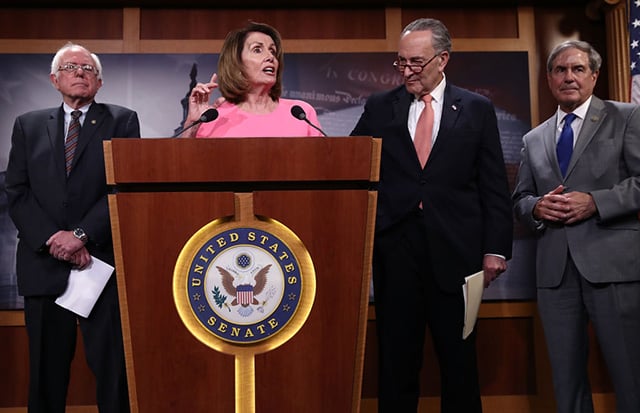
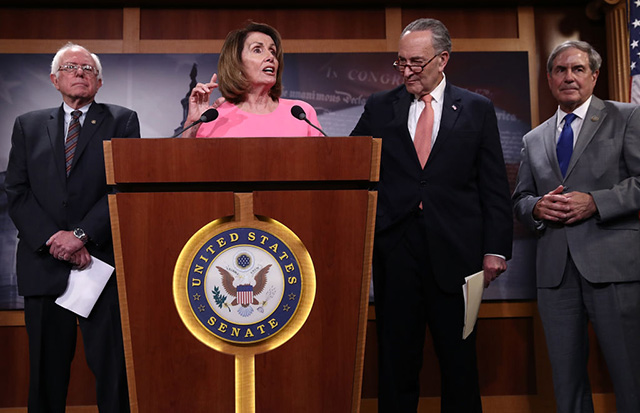 House Minority Leader Nancy Pelosi answers questions with US Sen. Bernie Sanders, Senate Minority Leader Chuck Schumer and Rep. John Yarmouth during a press conference at the US Capitol May 23, 2017, in Washington, DC. (Photo: Win McNamee / Getty Images)