Did you know that Truthout is a nonprofit and independently funded by readers like you? If you value what we do, please support our work with a donation.
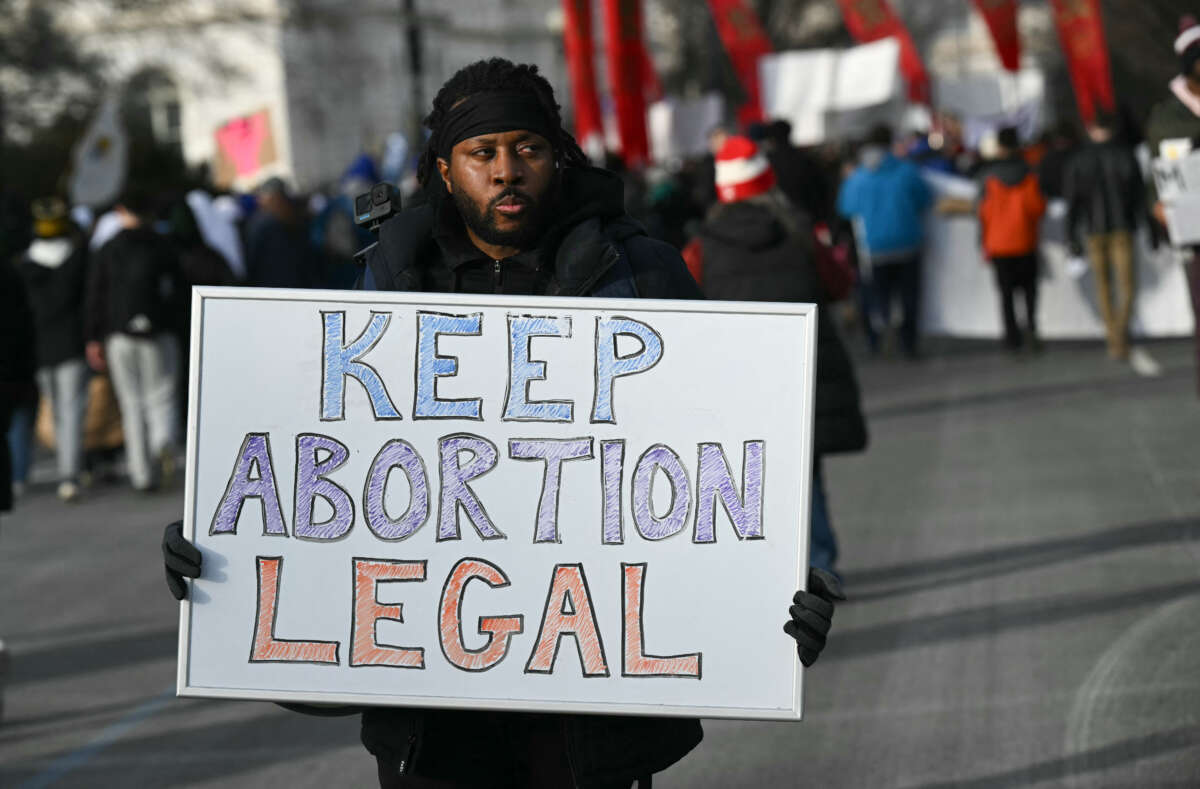
In the aftermath of the Dobbs v. Jackson Women’s Health Organization Supreme Court decision that overturned Roe v. Wade, there has been increased movement toward criminalization of abortion.
The Fifth Circuit Court recently ordered the Food and Drug Administration (FDA) to rescind guidance permitting the use of telemedicine for mifepristone, one of the two medications used for medication abortion. The US Supreme Court on Monday announced a one week stay on the Fifth Circuit’s order, once again allowing the FDA to permit telemedicine abortion. This legal battle is ongoing. Abortion pills remain legal in the United States. It is clear, however, that attempts to eliminate telemedicine abortion are part of a movement to ban and even criminalize abortion at the federal level.
Multiple states have explored legislation that would define abortion as homicide. A new federal bill calls for people having miscarriages (which often occur on the toilet) to use “catch kits” to prevent water contamination, with criminal penalties for failure to do so. Arrest cases where people have been accused of self-managing abortions seem to pop up on national news outlets every few weeks.
The “criminalization of pregnancy” is a legal phenomenon where, but for the fact of a person’s pregnancy, there would be no crime. Despite the recent uptick in interest, pregnancy criminalization is not new — it was alive and well even when Roe was in place. In some states, like Alabama, pregnancy-related arrests have become widespread, formalized, and routine. The criminalization of abortion is only one example of pregnancy criminalization. There are others. For example, testing positive for a drug is not generally considered a crime, except maybe when the person is pregnant. Rejecting a course of medical treatment is generally considered a fundamental constitutional right, not a crime, unless the person is pregnant. Harming yourself is generally not considered a crime, unless, sometimes, when you are pregnant.
There are lessons to be learned from over 40 years of pregnancy criminalization.
The Pregnancy Police Rely on Stigma
Most pregnancy criminalization doesn’t involve abortion. In most cases, people were arrested for drug use during pregnancy. Well over a thousand people have been arrested and charged with crimes against their own pregnancies after they tested positive for drugs. Myths like the so-called “crack baby” drove a moral panic about the alleged harms of substance use during pregnancy that targeted impoverished Black people for punishment — think: “fetal personhood” and eugenics meets the “war on drugs.” The moms were depicted as selfish and irresponsible — the antithesis of what mothers should be. The population of babies were described almost like damaged beings who would sap the social welfare system and grow up to be inherently violent. If something wasn’t done, the myth alleged, they could bring on the downfall of the United States.
Some reproductive rights organizations and advocates contributed to the stigma, using the specter of drug-damaged babies flooding the foster care system to argue in favor of abortion access, ignoring the unjust realities of substance use disorder and child removal. This even occurred during the oral arguments for the Dobbs case, when Solicitor General Elizabeth Prelogar, who was arguing in favor of abortion rights, responded to Justice Clarence Thomas’s inquiry about criminal child neglect charges to pregnant drug users by saying: “we are not denying that a state has an interest there […] Roe recognized that states have interests that exist from the outset of pregnancy.”
Other reproductive rights groups steered clear of the issue. Many dismissed pregnancy criminalization as a racism issue, a drug issue or a criminal legal system issue separate from reproductive autonomy. Since the 1980s, states were passing laws and building precedents that would establish the fetus as a person in the criminal code.
When Health Care Providers Act Like Cops, People Avoid Health Care
While it is true that your electronic footprint — period-tracking apps, text messages, social media posts, search histories, geolocation information, credit card transactions — can be used as evidence to prosecute you, you have to get “caught” first. Most pregnancy-related arrests start when a health care provider decides to report them to the authorities, either to child protective services or directly to law enforcement, based on an understanding that the pregnant person has abused the fertilized egg, embryo, or fetus they carry. In my own study of pregnancy-related arrests in South Carolina, Alabama, and Tennessee, 77 percent of criminal cases originated with a health care provider report. This is troubling for a number of reasons. Not only have these health care providers abdicated their ethical obligations to their patients, but when health care providers act like cops, people avoid health care.
This is not good for the health and well-being of pregnant people or their babies. In my own research I found people giving birth unassisted in motel bathrooms, in abandoned houses, and in one case, on the side of the road (she was fleeing her home state while in labor, hoping to give birth in a state where she was less likely to be charged with a crime).
People have died preventable deaths because of this fear. For example, in 2022, a 41-year-old Black woman named Candi Miller wanted an abortion because she had health issues that could make pregnancy dangerous. Georgia had recently passed a law banning abortions early in pregnancy, so Candi ordered abortion pills online. While self-managed abortion using pills is very safe, sometimes follow-up care is needed. That’s what happened to Miller. Afraid that she would get in trouble if she went to the hospital, and worried that she would be denied care because of the law, Miller languished at home and died.
While pregnancy criminalization is still relatively sporadic in Georgia, Miller’s fears were not unsubstantiated. More recently, a nurse reported a 31-year-old Black woman to the police for allegedly taking abortion pills. While it is not clear if she actually took the pills or if she had a spontaneous miscarriage, she was arrested and charged with homicide.
Prosecutors Are Making the Law
One of the biggest changes in the post-Roe legal landscape is an increased effort at the state and federal level to criminalize abortion — not only for the person performing the abortion, but for the pregnant person too. These bills are outrageous, dangerous, and are becoming more common around the country.
However, you don’t need a law explicitly criminalizing pregnancy to criminalize pregnancy. For example, last November, a 20-year-old Black woman in South Carolina was arrested after she gave birth at 27 weeks. She was accused of taking abortion pills to end her pregnancy. She was charged with attempted murder and unlawful neglect of a child. While we don’t know if she actually took abortion pills, we do know that self-managed abortion is not a crime in South Carolina. In fact, the week the news of her arrest broke, the South Carolina legislature rejected a bill that made self-managed abortion a crime. The fact that taking abortion pills was not a crime in South Carolina was literally a current event, but this didn’t stop the authorities from arresting and charging her.
Sometimes, prosecutorial shenanigans in individual cases end up formally criminalizing pregnancy. Alabama makes a compelling example. In 2006, a new law was passed creating the crime of chemical endangerment of a minor. The law was framed by fears of children in clandestine meth labs, and made it a crime to have children in environments where controlled substances are being used or produced. The law says nothing about pregnancy or about fertilized eggs, embryos, or fetuses. Despite this, soon after it was enacted, a few prosecutors around the state started using this law to charge pregnant people with felonies when they tested positive for drugs during pregnancy or birth. This practice spread around the state, and hundreds of people were arrested and charged for endangering their pregnancies. Eventually, appeals brought the charges before the State Supreme Court, which found the charges to be legally sound. Now, despite the state legislature refusing to criminalize a pregnant person’s actions with regard to their own pregnancy, Alabama has become the nation’s leader in pregnancy criminalization, with some arrests being made as early as six weeks of pregnancy.
In Alabama, pregnancy-related arrests are now common, frequent, and widespread. When I interviewed district attorneys in Alabama who were among the first to bring these charges, they argued that the law is whatever they can get away with. While some of them would have been more comfortable working with a clear criminal law, they felt confident enough to proceed. It appears that some prosecutors around the country are hoping to accomplish something similar with self-managed abortion. We cannot let them.
What Can We Do?
Fighting the criminalization of pregnancy will require a multi-tiered approach, both inside and outside of institutions, from grassroots organizing to working with elite stakeholders. There are so many ways to push back against the pregnancy police, and there is a place for everyone in this fight.
District attorneys are major drivers of pregnancy criminalization. In most states, these are elected positions. Some DAs refuse to prosecute these cases out of the knowledge that prosecutions will only harm maternal and infant health. Voters should make sure district attorneys who pursue prosecutions, and judges who support these prosecutions (particularly without a sound legal foundation to do so), know of their opposition.
While many health care providers have likely been instructed to make reports by hospital attorneys, reporting pregnant drug users and patients who are suspected to have self-managed abortions is only legally required in a few states. Even when these reports are legally required, health care providers should be reminded of their ethical obligation to protect their patients. Reporting patients to law enforcement is harmful, and we have not yet seen a case of a health care provider getting in trouble because of their failure to report pregnancy “crimes.” Health care providers should be mindful of their decision to drug test their patients, which is almost always done as a form of evidence collection instead of as a part of medical care. Health care providers should also be mindful about what they choose to write down on a patient’s chart. Remember: Anything written on a medical chart can become evidence in a criminal case.
Finally, we need to exercise more compassion and understanding for pregnant folks. Talk to your friends, family members, and loved ones. Urge reproductive rights organizations to get out of their silos and stop playing respectability politics. Push elected officials to respect the full humanity of people with the capacity for pregnancy. Don’t share names or mugshots of people who have been arrested and charged with pregnancy crimes.
We must also examine our own internalized stigma toward pregnant people who don’t live up to societal ideals. Instead, offer support, care, and an open mind. Remember that pregnancy does not upend a person’s humanity, and the basic dignity that all people deserve. Together, we can build something better.
Important Message: Please Read
For 25 years, Truthout has survived by publishing impactful investigative journalism and analysis; distributing full editions 365 days a year; and building a community of readers who support us with small, hard-earned donations.
Eighty percent of our $3 million yearly budget comes from small donors alone. Of those, 8,000 readers support us with monthly donations. Back in 2018, when Facebook decided to suppress the circulation of posts made by organizations, thereby cutting readers off from seeing many articles shared by the news organizations they had intentionally decided to follow, Truthout’s total traffic declined by 40 percent, as nearly all of our traffic from that platform disappeared.
Now, Google has recently rolled out its AI search bar, providing AI summaries instead of directing readers to our site. Google Search is our single largest source of traffic; it’s the route by which nearly one third of our readers find us. Much like in 2018, a shocking 40 percent of our Google traffic has disappeared overnight.
It will not be easy for Truthout to shoulder this blow. Nor will it be easy for our peers and collaborators — news sites that depend on traffic and aren’t bankrolled by large corporations.
If you can support Truthout with a donation today, you can help us resist the AI onslaught. Please give today.