
Part of the Series
Struggle and Solidarity: Writing Toward Palestinian Liberation
Truthout is a vital news source and a living history of political struggle. If you think our work is valuable, support us with a donation of any size.
In the fall of 2023, Peyrin Kao was teaching one of his giant computer sciences (CS) courses — classes with a capacity cap of 800 people that students often compete to enroll in, hoping to springboard six-figure careers in the tech industry. Kao had completed his formal lectures for the semester when he projected an announcement onto the classroom’s screen. “At this point, C16B lecture is over, and you are free to leave. Anything I say from this point onwards is solely on behalf of myself, and I don’t speak for CS16B staff, the EECS Department, or the university.”
After repeatedly informing students that they could leave the lecture hall at any time, Kao projected six photographs depicting scenes of protests for Palestine, and began to describe the Israeli assault on Gaza as it had transpired in recent weeks, from his own perspective. He told students that he had been spending his weekends learning about Gaza and the Israeli assault.
“I don’t know if you’ve been following the news or whatever,” Kao addressed his students, “but the scenes coming out from Gaza just like, break my heart, man.” Kao described the news that he knew his students may have scrolled past without pause: “They’ve been bombing hospitals, they’ve been bombing schools, they’ve been killing journalists, children, women.”
Kao’s approach was casual and emotional, not based on his professional expertise. Rather, he spoke to students from the standpoint of an ordinary person in the U.S. trying to understand the depth of injustice and violence Palestinians in Gaza face, from the notion of the “open-air prison” that names the entrapment of the people of Gaza, to the Israeli obstruction of food, fuel, and resources such as electricity and internet connectivity that had already increased the lethality of Israel’s assault. He also told students the risk he was taking in delivering this lecture: “I know they’re coming for my job.”
By the time of Kao’s “After Lecture,” the then five-week-long Israeli decimation of Gaza, including mass casualties and injuries, had already shocked the world. As the Palestine Chronology records, on November 17, 2023, the date of Kao’s presentation:
The Gaza Ministry of Health was not able to update the casualty figures due to a collapse in services and communications at hospitals in northern Gaza, leaving the death toll at 11,479, including 4,630 children and 3,130 women, and around 32,000 injured in Israeli airstrikes on Gaza since 10/7. At least 3,250 people were missing in rubble, including 1,700 children.
After broadly sketching the current state of the assault, Kao brought the incomprehensible violence home to students by drawing the connections between their lives and the architecture of genocide. “One thing I’ve heard from a lot of people which really resonated with me is that we are not free until Palestine is free,” he said. “So what does that mean? Well, I think you can interpret it lots of different ways. I’m not going to tell you how to interpret it, but to me, what it means is that all of our struggles are interconnected.”
“I feel solidarity with the Palestinian people. I feel that they give me the bravery to say this as an educator, and I hope they give you the bravery to go out and take a stand for things like this and do what’s right.”
Kao went on to touch upon themes that reveal the common ground between the facilitation of Israel’s genocide, and life for UC Berkeley students in computer science. He began with a discussion of the AI facial recognition technology and social media platforms that students themselves might one day contribute to creating — thanks to Kao and his colleagues’ underpaid teaching labor — that are currently used to identify and criminalize Palestine protesters, and to spread disinformation. Kao then named the link between Berkeley CS students’ overpriced, overcrowded public university education, and the tax dollars being “funneled into sending bombs to other countries so they can bomb children in hospitals.”
Kao concluded his lecture that day with a call for students in computer science to attend to the world and to bravely do the right thing:
I just want to remind you that that power comes with a lot of responsibility. I really hope that when you go out, you remember that even though maybe CS on the surface doesn’t seem connected to all of this, it is all connected. I feel solidarity with the Palestinian people. I feel that they give me the bravery to say this as an educator, and I hope they give you the bravery to go out and take a stand for things like this and do what’s right.
Kao posted the audio of this lecture on YouTube not long after, and a year later, this comment was added: “As a student in this class who lost my entire family in Gaza. 22 members, 6 children under the age of 5. My family name is expunged from the civil registry. This means so much to me. God bless you.”
This comment points to a hidden reality on Berkeley’s campus, as on so many others: When speech about Palestine has been smeared as “antisemitic” and prohibited, an entire constituency of students has likewise experienced the silencing of their grief, which is too often bypassed even in the discourse of social justice. Palestine is here at UC Berkeley, as well as there, in the ongoing Israeli genocide in Gaza.
Students in STEM fields have since been inspired to collectively organize, following Kao’s challenge to them to find methods for practical solidarity and to focus on the genocide in Palestine.
On UC Berkeley’s campus, we soon founded our chapter of Faculty and Staff for Justice in Palestine and began to raise a collective voice, in concert with Students for Justice in Palestine and additional student groups, calling for campus boycotts of Israel, and demanding that the UC divest from its investments in the genocidal state. Since then, as we have repeatedly made this demand, the UC president, the regents, and the administration of UC Berkeley themselves have all refused these calls to action and obstructed our right, as a campus community, to make them.
In their most recent and most notorious maneuver, the UC administration turned over the names of students, staff, and faculty, 160 of them at UC Berkeley, including Peyrin Kao, to the Trump administration, as it continues its extralegal persecution of Palestine activists.
Israel’s genocide in Gaza has proceeded unabated for the nearly two years since Kao spoke before his students. Like so many in the Palestine solidarity movement, Kao has not stopped, but has escalated his actions in solidarity with Palestinian people. As the 2025 school year began, Kao announced publicly that he would be putting himself on a starvation diet of 250 calories per day, the average nutrition accessed by Palestinians in Gaza. Currently, Kao’s independently run course website lists the two classes he’s teaching — an 800-seat course and a 700-seat course, with the disclaimer: “Apologies in advance if I’m in poor health during lectures. I’m currently undergoing a starvation diet in support of https://www.instagram.com/berkeleyeecs4palestine/.”
Since launching his hunger strike, Kao continues to teach his courses, while appearing at in-person events on campus, posting videos and social media content daily, and advocating for BDS and also for direct support for Palestinian people through mutual aid.
Students in STEM fields have since been inspired to collectively organize, following Kao’s challenge to them to find methods for practical solidarity and to focus on the genocide in Palestine. Their newly minted organization, Berkeley EECS/STEM for Palestine, and their current campaign, a fundraiser to directly support refugees streaming into Deir al-Balah, take action in an attempt to reverse the circuit that Kao first elucidated in the fall of 2023, provoking a question: Instead of contributing to the genocide of the Palestinian people, how could students in STEM fields collectively and materially enact resistance to it?
Instead of contributing to the genocide of the Palestinian people, how could students in STEM fields collectively and materially enact resistance to it?
Kao is now on day 36 of his starvation diet. In the midst of his campaign, I asked him to take some time to explain, from his perspective, all that has transpired. This interview has been lightly edited for clarity.
Brooke Lober: Before we get into the genocide in Gaza that your action is focused on, can you just share — how does it feel to be on this starvation diet, and what’s it like teaching and also organizing with our campus community for you now?
Peyrin Kao: It’s exhausting. Every day, I have trouble getting out of bed, using the bathroom, or standing up for extended amounts of time. But my experience is nothing compared to what the people of Gaza have been going through. I have a bed to sleep in every night. I don’t have to worry about being displaced or bombed. I don’t have to watch my children and loved ones starve in front of me. I don’t have to drink contaminated water with no access to clean toilets or medical facilities.
The reason I continue teaching and organizing through the hunger strike is because people in Gaza don’t have a choice to stop their work. The heroic doctors, journalists, and teachers in Gaza continue their work every day, even as they themselves are starving. I’ve heard reports of doctors working 24-hour shifts in Gaza hospitals and collapsing from hunger while trying to save lives.
We’ve been witnessing what a lot of people have called the world’s first live-streamed genocide for 23 months now. But I first heard you speaking out on this issue in November 2023. How did you know then that a genocide was underway so early on? And why did you respond in the way that you did?
Western propaganda media notwithstanding, it was plainly obvious from October 7, 2023, that a genocide was unfolding. Then-Defense Minister Yoav Gallant famously said “We are fighting human animals,” and that was just one of many dehumanizing statements made in the opening days of the war (not to mention the many “no innocents in Gaza” statements made before October 7).
I sometimes get asked why I’m not similarly outspoken about other issues, like the humanitarian situation in Sudan, or Haiti, or the domestic crackdown on immigrants, or the attempted erasure of the transgender community, anything else. It’s not that I’m not also passionate about these topics; in fact, I’m involved in activism outside of my workplace as well. There are a couple reasons I spoke about Palestine in particular:
1) Palestine is a bellwether issue from which all other social justice causes follow. The existence of the term “progressive except Palestine” exemplifies how the Palestinian cause is the first cause thrown under the bus when politically inconvenient or dangerous. But being progressive means uplifting the voices of the most marginalized in our communities, and who is that if not the Palestinians suffering an ongoing genocide? If we don’t talk about Palestine, we lose all our credibility on other social issues, because it shows that anybody is disposable. Our university is a prime example of this.
2) Israel has been open about waging an information war in the United States to promote continued public support for Zionism. Just recently, it was reported that Israel and Google signed a $45 million deal for Google and YouTube to promote disinformation denying the ongoing famine in Gaza. The only way to combat this propaganda and disinformation is to use your voice and drown it out with the truth.
3) The humanitarian situations in Sudan, Haiti, etc. are also catastrophic, but we are most directly complicit in the catastrophe in Palestine. Our tax dollars, our university tuition, and the innovations that our tech industry creates all contribute to the ongoing genocide. We live in the metropole, and the path to ending the genocide and the occupation runs through us.
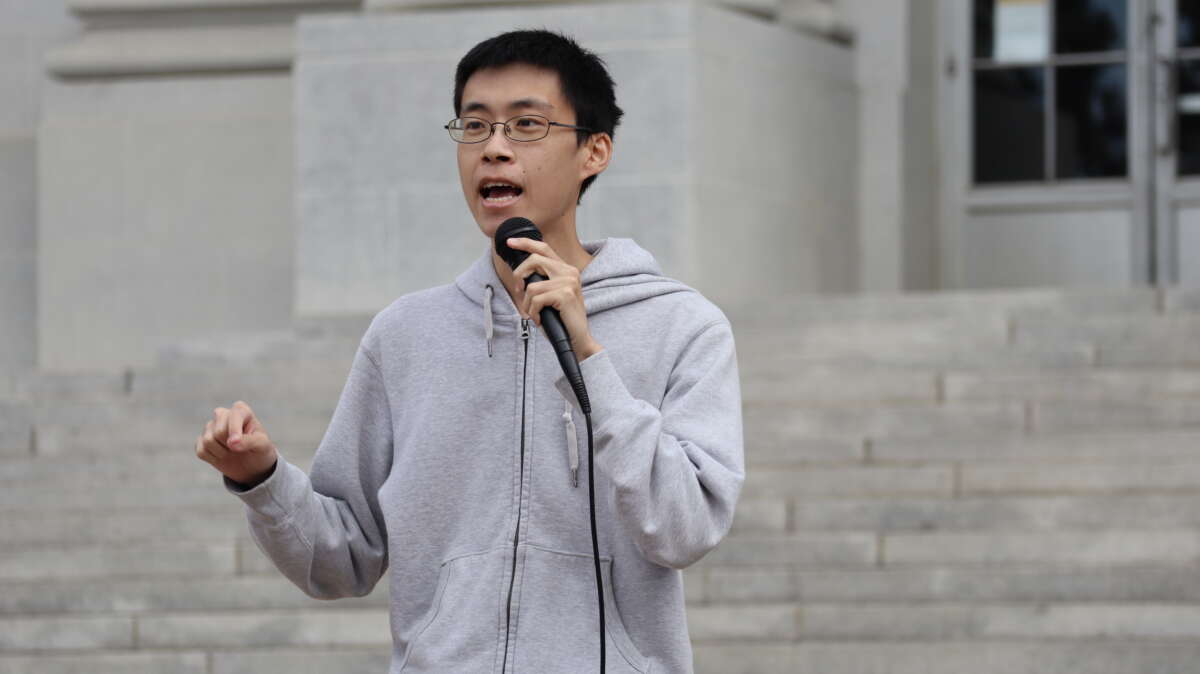
What kinds of Palestine solidarity activism have you been part of the past two years — or even before then?
I grew up in a mostly apolitical household, so I was taught that Israel-Palestine is an intractable, thousand-year-old, faraway conflict that I should ignore. It wasn’t easy to break out of this narrative, and my time as an undergraduate CS student was no help whatsoever. The first cracks for me were when I peripherally heard about the 2018-2019 Great March of Return, where residents of Gaza peacefully protested for human rights, and Israeli soldiers responded by holding a shooting competition to maim and cripple as many Palestinians as they could.
The scales fully came off my eyes during the 2021 Israeli bombing campaign on Gaza. The scenes of civilians being killed, press buildings being targeted, and Republican and Democratic politicians uncritically supporting Israel through it all, were a smaller-scale version of the ongoing genocide. Once you see the reality of apartheid and occupation, it becomes instantly clear that it’s not a complicated issue at all.
I did talk to some coworkers (at the time, TAs in the CS department) about Gaza during the 2021 bombing campaign, though it was met with total silence. The shift in American popular opinion on Palestine since then is something I never would have imagined seeing in my lifetime.
Can you tell us what actions in the Palestine solidarity movement seem most important to you, and why?
The people in Gaza can’t wait for us to do the “more important” actions first, and the “less important” actions later. We have to simultaneously take all measures that could potentially end the genocide, however insignificant they may be.
In the short term, we have to continue directly supporting people in Gaza with money. As with every war, there are bad-faith actors (including criminal gangs backed by Israel) trying to profit off war by selling humanitarian essentials at inflated prices. There have also been reports of Israel intentionally letting in commercial trucks loaded with food, so that the markets seem full, but the prices are out of reach for starving Palestinians. Our taxpayer dollars are being used to starve Palestinians, so the absolute least we can do is offset our financial complicity by contributing whatever we can to stave off the famine.
In the longer term, speaking out is important to make sure we don’t let Israeli propaganda win the information war. Westerners are finally waking up to the atrocities of occupation and genocide in Palestine, and we are watching European and American Democratic politicians shift on the issue in real time (though far too slowly). Continued public pressure from our collective voices is required, until unconditional support for Israel becomes politically untenable.
Tell us about the hunger strike. My daughter is in Students for Justice in Palestine at Occidental College, where the student hunger strikes began last spring. Those strikes were very intense, and unusual in the U.S. Why a hunger strike?
Palestinians have been dehumanized in the Western media throughout the entire genocide, not to mention the 75 years of occupation before. When Palestinians are killed, they’re merely a statistic and a number. Starvation and displacement seem like faraway issues. Launching a hunger strike means bringing the starvation here to Berkeley, and forcing students to reckon with the issue when they interact with me in class or office hours. One of the people who starved to death in Gaza recently was a lecturer, just like me. That could have been me.
Since you started your hunger strike, another mass campaign of ethnic cleansing has transpired, with a ground invasion of Gaza City, under cover of a media blackout, and a million people displaced, moving from the North to the South. How do you follow news of Palestine, and stay connected to the reality that is happening on the ground?
That’s easy — I listen to Palestinian journalists. These are the greatest journalists of our lifetimes, heroically documenting the genocide of their own people while they themselves are being starved, bombed, and displaced. Many have been assassinated by Israel for their work — Ismail al-Ghoul, Hossam Shabat, Anas al-Sharif, and hundreds of others. Yet others, including Hind Khoudary and Tareq Abuo Azzum, continue to keep the world informed despite the threats to their lives.
You are a lecturer at UC Berkeley, not part of the senate faculty. A lot of students don’t pay much attention to the difference between the two kinds of faculty. Can you talk about what is distinct about us — as lecturers — on this campus? Why do you think it’s important for a lecturer to be representing opposition to the genocide?
As a lecturer, I am hired on short, one- to three-year contracts, and the university can freely choose to terminate my employment by not renewing my contract after the current one expires. I am only able to speak openly about Palestine because of the support of my union, UC-AFT, which defended me when the university investigated me in November 2023, and is defending me again now, when the university handed my name over to the Trump administration.
If a lecturer with minimal job security is speaking out about Palestine, what’s stopping the hundreds of tenured faculty on campus? A larger crowd speaking out makes us all safer, and it protects the most vulnerable among that crowd.
You teach these massive courses, and in 2023, you talked with your students about the ethical decisions they’d be making as potentially high-paid tech workers. Tell us about the EECS department, who attends your classes, and the industry they will graduate into.
This semester, I’m teaching an 800-person introductory computer science class, and a 700-person artificial intelligence class. Many of these students will go on to work for Microsoft, Amazon, and Google, three companies that have signed billion-dollar contracts with Israel to conduct mass surveillance and targeting of Palestinians. There’s a common conception that tech is “apolitical,” but choosing to stay silent and ignore our role in this high-tech genocide is a political choice.
I need to ask you about the administration’s turning over of names to the federal government. Can you talk about what happened, what you and others are accused of, and just share your thoughts on how this occurred? What should the administration do, if anything, to make this right?
I received a letter saying that my name was turned over to the Department of Education as part of an ongoing probe into antisemitism. Antisemitism is a real issue … but the Trump administration’s investigation has nothing to do with antisemitism, and everything to do with silencing anyone who speaks out against Israeli war crimes.
On the issue of silencing pro-Palestinian voices, the university and the Trump administration are on the same side. But their crackdown is proof that we have a winning message. People are horrified at the humanitarian disaster in Gaza and don’t want to see their tax dollars paying for the bombs being dropped on Gaza. We must continue to speak out, because the more we use our voices, the harder it is to silence all of us.
We know that the university works with all the major companies that facilitate the genocide. The UC also participates in exchanges and programs with Israeli universities. And they welcome, and often institutionalize, Zionist ideology in knowledge production — in addition to cracking down on protests against this. How do you feel about working here? What do you think should happen next?
We’re in the belly of the beast here in the U.S., and at UC Berkeley. This puts us in a uniquely powerful position to make a difference.
An urgent fundraising appeal: 9 Days to raise $50,000
Thank you for reading Truthout today. We have a brief message before you go —
Unfortunately, donations are down for Truthout at a time when media is under immense pressure. Trump is arresting journalists, Big Tech is censoring independent news, and economic conditions for media have been worsening for years.
Simultaneously, movement media is vital in the fight against Trump’s authoritarian reign. Our mandate to tell the truth, share strategies for resistance, and speak against fascism is ever more urgent in this deluge of political censorship. Yet, we are struggling to meet our publishing costs when our work is so urgently needed.
If you can support Truthout with a one-time or monthly donation, you will make a significant impact on our work. Please give today during our fundraiser (9 days left).