Support justice-driven, accurate and transparent news — make a quick donation to Truthout today!
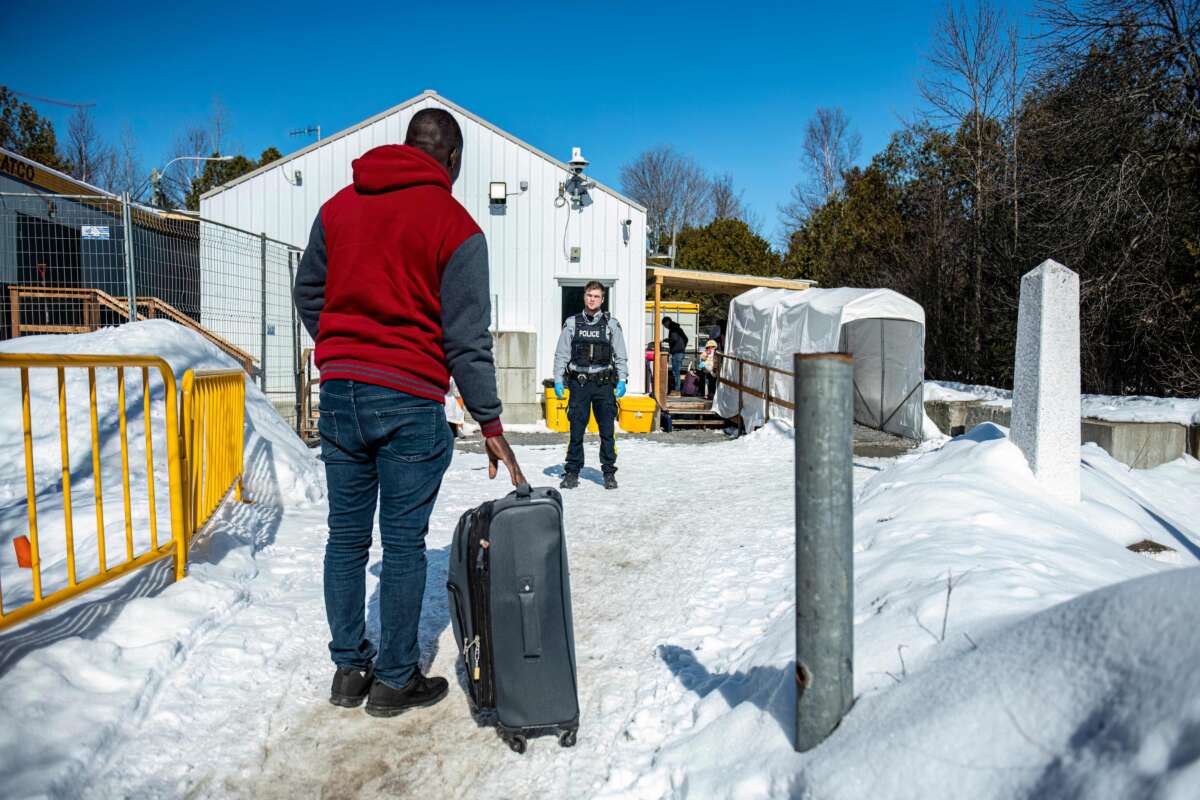
For several hours, the woman and her children lay in the mud, hoping not to be found by Canadian authorities. She was in the middle of her 14 days — the amount of time that a person who entered via the United States has to be in Canada before making an asylum claim. During those 14 days, asylum seekers cannot be caught. They have to live underground. And even harder, they have to be able to prove that they were in Canada for 14 days when they go to make their asylum claims. If they’re found or caught, or if they can’t prove Day 1 or Day 14, their claim will be denied, and they will be deported.
On July 13, a U.S. citizen driving an SUV allegedly drunk in southern Quebec crashed into a van carrying 12 people who had entered Canada from the United States. Another van following behind, also carrying migrants, veered away to not be caught by authorities. The first van rolled over, and four people were injured and brought to a hospital. Frantz André, coordinator of the Comité d’Action des Personnes Sans Statut (a committee that supports people without legal status in Canada), is helping some people from both vans, and he says that the remaining eight fled into the woods, as did the passengers in the other van to avoid being caught. The mother who hid in the mud with her children was among this group. After the crash, they lay in the mud for four hours, until another van came to get them.
Experts insist that these kinds of events will continue to increase.
“It’s inhumane” says Jean-Pierre, a Haitian refugee who crossed into Canada from the United States with his wife and child and made his request for refugee status in 2021. Sharing his story in an interview with Truthout, he asked to be identified by a pseudonym to avoid repercussions to his refugee claim. He and his family had been living in Indiana and are now in Western Canada. Jean-Pierre cannot work as he’s been waiting for a work permit since April.
Haitians in the United States have had a Temporary Protected Status since 2010, and the status has been canceled, appealed, and renewed many times since then. After U.S. Secretary of Homeland Security Kristi Noem declared that Haiti no longer meets the program requirements for Temporary Protected Status, the status was set to expire on September 2, 2025. A judge has temporarily blocked this order, extending the Temporary Protected Status designation again until February 3, 2026, but the Trump administration says it “vehemently disagrees” with the judge’s ruling and “is working to determine next steps.”
All of this uncertainty has driven many Haitians, like Jean-Pierre, to cross into Canada, usually at Quebec. But now, people are even more afraid, and Canada has made it even harder than before for Haitians and anyone else fleeing the United States to be given asylum.
Already, the largest group of migrants ever tried to enter Canada in the back of an unventilated cube van, just a few weeks ago. The Canadian Press reports that 44 people, mostly Haitians, crossed into Canada on foot on August 3, and were picked up by the cube van. Once the van was intercepted, the migrants were sent to be processed. If they don’t have a first-degree relative living in Canada, it is likely that they will be sent back to the United States.
That’s because the primary way for someone who is Haitian to stay in Canada is to have a first-degree relative, rather than simply claiming asylum, and Canada has no plans to make it easier for anyone coming from the United States to claim asylum in Canada. Immigration, Refugees and Citizenship Canada spokesperson Matthew Krupovich told Truthout that the government of Canada has extended to November 19, 2025, a temporary measure in place to allow people who have a first-degree relative in Canada to enter through a special program. “These measures help keep families together and give Haitian nationals in Canada a safe place to work and study,” he said.
André is critical of the program, which he describes as being a family reunification program rather than a true asylum program. André argues that by allowing Haitians who have first-degree relatives to stay in Canada while not accepting people who are claiming asylum from the United States, Canada is not upholding its responsibilities under international law to accept refugees. Moreover, he says he has seen situations where families are broken up because one person has a direct relative in Canada but the other person in a couple does not.
There are 80,000 Haitians who live in Montreal, and 47,550 of them were born in Haiti, and 140,000 people of Haitian descent who live in Quebec. The vast majority chose Quebec because it is North America’s only majority French-speaking jurisdiction.
But the passage into Canada has been made particularly perilous due to the “Safe Third Country Agreement” — a policy that says immigrants who are crossing into Canada from the U.S. cannot immediately seek refugee status in Canada because they are coming from a country deemed to be “safe”; once they have been in Canada for at least 14 days, however, they are then allowed to seek refugee status in Canada.
While the Supreme Court of Canada found parts of the Safe Third Country Agreement to be constitutional in 2023, it bounced the question of rights violations back to a lower court. In February, the Canadian Council of Refugees and Amnesty International renewed their call for the agreement to be scrapped. They wrote, “Canada’s assertion that the United States remains a safe country for refugees under the Trump administration is a cruel irony to those fleeing persecution today. It must be urgently rescinded, and tariff threats must not blur the plight of those at immediate risk.”
“Canada’s assertion that the United States remains a safe country for refugees under the Trump administration is a cruel irony to those fleeing persecution today.”
Canada has no plans to eliminate the agreement, though. In fact, rather than preparing for more people to come to Canada as a result of the end of the American Temporary Protected Status, Canada’s new Liberal government’s second bill would make it even more difficult for people to seek asylum from the United States. If passed, Bill C-2 will eliminate the 14-day period that people are currently waiting before they make a refugee claim and instead make it impossible for someone to make a claim at all if they cross into Canada from the United States, whether via an official port of entry or not. The bill was presented on June 3, 2025.
André says Canada’s confusing asylum rules aren’t enforced evenly and can change depending on which agent someone deals with, and the stakes are considerably higher now that Trump’s administration has stepped up deportations. He tells the story of a man living in the United States who had both a Canadian and American visa, and who had applied for Temporary Protected Status. He planned to visit Canada for a few weeks. Upon trying to enter Canada, he was told that he couldn’t bring a scooter he had with him to give to a family member, as it didn’t meet certain standards. The man was given two choices: either leave the scooter at the border or go back. The man decided to go back into the United States with the scooter and within days, he was captured by Immigration and Customs Enforcement and sent to an immigration jail where he currently awaits deportation.
What’s worse is that while the Canadian government is squeezing migrants at the border, the government of Quebec has doubled down on ethnic nationalism as a political strategy, demonizing immigrants and refugees in general and Haitians in particular. While the federal government controls Canada’s asylum system, Quebec is the only province that manages its own immigration levels. The province is currently in a process to determine its immigration levels for the next four years, though the governing Coalition Avenir Québec has made it clear that it does not support making it easier for people to claim asylum from the United States.
In a statement given to Truthout in French, Xavier Daffe-Bordeleau, a representative of Quebec’s Ministry of Immigration, Francisation and Integration, explained, “Quebec remains committed to offering a dignified and secure welcome to asylum seekers, with help from … community groups, who have already done a lot over the years to welcome asylum seekers. The cumulative effect over the past many years has placed pressure on the Quebec public and we have largely surpassed our capacity.”
Quebec’s government has formally requested that the Canadian government reduce the number of work permits and refugee status granted from 416,000 in 2024 to 200,000 by 2029, especially in the greater Montreal region, even though cutting immigration levels has already placed Quebec into population decline.
Neither the Canadian nor the Quebec governments have demonstrated meaningful regard for the humanity of asylum seekers, and neither have any plans for the inevitable wave of people who will request asylum in Canada when the Temporary Protected Status ends. The situation in Haiti continues to deteriorate, with the UN-coordinated police force from Kenya having largely been a failure. And with Erik Prince’s Vectus Global about to deploy mercenaries in Haiti, most Haitians in North America are left with only one option: asylum in either the U.S. or Canada.
Despite the crisis, Canada knowingly sends people back to the U.S. where they can face deportation, a kind of deportation by proxy, says André, when really, all they want is the safety and security that every person wants.
“What they need and are looking for is a safe place to rebuild, to build a life and to eventually have their family reunite with them,” André told Truthout. “That was the perception of Canada years ago, which is no longer what’s happening.”
25 Years of Truthout: An important fundraising appeal
This September, Truthout is celebrating 25 years of publication. For over two decades, we have been a trusted source for fiercely independent journalism thanks to readers like you.
As we look to the next 25 years, we have launched a special fundraising campaign. Looking to a sustainable future for our publication, we have a fundraising goal of $100,000 in the next 9 days.
We are asking for your support at this juncture because we face greater threats than ever before in our organizational history. Trump and his MAGA allies are determined to control the information ecosystem, and movement-based organizations are subject to dangerous censorship and scrutiny.
If you can support Truthout with a one-time or monthly donation, you will make a significant impact on our work and our legacy. Anything you can do makes a difference!