Honest, paywall-free news is rare. Please support our boldly independent journalism with a donation of any size.
HHS secretary Alex Azar refused to guarantee a coronavirus vaccine would be affordable to all during Congressional testimony on Wednesday. The outrage reminded Americans why they are sick and tired of the unchecked pharmaceutical industry’s abuses. As we wrote for the American Prospect, Azar is a former pharma lobbyist who, like the rest of President Trump’s coronavirus response team, has no background in public health or research.
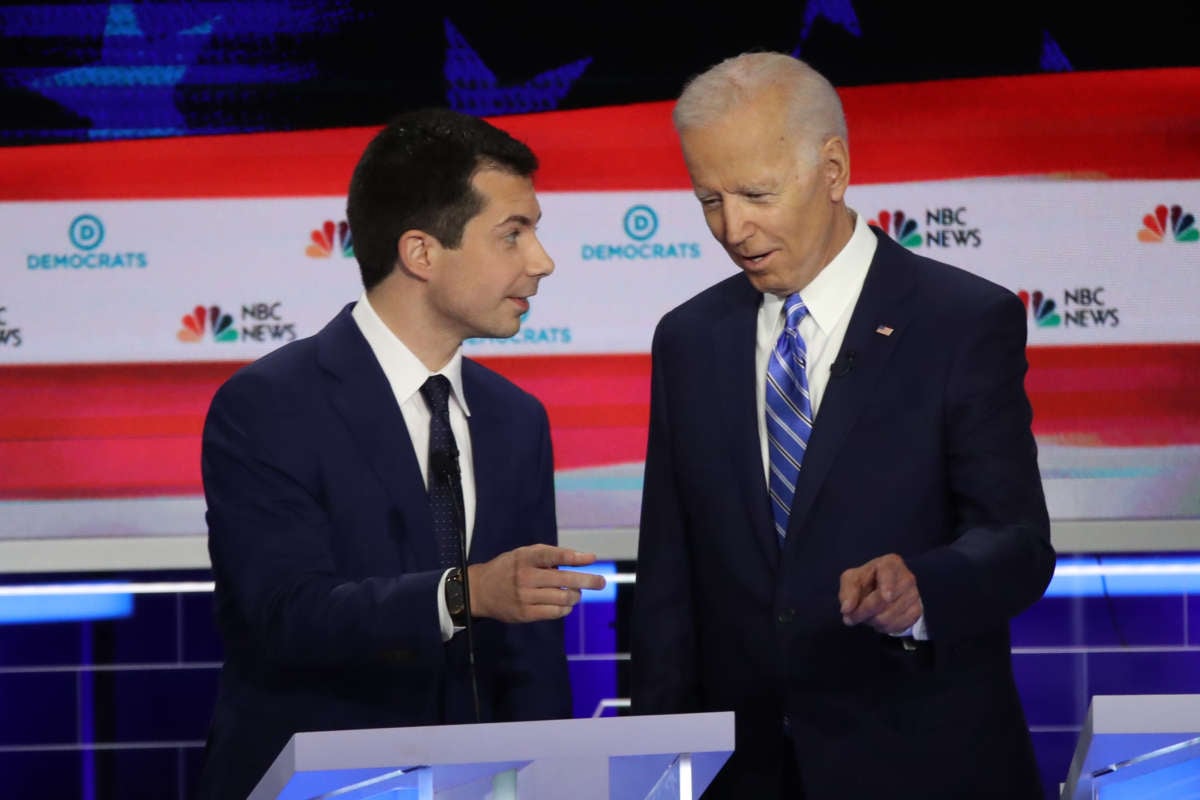
Yet Trump might not be alone in trusting unqualified pharmaceutical executives with policy decisions. The Revolving Door Project has found 2020 candidates Joe Biden and Pete Buttigieg are both accepting significant donations from the pharmaceutical industry. The rallying of donations around these two candidates indicates the industry is already placing bets to install its allies in key positions across the next administration and minimize government oversight on, say, lowering drug prices.
Biden is currently the Democratic candidate with the highest donations from the pharmaceuticals and health products industry, second only to President Trump. His ties to pharma run deep: Biden’s campaign chairman is Steve Richetti, a former lobbyist for pharmaceutical companies Novartis, Eli Lilly and Sanofi. The latter two corporations are currently embroiled in a class action lawsuit over accusations of fixing insulin prices. Biden also chose a former senior VP from Pfizer, Greg Simon, to lead his Biden Cancer Initiative. On the campaign trail, Biden came under fire for praising pharma when speaking about the initiative to donors.
Like many moderates on the 2020 trail, Biden’s most recent fundraising events required a $2,800 campaign donation to gain entrance. His new donors included Jon Selib, a VP of global policy at Pfizer, and Ercument Tokat, a partner at Centerview who has advised Pfizer, Wyeth, Celgene.
Several of Biden’s finance industry backers also boast ties to pharmaceuticals. Billionaire David Bonderman, the chairman of private equity firm TPG Capital and board member of Kite Pharma, maxed out his contributions to the Biden primary campaign. John Vogelstein, a partner at Warburg Pincus which invested in Vertice Pharma, also donated the $2,800 maximum. Venture capitalist David Scheer, who sits on the board of pharmaceutical companies including Esperion Therapeutics, OraPharma, and ViroPharma (which the FTC slammed with a complaint in 2017 for delaying generic competition to one of its drugs), has raised at least $25,000 for Biden. This makes him a campaign “bundler,” or high-dollar volunteer fundraiser. Alan Blinken, the former Clinton ambassador to Belgium and board member of biopharmaceutical company UCB, is also a Biden bundler.
Buttigieg follows Biden in the race for pharma and health products donors, with contributions from executives at Pfizer, Bayer and Eli Lilly. Pfizer chief corporate affairs officer Sally Susan donated $2,800 to the Buttigieg campaign. Chief medical officer Kevin Williams donated $1,000, and former Pfizer general counsel Louis Ramos donated $2,820.
Buttigieg’s funders also include Thaddeus Burns, the head of government affairs at pharmaceutical company Merck Life Sciences. Burns donated $6,300 to Buttigieg’s campaign (slightly overstepping the legal maximums) and hosted a fundraiser for him in Geneva. Merck paid out over $950 million in 2011 for illegally marketing a drug for uses the FDA didn’t approve. From 1999 to 2007, Burns worked for lobbying firm Akin Gump. There, he schmoozed on behalf of pharma industry clients including Merck, Pfizer, Human Genome Sciences, and Wyeth.
Influential executives at the pharma giant Bayer are also cozying up to Buttigieg. Their senior director of international government affairs and registered pharma lobbyist Jim Travis contributed $2,800 to the campaign, while frequent Bayer counsel and Wilkinson Walsh partner Alexandra Walsh contributed $4,250.
Buttigieg also took money from executives at Eli Lilly, based in his home state of Indiana. Former Indianapolis mayor Bart Peterson, who is the Eli Lilly head of government relations (read: lobbying), contributed $5,000 to the campaign. Chief Financial Officer Joshua Smiley also donated $2,800, and public relations head Jennifer Scroggins donated $1,000.
Biden and Buttigieg’s influx of pharmaceutical money doesn’t bode well for their campaign promises to reign in the industry. All of that campaign cash doesn’t come for free. Expect pharma giants to come knocking when Biden or Buttigieg start filling crucial executive branch roles overseeing the health sector, thus allowing these companies to continue harming consumers.
Important Message: Please Read
For 25 years, Truthout has survived by publishing impactful investigative journalism and analysis; distributing full editions 365 days a year; and building a community of readers who support us with small, hard-earned donations.
Eighty percent of our $3 million yearly budget comes from small donors alone. Of those, 8,000 readers support us with monthly donations. Back in 2018, when Facebook decided to suppress the circulation of posts made by organizations, thereby cutting readers off from seeing many articles shared by the news organizations they had intentionally decided to follow, Truthout’s total traffic declined by 40 percent, as nearly all of our traffic from that platform disappeared.
Now, Google has recently rolled out its AI search bar, providing AI summaries instead of directing readers to our site. Google Search is our single largest source of traffic; it’s the route by which nearly one third of our readers find us. Much like in 2018, a shocking 40 percent of our Google traffic has disappeared overnight.
It will not be easy for Truthout to shoulder this blow. Nor will it be easy for our peers and collaborators — news sites that depend on traffic and aren’t bankrolled by large corporations.
If you can support Truthout with a donation today, you can help us resist the AI onslaught. Please give today.