Did you know that Truthout is a nonprofit and independently funded by readers like you? If you value what we do, please support our work with a donation.
Gov. Andy Beshear (D-Kentucky) told the hosts of ABC’s “The View” that he still has concerns about Sen. Mitch McConnell’s (R-Kentucky) ability to serve in Congress.
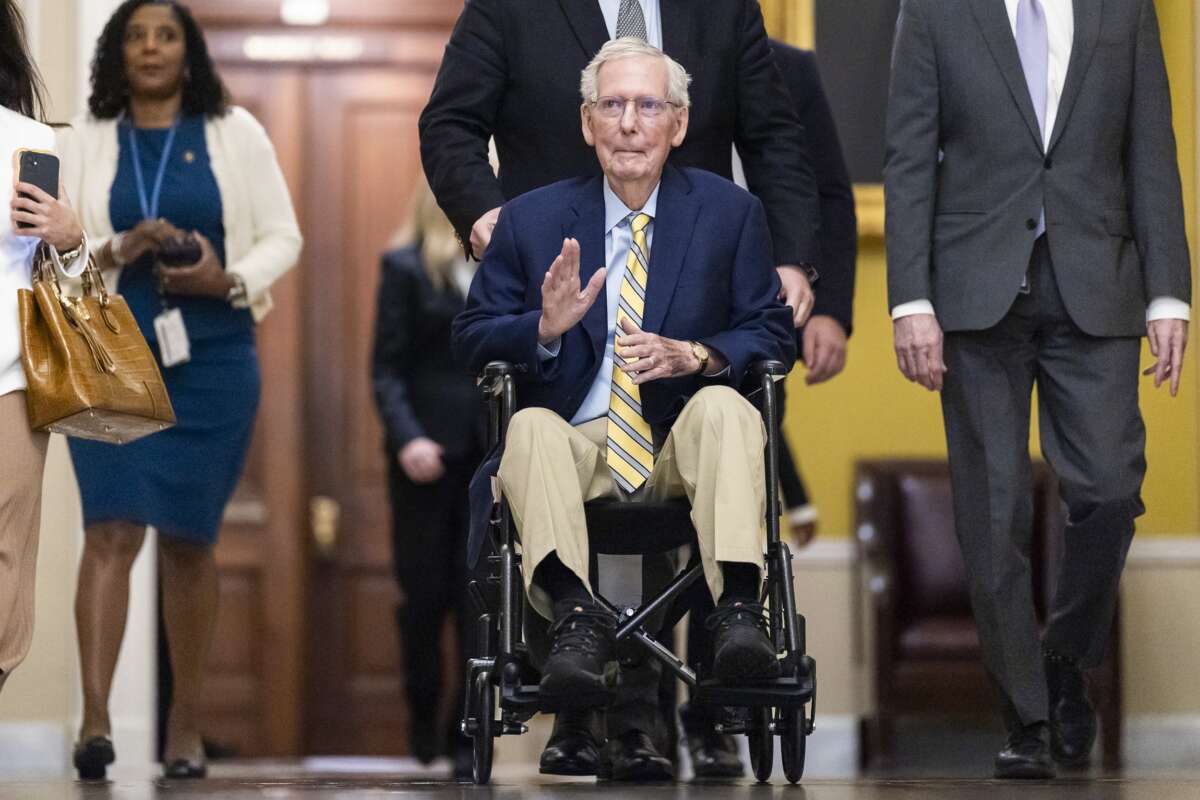
McConnell returned to work at the U.S. Capitol earlier in September, after spending three months out of public view following a fall in his home in June. During that time, the Kentucky senator made some public statements, but never provided audio or video evidence of his recovery, leading to questions about his ability to remain in office for the rest of his term.
When he did return, McConnell was noticeably frail, observers noted. He did speak for a brief time to reporters, but took no questions, and his speech was much slower than usual.
Beshear took notice of McConnell’s condition and said Monday morning he was still worried about McConnell’s health — and whether he should remain in office.
“I still have concerns, and I think anybody who actually watches the video has concerns, both for him and for the position,” Beshear said.
The Kentucky governor, who joined many lawmakers and observers in demanding McConnell show proof of his recovery during the three months he was gone, also believes the situation showed a larger problem with Congress in general.
“This is what’s broken about the current Senate: they don’t think they work for anybody. I mean, Mitch McConnell was gone for three months, three months away from work, and wouldn’t tell his boss, which are the people of the Commonwealth of Kentucky,” Beshear explained.
Beshear also used the opportunity to call for term limits.
“None of us wish [McConnell] ill will,” Beshear insisted, “but we all deserve senators that can actually do their job. And I think it’s fair to say we can now all agree it’s time for term limits for Congress. Yeah, and I’ll throw it out for the Supreme Court, too.”
Some government reformers have maintained that, while well-intentioned, term limits are not the best way to address issues like aging lawmakers or long-term, unpopular incumbents remaining in office, as they would prevent constituents from selecting effective leaders who have been in Washington a long while but are still supported by voters. Experts also agree that term limits would be ineffective at addressing the core reasons why incumbents like McConnell stay in office so long — including issues like gerrymandering and corporate spending in elections.
But on Supreme Court justices facing tenure limits, experts say the matter is different, as those chosen for the role are not elected by the people themselves. According to a recent Marquette University Law School poll, nearly 8 in 10 Americans (79 percent) support fixed terms for Supreme Court justices, while 2 in 10 (21 percent) oppose the idea.
We lost 15 percent of our traffic overnight.
We now have three full months of data since Google changed its search to feature AI results. The numbers are worse than we anticipated. Overall readership that comes to Truthout through Google is down 54 percent against last year. The number of new readers who discover Truthout via Google searches is down 49 percent, and returning users from Google are down 51 percent.
We lost 15 percent of our readership overnight. This was a readership we painstakingly built over decades, and it vanished because Google chose corporate greed over a healthy democracy.
We anticipate a loss of roughly $500,000 in online revenue as a result of this massive traffic plunge in the next year alone.
The only way we can keep publishing is with strong reader support. We are asking you to start a monthly donation to Truthout today — anything you can do, whether $5 or $25, makes a difference.