Did you know that Truthout is a nonprofit and independently funded by readers like you? If you value what we do, please support our work with a donation.
The militaries of North Atlantic Treaty Organization member countries emitted an estimated 233 million metric tons of greenhouse gases in 2023, a sharp uptick that exacerbates climate breakdown and serves only to enrich weapons manufacturers, according to a briefing issued Monday by the Transnational Institute, a research and advocacy organization, and several other nonprofits.
The 32 national militaries together emitted more carbon than the country of Colombia, which has a population of about 52 million people, the briefing says. NATO countries’ military spending increased from about $1.21 trillion in 2022 to $1.34 trillion in 2023, thanks in part to the conflicts in Ukraine and Palestine. TNI used a spend-emission conversion factor to estimate the carbon cost of the spending.
The briefing’s authors warn that NATO’s spending targets must be abandoned or its emissions will continue to rise significantly in the next few years — despite a pledge to reduce emissions by 45% by 2030. Member countries have pledged to spend at least 2% of gross domestic product on defense, and many have have already met or surpassed the target.
The authors note that the Intergovernmental Panel on Climate Change determined that all sectors of the economy need to reduce emissions by 43% by 2030 from 2019 levels to keep global warming at or below the Paris agreement’s 1.5°C target.
“By 2030, we have to make a radical cut in emissions,” Nick Buxton, TNI’s communications manager, told The Guardian. “But the biggest investment we’re making worldwide, and in particularly NATO, is in military spending, which isn’t just not addressing the problem, but actually worsening the problem.”
NATO’s goal of spending 2% of GDP on the military will accelerate climate breakdown and can cost us the planet. In 2023, NATO members-mostly rich states historically responsible for the climate crisis-spent $1.34 trillion on their militaries, an increase of $126 bn in one year. pic.twitter.com/Ft1oZqv7aI
— Transnational Institute (@TNInstitute) July 9, 2024
The United States accounts for more than two-thirds of NATO countries’ military spending and one-third of the world’s, which also surged in 2023. U.S. military spending increased by 24% from 2022 to 2023, and some leading Republicans in Congress have recently called for large increases.
A 2022 report from the Conflict and Environment Observatory, a research and advocacy group, estimated that military emissions accounted for 5.5% of all global carbon emissions. Estimates are difficult because lack of transparent reporting practices by many militaries, experts say.
The new briefing suggests that military spending could be diverted to climate finance for developing countries, which have been the subject of intense international negotiations in recent years, with rich countries slow to provide funding even as they spend profligately on their militaries, critics have argued.
“The climate is caught in the crossfire of war,” TNI said on social media. “We need peaceful solutions to conflicts if we are to defend our world. There is no secure nation on an unsafe planet.”
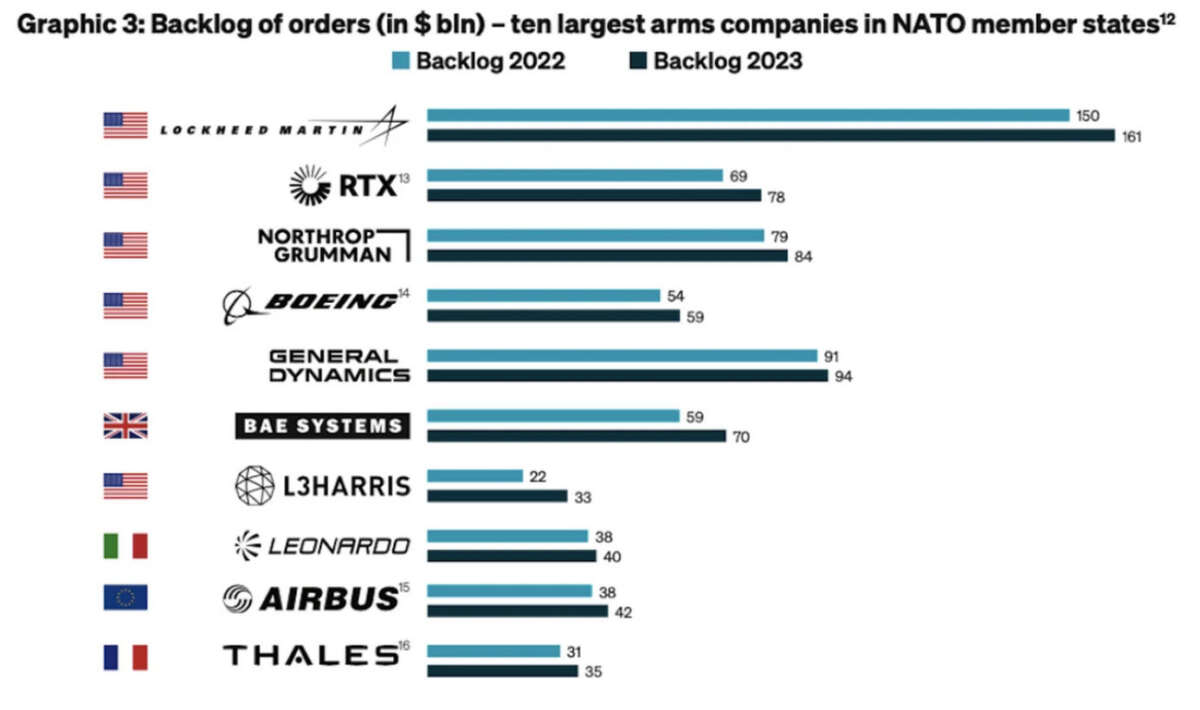
The “only winners” from NATO’s spending policy are weapons manufacturers, says the briefing, which states that backlogs of weapons orders at the 10 largest arms companies based in NATO member countries went up by an average of 13% in 2023.
Current orders will lock in emissions for decades, as military systems are normally used for 30 or 40 years, the briefing warns. For example, Lockheed Martin, a major defense manufacturer, has said that NATO countries will by 2030 fly 600 of its F-35 jets, which use 5,600 liters of oil an hour, even more than the F-16 jets they’re replacing, the briefing says.
“The legacy of this increased arms trade will be an ever more militarized world at a time of climate breakdown,” the authors wrote. “This military expenditure will fuel wars and conflict that will compound the impact on those made vulnerable by climate change.”
Press freedom is under attack
As Trump cracks down on political speech, independent media is increasingly necessary.
Truthout produces reporting you won’t see in the mainstream: journalism from the frontlines of global conflict, interviews with grassroots movement leaders, high-quality legal analysis and more.
Our work is possible thanks to reader support. Help Truthout catalyze change and social justice — make a tax-deductible monthly or one-time donation today.