Did you know that Truthout is a nonprofit and independently funded by readers like you? If you value what we do, please support our work with a donation.
A heat wave is spreading across the U.S. this week that will affect over 250 million people from the Midwest to the East Coast.
Last week, a heat dome covered much of Europe, causing over 1,300 excess deaths. This week, a new heat dome is bringing record-shattering heat to two thirds of the U.S. population, affecting areas that normally do not see such high temperatures.
The heat wave is expected to worsen as the week continues. Heat indexes – or how hot the temperature feels to the body, worsened by high humidity – are expected to reach between 100 and 110 degrees over large parts of the country. On Tuesday, the highest heat index value was 113.6 degrees Fahrenheit in southern Illinois.
Temperatures are expected to peak on Thursday and Friday, with cities like Newark, New Jersey, and Philadelphia, Pennsylvania, expecting actual temperatures of 105 degrees Fahrenheit starting Thursday. Parts of Virginia and North Carolina are expecting four to five consecutive days of 100-degree heat, from Wednesday, July 1 through the July 4 weekend.
Last week, a study from World Weather Attribution found that Europe’s heat wave would have been “virtually impossible” without climate change. Similar findings are expected for this U.S. heat wave.
In France alone, around 1,000 excess deaths were reported during the heat wave last week – hundreds more deaths per day compared with the daily death rate before the heat wave.
Fewer Americans are expected to die from heat in the U.S. than in Europe, largely because the U.S. has far more air conditioning, particularly in homes.
But while air conditioning for households is largely a necessity to deal with the reality of climate change, another source is straining power grids: AI data centers, which have expanded across the U.S. since 2023 in an AI boom and require significant amounts of water, energy, and cooling.
Due to the demands of AI, over 1,500 data centers are currently in development across the U.S. Virginia, which is expected to experience some of the highest temperatures later this week, currently operates over 600 data centers, the highest concentration in the country.
Data centers currently consume roughly 4.5 percent of the total electricity in the U.S., and this number continues to grow. It is expected to reach 10 percent or more by 2030.
Scientists have also found that data centers are creating “heat islands,” warming the temperatures in the areas around them, even over 6 miles away.
Even tech CEOs are admitting a problem. “Extreme heat stresses data centers and the grid they rely on at the same time,” Mishal Thadani, the CEO of AI platform Rhizome, explained to CNBC this week. Cooling already makes up around 40 percent of data centers’ energy use at normal temperatures, and this amount rises as the temperature rises. “Data centers need the most energy exactly when the grid has the least available to give.”
In Europe, the record-breaking heat wave caused power outages that left 68,000 households without electricity on Tuesday night and Wednesday last week.
“Now add facilities that each pull as much power as a hundred thousand homes,” Thadani said.
Regional grid operators in the U.S. have said that they are expecting record electricity demands this week, which also carry risk of blackouts.
Blackouts in turn amplify mortality and morbidity rates, with one 2023 study concluding that blackouts combined with heat wave conditions can “more than double the estimated rate of heat-related mortality.”
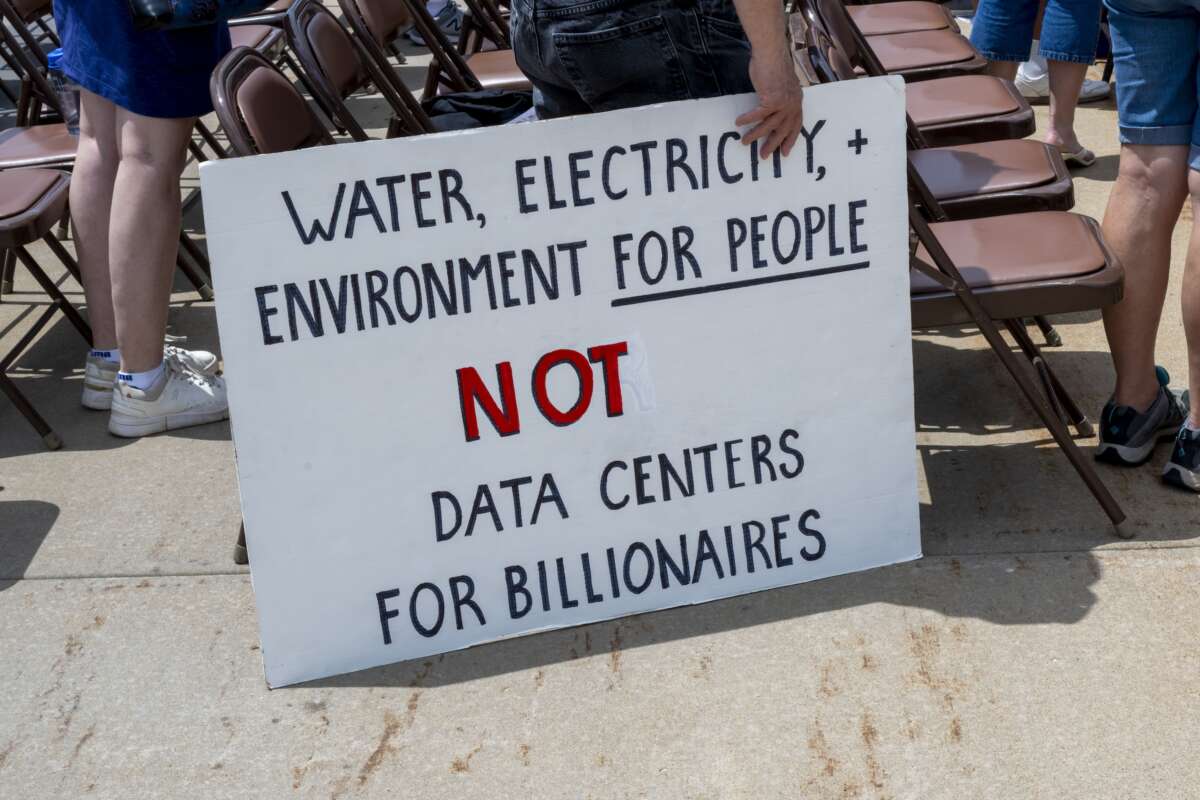
As awareness grows around the threats of data centers, more people are opposing them, and campaigns are growing to stop their spread.
An important fundraising appeal: 8 Days to raise $47,000
Truthout is one of only a few platforms for justice-oriented, grassroots journalism. Today, as political censorship from the right intensifies, we have no choice but to ask for your help.
We are fundraising right now to cover our basic operating expenses. If you can support Truthout with a one-time or monthly donation, you will make a significant impact on our work. Anything you can do makes a difference — we appreciate your support.