Support justice-driven, accurate and transparent news — make a quick donation to Truthout today!
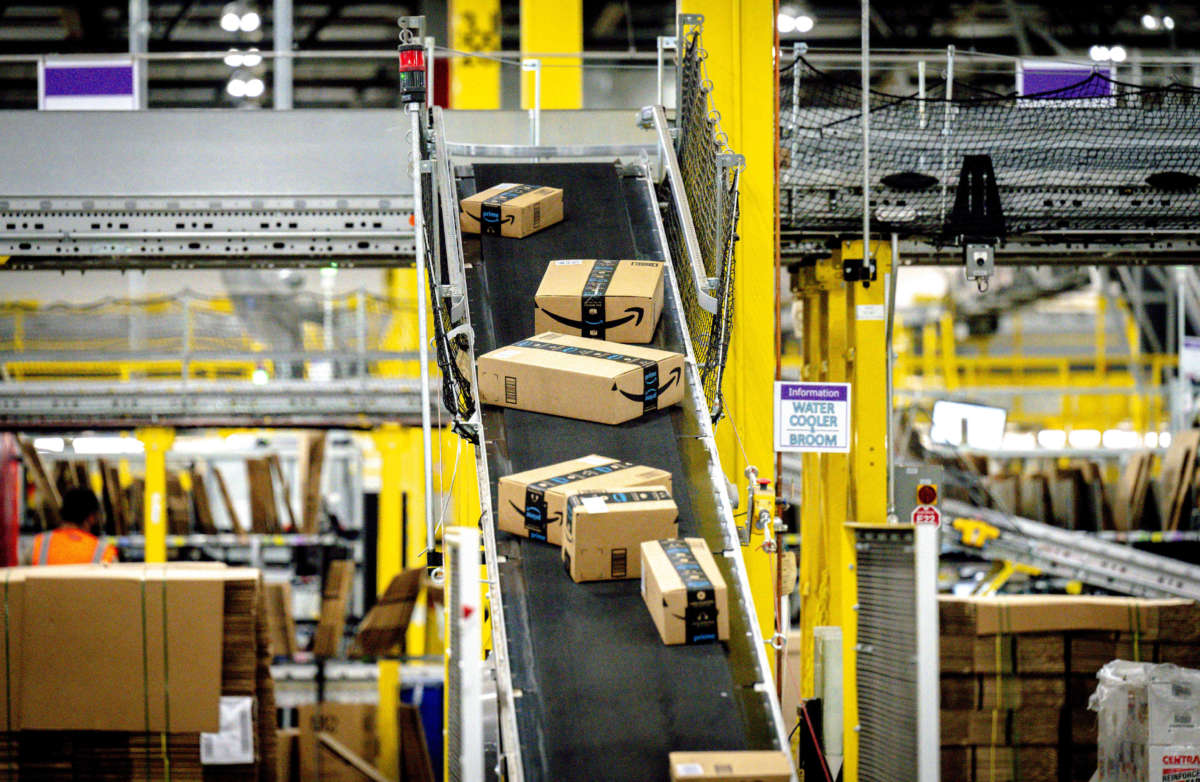
A California court has approved a settlement between the state attorney general’s office and Amazon, over claims that the company concealed information from workers and local health agencies about coronavirus infections in its warehouses.
A “right-to-know” law that was passed in September 2020 requires companies in the state to keep workers informed about the spread of the virus among the workforce, and to provide safety plans as well as COVID-related benefits to their employees. According to California Attorney General Rob Bonta, Amazon failed to let tens of thousands of workers in its warehouses know how many of their co-workers were infected with the virus.
As part of the settlement, Amazon will pay California a sum of $500,000, which will help the state enforce consumer protection laws. The company will also modify its notification systems to inform workers about potential exposures to the virus, and will submit to monitoring from the attorney general’s office.
The settlement, which was filed and approved within the California Superior Court in Sacramento, allows Amazon to deny any wrongdoing. In a statement from the company, Amazon said that the attorney general “found no substantive issues with the safety measures in our buildings,” and that the settlement simply resolves a “technicality” that they will now abide by.
However, a press release from Bonta’s office implied that the company had acted improperly, describing Amazon’s failure to follow the year-old law as “harmful” to its workers.
“Californians have a right to know about potential exposures to the coronavirus to protect themselves, their families, and their communities,” Bonta said in a statement.
Amazon has frequently faced criticism for its poor treatment of workers. At the beginning of the pandemic, the company faced widespread backlash after it was revealed that workers were having to urinate and defecate in delivery trucks in order to meet productivity demands.
Previously, the company had publicly and vehemently denied media reports that this ever took place, implying that workers were lying about the matter — but internal documents uncovered by The Intercept in March 2020 contradicted the company’s claims, and made clear that Amazon was aware of the situation.
The company is also being accused of having poor workplace standards in other parts of the country. Amazon is currently embroiled in a lawsuit against New York State Attorney General Letitia James, attempting to block her office from bringing charges against them over workplace safety concerns at two of the warehouses in New York City.
Important Message: Please Read
For 25 years, Truthout has survived by publishing impactful investigative journalism and analysis; distributing full editions 365 days a year; and building a community of readers who support us with small, hard-earned donations.
Eighty percent of our $3 million yearly budget comes from small donors alone. Of those, 8,000 readers support us with monthly donations. Back in 2018, when Facebook decided to suppress the circulation of posts made by organizations, thereby cutting readers off from seeing many articles shared by the news organizations they had intentionally decided to follow, Truthout’s total traffic declined by 40 percent, as nearly all of our traffic from that platform disappeared.
Now, Google has recently rolled out its AI search bar, providing AI summaries instead of directing readers to our site. Google Search is our single largest source of traffic; it’s the route by which nearly one third of our readers find us. Much like in 2018, a shocking 40 percent of our Google traffic has disappeared overnight.
It will not be easy for Truthout to shoulder this blow. Nor will it be easy for our peers and collaborators — news sites that depend on traffic and aren’t bankrolled by large corporations.
If you can support Truthout with a donation today, you can help us resist the AI onslaught. Please give today.