Truthout is an indispensable resource for activists, movement leaders and workers everywhere. Please make this work possible with a quick donation.
Zip ties. Helicopters. Crowded cells. Guns trained on bewildered workers. Foul water. Forced vaccinations. An unconscious detainee left on the floor by negligent guards. A pregnant woman in handcuffs. A detainee being called “Rocket Man” (Donald Trump’s nickname for Kim Jong Un) by sneering federal agents. A menstruating woman forced to attend to her period with only toilet paper.
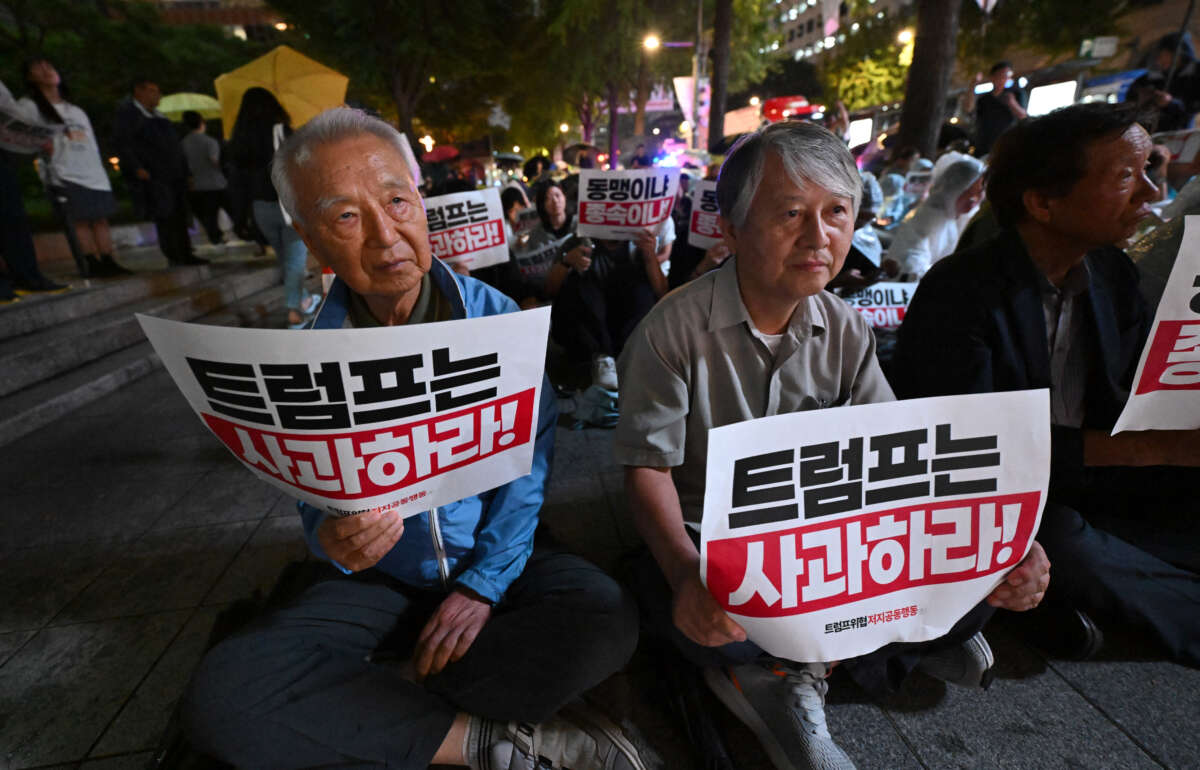
These are the details of 316 South Korean nationals’ experiences in Immigration and Customs Enforcement (ICE) detention that have flooded the country’s media in the weeks after the September 4 raid on a Hyundai-LG electric vehicle battery plant in Ellabell, Georgia. A wave of fury is now pouring forth from across South Korean society — and the political consequences are only just beginning.
There is far more at stake than a single factory in Georgia, which by itself represented 8,500 jobs and $4.3 billion in investment, and is just one of 23 plants being built across the U.S. by Korean conglomerates. Since the raid, the U.S. and South Korea have announced that Korean workers will be able to use B-1 visas and ESTA visa waivers to continue working in the U.S. A new bill in Congress, the Partner with Korea Act, also seeks to extend 15,000 professional E-4 visas to South Koreans for the first time.
But U.S. flexibility on immigration is not all that matters. Seoul and Washington have yet to finalize their trade deal instigated by Trump’s threat to impose a 25 percent blanket tariff on South Korean goods. At the current stage of negotiations, South Korea has agreed to accept a 15 percent tariff on its exports and provide tremendous investments and other financial agreements: $350 billion in state-backed short-term investment, $150 billion in private sector contracts with U.S. corporations, and a guarantee to purchase $100 billion in U.S. liquid natural gas. Despite so much on the table, a written agreement has yet to be produced, and negotiations are proving tense as the Trump administration presses for Seoul to provide the lion’s share of its $350 billion commitment in cash. While some of the shock over the ICE raid has died down, Washington’s conduct over the course of months of negotiations has also raised deeper questions in South Korea about the real nature of the alliance — and whether this is a relationship that can last.
The Art of the Steal
The anger unleashed by ICE’s abuse of Korean workers has been building for some time. Trump’s tariff threats, announced in March, hit South Korea at a difficult time, when the impeachment of former President Yoon Suk Yeol was unresolved, and the country was reeling from years of flagging economic performance.
The issue was not only a matter of timing. The Biden administration’s CHIPS Act and Inflation Reduction Act also used similar (though less onerous) tariff threats to force South Korean conglomerates to transfer production and make large investments in the U.S. — which is how the Hyundai-LG plant made its way to Georgia in the first place. Having already complied with the previous administration, South Korea nevertheless now finds itself facing an even graver economic threat that could lead to recession: not just a 25 percent tariff on all exports (since reduced to 15 percent), but sector-based tariffs impacting most of South Korea’s key industries as well.
Trump’s tariffs are just the latest in a string of U.S. policies that have sought to deny South Korea its economic sovereignty, open its markets to foreign takeover, and degrade the rights and dignity of its working people.
While much of the anger on either side of the Pacific has focused on the current administration in Washington, Trump’s tariffs are just the latest in a string of U.S. policies that have sought to deny South Korea its economic sovereignty, open its markets to foreign takeover, and degrade the rights and dignity of its working people.
The 1997 International Monetary Fund crisis is the most notorious of these, and led to the “irregularization” of nearly half the workforce as employers moved to subcontracting and other forms of indirect employment to dodge existing labor law and deny rights to their workers. The 2007 U.S.-South Korea Free Trade Agreement further empowered U.S. multinationals, devastated local agriculture, and weakened the power of workers. With Joe Biden, and now Trump, the U.S. has moved to maintain its privileges under the agreement while subjecting South Korea to unequal burdens and penalties.
As with prior rounds of U.S. economic warfare, South Korea’s workers and other affected sectors of society responded to the tariffs with force. Farmers reacted with rancor to demands to open up the rice and beef markets to U.S. imports; civic groups staged protests at the U.S. embassy; peace groups highlighted the military demands attached to the tariff threats; and unions educated their workforces and, in some cases, moved to partial strike action — as with the case of General Motors Korea.
Like most governments, South Korea opted to appease the U.S. in exchange for a lower tariff rate of 15 percent, with no corresponding tariff on U.S. goods in the Korean market. So far, Seoul has offered to inject a cumulative $600 billion into the U.S. economy. This is a dizzying figure for any country, no less for South Korea with an annual GDP of roughly $1.7 trillion in 2023, and an annual budget of roughly $500 billion in 2024.
According to the Export-Import Bank of Korea, the $350 billion in short-term state-backed investments offered by South Korea is more than the total direct investments it made worldwide over the five-year period from 2020-2024. Beyond extracting such an enormous tribute, Washington has cast a covetous eye toward South Korea’s most valuable and strategic industries, seeking to either smother them through tariffs or transfer their most lucrative parts of the production chain to the U.S.: in shipbuilding, automobiles, steel, and more.
While South Korean President Lee Jae Myung attempted to spin the deal as a victory, the domestic labor movement and many progressives swiftly rejected this. The minority Progressive Party, which holds seats in the National Assembly, denounced Trump’s tariff maneuvers as “an act of plunder.” The Korean Confederation of Trade Unions, a massive umbrella union representing over a million workers, described the “unilateral” negotiations as “humiliating,” and criticized the government’s declaration of victory as an attempt to confuse the public, since the 15 percent tariff is still ultimately an increase that will burden Korean industry and workers.
Fraying Bonds?
At the outset of Trump’s tariff threats, labor, farmers, and progressive civil society organizations spearheaded vocal opposition. South Korea’s conglomerates (or chaebol) opted to hedge against further potential losses by adopting conciliatory rhetoric and offering handsome investment packages before the details of a deal were worked out at the state level. This was reflected in Lee’s first summit with Trump in August, which was noted for its convivial atmosphere and his lavish praise of Trump. Pressure to transfer production to the U.S. was no doubt uncomfortable for South Korea’s capitalists, but for a moment, an illusion endured that profits might be sustained in the long term. Then came the ICE raid in Georgia — not only raising questions about the safety of the workforce, but also raising questions about investments.
The ICE raid in Georgia … precipitated a sharp change in tone among traditionally pro-U.S. elements in South Korea.
This precipitated a sharp change in tone among traditionally pro-U.S. elements in South Korea. Right-wing papers and business media outlets released a barrage of editorials in the wake of the raid. The Chosun Ilbo, South Korea’s conservative paper of record, said the raid “raises fundamental questions about what the United States truly means by ‘alliance.’” Even the People Power Party, whose former leader, ex-President Yoon, now sits in jail, spoke out against the incident.
Some even went as far as to speculate whether the ICE raid might have had something to do with the unsettled tariff negotiations. The Korea Economic Daily, one of South Korea’s most important business papers, left little room for subtlety in its editorial: “If the US attempts to leverage this incident in trade negotiations, such as the $350 billion US investment fund and the further liberalization of agricultural and livestock products, it would be a betrayal of the trust of the alliance.” While this statement falls short of an outright accusation in print, one wonders what might have been said in more private settings among the elite.
Despite the pivot in South Korean public opinion, Washington has since only doubled down. Since the announcement of the trade deal in July, the U.S. and South Korea’s governments have been at odds over how South Korea’s investments will be decided. Trump has long claimed that he will personally determine the allocation of South Korea’s investments, and Secretary of Commerce Howard Lutnick previously tweeted that “90 percent” of the profits will go to “the American people” — a point that continues to rankle South Koreans.
According to the Wall Street Journal, Lutnick is also applying additional pressure to get Seoul to further raise its investments. Trump has no doubt taken confidence in his success in getting Japan to agree to similar terms, under which its $550 billion tariff tribute will be distributed according to the decisions of a U.S. committee — with Japanese input relegated to only a consultative position. If this all sounds bizarre and corrupt, that’s because it is. While Trump has touted his tariff deals as the prelude to a U.S. manufacturing renaissance, a better way to see them may be as just another handout for Wall Street — this time subsidized by taxpayers worldwide.
Now, the Trump administration is demanding that the majority of Seoul’s $350 billion investment be made “up front” in cash. Though an arrangement based on some credit is more likely, if handed over in full, the $350 billion would represent 83 percent of South Korea’s foreign reserves, threatening to trigger a currency crisis for the Korean won. Lee’s government has rejected this demand and countered with an offer for an unlimited currency swap to protect the value of his country’s currency, but the Trump administration has so far refused.
As negotiations drag on, Lee faces growing pressure to adopt a more assertive stance — including from within his own Democratic Party. For a moment, Lee put up more combative rhetoric, telling the Korean press he would not accept “any irrational or unfair negotiations,” and noted that, “We did not go to the US to gain anything, but to defend ourselves against the US’ unilateral tariff increases.” In a separate statement, Lee’s office indicated it would be willing to accept a 25 percent tariff to the U.S. market if the alternative were overly detrimental to South Korea. And in a much-circulated Facebook post, Lee called for a “self-reliant” South Korean military while castigating the “submissive mindset of some who think that self-defense is impossible without foreign troops” — a statement widely interpreted as made in reference to U.S. Forces Korea, which stations over 28,000 permanent U.S. troops in South Korea in more than 60 military bases.
Lee’s rhetoric is certainly sharpening, but his administration isn’t done with the U.S., or Trump, just yet. There are real obstacles preventing a sudden strategic shift from Washington. Lee’s economic program pegs South Korea’s future competitiveness to massive investments in AI and associated hardware, and recent deals with BlackRock and Open AI would provide the capital for the necessary data infrastructure and chip production.
More immediately, South Korea needs to diversify its trade partners to soften the blows of the U.S. tariff cudgel. Exports rallied to a new monthly record high in September, buoyed by a sharp rise in trade with the Association of Southeast Asian Nations and the European Union, and more modest gains in trade with China. Beyond the economic dimension, the U.S. also holds operational wartime control of South Korea’s military — something Lee has vowed to recover more than 20 years since Washington first agreed to a process for transferring military control.
Beyond the economic dimension, the U.S. also holds operational wartime control of South Korea’s military.
A disadvantageous deal for South Korea may yet be in the offing, but a victory on trade may prove pyrrhic for Washington. For its part, the Korean Confederation of Trade Unions has unambiguously called for Seoul’s investment pledges to be withdrawn. Should a potential deal fail to spark public ire immediately, ample opportunities will remain. Trump’s demands go far beyond economic matters. The U.S. is also calling for South Korea to raise its defense spending to 3.5 percent of its GDP (Lee has already taken steps towards this, increasing defense spending by 8.2 percent in next year’s budget); raise its annual military “cost-sharing” payments to the U.S. to $10 billion a year; and consent to changes in U.S. Forces Korea’s mission that would permit U.S. troops and weapons in South Korea to be deployed throughout the region.
Out of all these demands, the proposed change in the mission of U.S. Forces Korea poses the gravest threat to South Korea. By redefining the mission of the U.S. occupation of Korea, South Korea would essentially lose any ability to avoid a U.S.-China war, since its territory would become part of a battlefield of Washington’s making. Lee has consistently maintained that South Korea should stay out of a potential conflict in the Taiwan Strait, which Washington has not been shy about as its rationale for pursuing “strategic flexibility” in Korea. As U.S. Forces Korea Commander Gen. Xavier Brunson put it, to the U.S. military in the New Cold War, South Korea is akin to a “fixed aircraft carrier” whose geographical position makes it indispensable to dominating the region.
The ICE raid and trade wars alone will not undo the U.S.-Republic of Korea alliance, but they will likely persist as an open wound marring the relationship for years to come. As Washington presses on with its efforts to economically cannibalize Seoul and impose its military exigencies in preparation for wars few Koreans or Americans want, something will have to give. Whether that will be the alliance and the U.S. empire of bases, or whatever vestiges of democracy that remain in both countries, only time will tell.
A terrifying moment. We appeal for your support.
In the last weeks, we have witnessed an authoritarian assault on communities in Minnesota and across the nation.
The need for truthful, grassroots reporting is urgent at this cataclysmic historical moment. Yet, Trump-aligned billionaires and other allies have taken over many legacy media outlets — the culmination of a decades-long campaign to place control of the narrative into the hands of the political right.
We refuse to let Trump’s blatant propaganda machine go unchecked. Untethered to corporate ownership or advertisers, Truthout remains fearless in our reporting and our determination to use journalism as a tool for justice.
But we need your help just to fund our basic expenses. Over 80 percent of Truthout’s funding comes from small individual donations from our community of readers, and over a third of our total budget is supported by recurring monthly donors.
Truthout has launched a fundraiser, and we have a goal to add 273 new monthly donors in the next 72 hours. Whether you can make a small monthly donation or a larger one-time gift, Truthout only works with your support.