 (Photos by David Bacon)David Bacon’s revealing photos can be seen in Berkley’s Addison Street windows through Dec. 15. The gallery, displayed in windows at 2018 Addison St., between Shattuck and Milvia, can be seen 24 hours a day.
Hunger is faced by people in every neighborhood in our community, every day – young and old, working and unemployed. Today 16 percent of Californians struggle with how they’ll afford their next meal. Meanwhile Congress debates and passes bills that make massive cuts in nutrition programs.
These photographs document a social fact that many would rather not see – that people in this richest of all countries go hungry. But these photographs also document what we as a community can do to care for each other and ensure that everyone can eat, while we struggle for a society and world in which no one will go hungry.
This show is a cooperative project between documentary photographer David Bacon and the Alameda County Community Food Bank, shown with the support of the Civic Arts Program of the City of Berkeley, Greg Morozumi, curator.
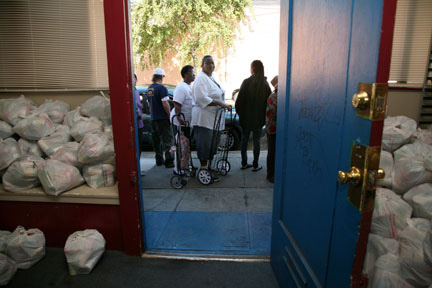
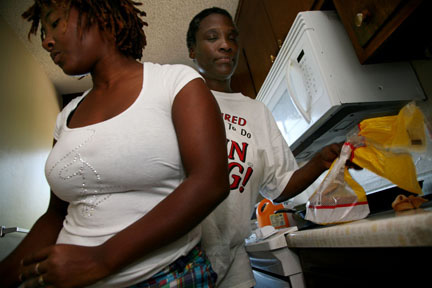
Cornerstone Baptist Church, Oakland
Families line up on the sidewalk outside a storefront where church members bag food, and then distribute to the hungry.
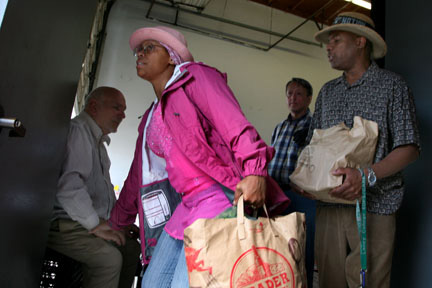
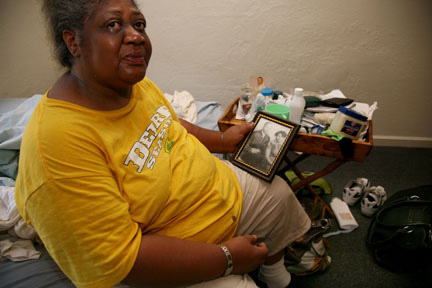
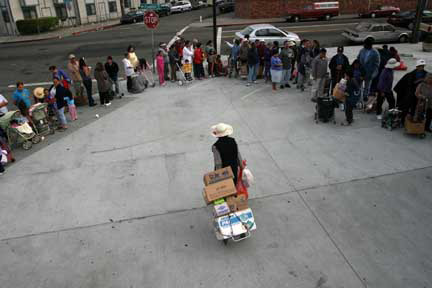
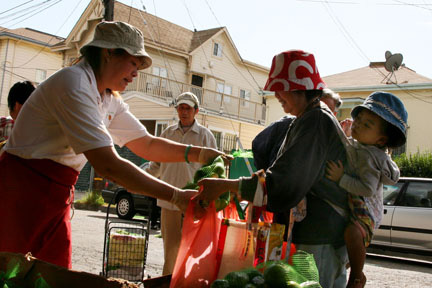
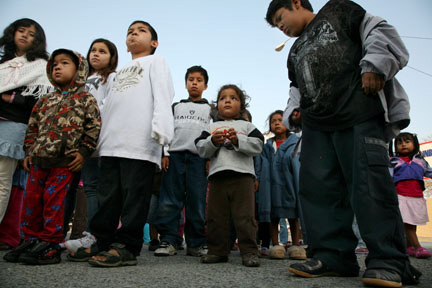
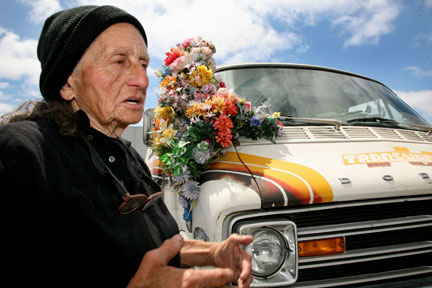
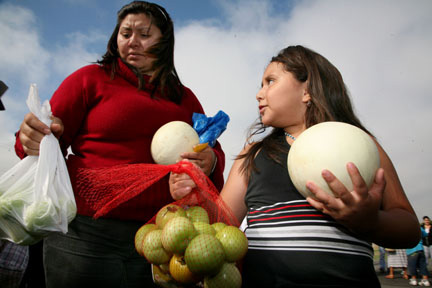

Some 16 percent of all families are food insecure – they don’t have the money to buy enough food at some point duirng the year. That amounts to 49 million people, including more than 16 million children, almost a quarter of all the children in the United States.
About a third of those families simply didn’t get enough food to eat – these families went hungry. That includes 12 million adults, and 5 million kids.
Hunger isn’t really spread evenly, as is obvious when you think about it. More in Oakland. Less in Lafayette. More than a quarter of all black and Latino households are food insecure – compared to 16 percent in general. And more than 13 percent of all families made up of single moms and their children are not just food insecure, but outright hungry.
Some 42.2 percent of food-insecure households have incomes below the official poverty line – $21,834 for a family of four. So more than half of all hungry families actually have incomes over the poverty line. Millions of families not officially “in poverty” still don’t have enough money to buy the food they need.
Breadwinners in hundreds of thousands of California families have lost their jobs. Families that formerly had no trouble feeding themselves, and even went out to eat in restaurants, can’t put enough food on the table at home at some point to keep everyone from getting up hungry.
So people go to food banks, food pantries and soup kitchens to try to make up for what they can no longer buy. Across the country, almost 5 million people went to food pantries last year. About 625,000 ate in soup kitchens.
Alameda County, with a population of 1.5 million, has probably a quarter of a million food insecure people. Contra Costa 160,000. Oakland 64,000. Berkeley and Richmond 16,000 each. Hayward more than 22,000 and Alameda more than 11,000. There are more than 20,000 hungry children in Oakland alone. Do the math for your own neighborhood or city.
Important Message: Please Read
For 25 years, Truthout has survived by publishing impactful investigative journalism and analysis; distributing full editions 365 days a year; and building a community of readers who support us with small, hard-earned donations.
Eighty percent of our $3 million yearly budget comes from small donors alone. Of those, 8,000 readers support us with monthly donations. Back in 2018, when Facebook decided to suppress the circulation of posts made by organizations, thereby cutting readers off from seeing many articles shared by the news organizations they had intentionally decided to follow, Truthout’s total traffic declined by 40 percent, as nearly all of our traffic from that platform disappeared.
Now, Google has recently rolled out its AI search bar, providing AI summaries instead of directing readers to our site. Google Search is our single largest source of traffic; it’s the route by which nearly one third of our readers find us. Much like in 2018, a shocking 40 percent of our Google traffic has disappeared overnight.
It will not be easy for Truthout to shoulder this blow. Nor will it be easy for our peers and collaborators — news sites that depend on traffic and aren’t bankrolled by large corporations.
If you can support Truthout with a donation today, you can help us resist the AI onslaught. Please give today.