Honest, paywall-free news is rare. Please support our boldly independent journalism with a donation of any size.
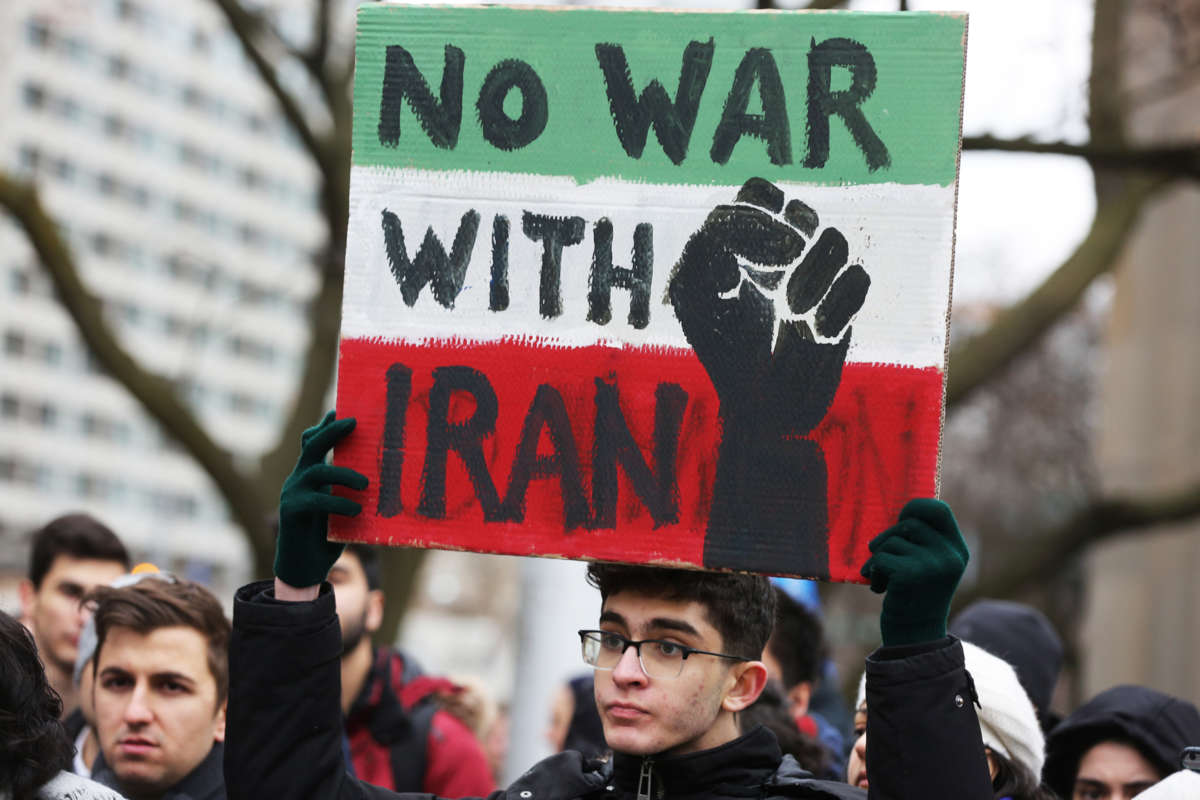
The unlawful and provocative assassination of Iran’s top general, Qassim Suleimani, has already given rise to an escalating spiral of lethal events. The greatest risks are to stumble into a devastating war in the Middle East with grave consequences for the peoples of Iran and Iraq and likely across the region. Such a war would have disastrous effects for this country, for the region and the world. It is certain to do further harm to the reputation of the United States, which already is perceived in much of the world as an irresponsible and criminal political actor in the region, using military force in ways that have made already difficult situations catastrophic by taking various dangerous military, economic and quasi-diplomatic initiatives misleadingly presented as “maximum pressure.”
It is imperative for the well-being of our country, and indeed the world, that the Congress of the United States fulfill its most solemn constitutional responsibility, and impose effective restraints on the war-making actions of this impeached president. This is a moment when partisan politics should be put aside, not only for the sake of national interests but for the benefit of humanity — we should realize that these unilateral actions by the United States have put the entire world at risk. It is also a moment when Republicans as well as Democrats must stand up for a sane foreign policy, and for diplomacy and peace instead of aggression and war, and fulfill their duties as members of Congress.
The Iranian people have endured decades of economic warfare waged by the U.S. and its allies. Since the revolution of 1979 in Iran and the end of a mutually beneficial relationship between the U.S. and Iran’s autocratic leader, the Shah, the U.S. has imposed numerous sanctions on Iran under various guises, threatened it with war, and inflicted pain and suffering on its people. What is desperately needed with respect to Iran is not any further recourse to coercive diplomacy based on escalating threats, debilitating sanctions, and tit-for-tat military actions. What is urgently needed is an immediate shift to restorative diplomacy based on mutual respect for international and domestic law, with the objective of peace, stability and cooperation.
From all that we now know, General Suleimani had come to Iraq without stealth on a commercial plane. He came to Iraq on a diplomatic peacemaking mission at the invitation of the Baghdad government, and with a meeting scheduled on the following day with the prime minister that was part of an ongoing effort to seek a lessening of tensions between Iran and Saudi Arabia. In reaction to major violations of its sovereignty, the Iraqi Parliament has voted to expel U.S. troops from their country. In place of what seemed a promising regional initiative, the assassination of General Suleimani has resulted in an intensification of conflict, further massive suffering and the likelihood of dangerous escalation.
We call on Congress to act with urgency to stem this slide toward war and regional chaos.
We urge Congress to consider imposing ironclad restraints on the authority of the U.S. president to make any further use of international force without a clear and definite authorization by the U.S. Congress, which itself should respect the relevant prohibitions of international law and the provisions and procedures of the UN Charter.
Important Message: Please Read
For 25 years, Truthout has survived by publishing impactful investigative journalism and analysis; distributing full editions 365 days a year; and building a community of readers who support us with small, hard-earned donations.
Eighty percent of our $3 million yearly budget comes from small donors alone. Of those, 8,000 readers support us with monthly donations. Back in 2018, when Facebook decided to suppress the circulation of posts made by organizations, thereby cutting readers off from seeing many articles shared by the news organizations they had intentionally decided to follow, Truthout’s total traffic declined by 40 percent, as nearly all of our traffic from that platform disappeared.
Now, Google has recently rolled out its AI search bar, providing AI summaries instead of directing readers to our site. Google Search is our single largest source of traffic; it’s the route by which nearly one third of our readers find us. Much like in 2018, a shocking 40 percent of our Google traffic has disappeared overnight.
It will not be easy for Truthout to shoulder this blow. Nor will it be easy for our peers and collaborators — news sites that depend on traffic and aren’t bankrolled by large corporations.
If you can support Truthout with a donation today, you can help us resist the AI onslaught. Please give today.