Did you know that Truthout is a nonprofit and independently funded by readers like you? If you value what we do, please support our work with a donation.
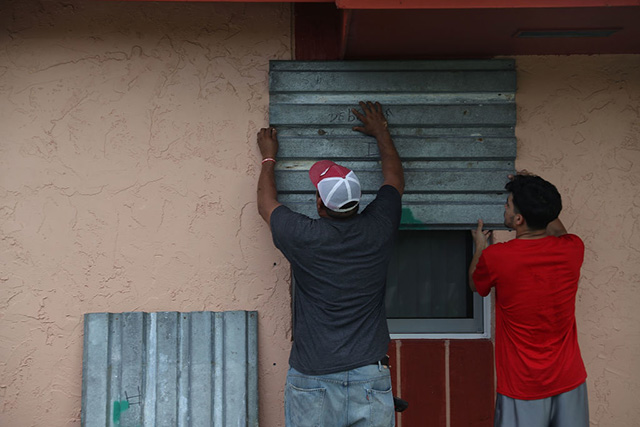 Jose Escobar and his son, Jose Escobar, Jr. put up shutters as they prepare for Hurricane Irma on September 5, 2017, in Homestead, Florida. A state of emergency has been declared in Florida as Irma has intensified to a Category 5 hurricane and heads toward the region. (Photo: Joe Raedle / Getty Images)
Fueled by warm ocean waters and fulfilling some of the most ominous predictions from climate scientists who warned that powerful storms would occur with increasing frequency and intensity, a “ferocious” Hurricane Irma slammed into the islands of Barbuda and Antigua early Wednesday morning as the most powerful Category 5 hurricane ever recorded in the Atlantic Ocean.
Irma’s landfall comes less than two weeks after Hurricane Harvey, a Category 4 storm, devastated the Texas coast and the city of Houston, killing dozens of people and now estimated to be the costliest natural disaster in US history.
According to the National Hurricane Center, Irma had maximum sustained winds of 185 mph (295 kph) when it made landfall in Barbuda and is expected to remain at Category 4 or 5 strength as it pushes westward to the Virgin Islands, the Bahamas, Puerto Rico, the Dominican Republic, Haiti, and Cuba.
5 AM AST forecast and key messages for Hurricane #Irma. Go to https://t.co/tW4KeGdBFb for the latest forecast. pic.twitter.com/N7gnRJ5B8N
— NHC Atlantic Ops (@NHC_Atlantic) September 6, 2017
In Barbuda, reports the Associated Press, “the storm ripped the roof off the island’s police station forcing officers to seek refuge in the nearby fire station and at the community center that served as an official shelter.” Communications between islands had been knocked out as well and officials on the ground said it could be days before the extent of the damage is known.
Direct hit for Barbuda.
Not on map, but top wind gust of 155 mph recorded before station knocked offline #HurricaneIrma pic.twitter.com/Bo7r1geLee— Greg Diamond (@gdimeweather) September 6, 2017
Unheard of for a #hurricane to be this strong for so long in the Atlantic basin- Anguilla/St Martin about to receive the full fury of #Irma pic.twitter.com/TTm4Mekx9V
— Eric Blake ? (@EricBlake12) September 6, 2017
“Quite simply,” wrote Eric Holthaus for Grist overnight, “meteorologists never expected a storm like Irma. The storm appears to have exceeded (or is about to exceed) the maximum theoretical strength for a hurricane in its environment — an estimate based on current water temperature and other conditions.”
Those in the path of Irma, Holthaus wrote, “have never seen a storm this strong. A direct hit could rewrite history for entire islands. The storm packs a punch that’s stronger than Andrew or Katrina, two of the most notorious recent hurricanes. In Antigua, one of the islands in Irma’s direct path, the national meteorological service lapsed into prayer.”
A state of emergency has been declared in the US Virgin Islands, Puerto Rico, and Florida — where the storm could hit later this week. Despite various models, the ultimate path of the storm remains uncertain.
“The dangerousness of this event is like nothing we’ve ever seen,” said Puerto Rico Gov. Ricardo Rossello. “A lot of infrastructure won’t be able to withstand this kind of force.”
As Holthaus notes in his assessment, Irma has already made history on her own, but coupled with the recent devastation of Harvey in Texas, the pair of storms represent a troubling new precedent:
Should the hurricane make landfall in the Virgin Islands, Puerto Rico, or Florida, it will set a regrettable record — the first-ever back-to-back US landfalls of Category 4 or higher storms.
Hurricane Harvey’s catastrophic impact in Texas and Louisiana now ranks as the worst natural disaster in US history. (Hurricane Katrina cost an estimated $150 billion in 2017 dollars, and the Texas governor’s office estimates Harvey could cost $180 billion.) A recent study examined the possibility of a Category 5 hurricane strike in downtown Miami. It calculated that damages from that nightmare scenario could cost upward of $300 billion.
As improbable as it may seem, two of the worst hurricanes in US history might hit in the span of just two weeks.
As many are noting, the threat to human life, infrastructure, and national economies are impossible to ignore:
Irma “one of most powerful Atlantic storms ever.”
2 wks after Harvey largest US rainfall ever.
Climate change? Nah.https://t.co/hIsCFu7Tyk— Barry Hudock (@BarryHudock) September 6, 2017
Harvey produced most rain ever recorded in US from a storm#Irma is strongest hurricane ever recorded in Atlantic
This in 9 days#climate pic.twitter.com/Y7fnWDWj53
— Assaad Razzouk (@AssaadRazzouk) September 5, 2017
An important fundraising appeal: 10 Days to raise $50,000
Truthout is one of only a few platforms for justice-oriented, grassroots journalism. Today, as political censorship from the right intensifies, we have no choice but to ask for your help.
We are fundraising right now to cover our basic operating expenses. If you can support Truthout with a one-time or monthly donation, you will make a significant impact on our work. Anything you can do makes a difference — we appreciate your support.