Truthout is a vital news source and a living history of political struggle. If you think our work is valuable, support us with a donation of any size.
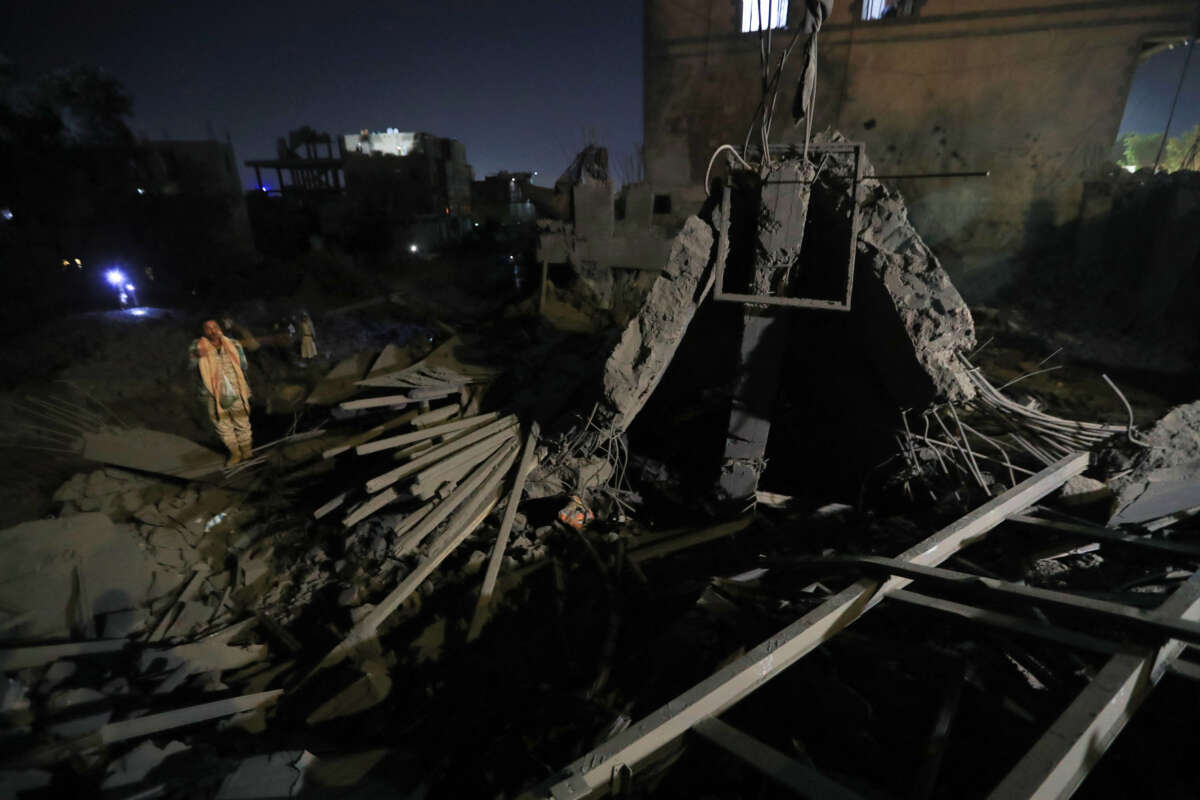
The strike on Yemen that was celebrated by Trump administration officials in a now-infamous leaked Signal chat killed a newborn baby and charred and killed a 5-year-old boy, according to new witness testimony of the strike.
In a New Yorker interview published on Tuesday with a man who survived the strike, identified by the pseudonym Hassan, the man said that he and his neighbors rushed to the site of the bombing, reportedly carried out by F-18 jets dropping Tomahawk missiles.
The strike leveled Hassan’s neighbor’s two-story house, in the Saada governorate. The house belonged to a Bedouin man named Mosfer Roga’ah, Hassan said, and served as a gathering point for his sons and their wives and children, as it did that night.
The sound of a strike, followed by two more, woke Hassan up around 1 am, he said, shattering his windows with their huge impact. Hassan’s family worked to dig through the rubble to search for remains. The men had been away doing evening prayers for Ramadan, and the rescuers found only women and children dead.
Of the 15 people killed, Hassan told The New Yorker, they unearthed the bodies of six children, one of them a newborn baby, Motlak. The oldest child killed was 13 years old. One 3-year-old girl survived the strike, but suffered severe burns and was hospitalized.
“They were scattered and torn into pieces,” Hassan said of the family’s bodies. One of the boys who was slain, 5-year-old Hamad, “was roasted,” he said.
This and dozens of other strikes were celebrated by top Trump administration officials in a Signal chat leaked by The Atlantic last month.
While much of the news coverage has focused on officials’ seemingly inadvertent inclusion of The Atlantic’s Jeffrey Goldberg in the chat, experts have said that the contents of the chat show officials like Vice President J.D. Vance and National Security Adviser Michael Waltz celebrating a strike that constituted a war crime. In response to the news that the bombing leveled a residential building, Vance said, “excellent.”
Al Jazeera also interviewed a man who survived one of the March 15 strikes; it’s unclear if it is the same strike, though the man, also under a pseudonym, similarly described the destruction of a two-story home in northern Saana, where Saada is located.
“Just like that, the house had collapsed into a smoldering heap of rubble and twisted metal,” said the man, identified as Ammar Mohammed.
“This was a family breaking their fast together, not a military base,” Mohammed went on. “Americans make no distinction between a rebel and a child.”
The family was among the 53 people estimated killed by 47 strikes dropped by the U.S. in its initial barrage in mid-March. Since then, the U.S. has repeatedly bombed Yemen, despite not having authority from Congress to conduct a war.
These near-daily strikes include one recorded and posted online by President Donald Trump himself that targeted a group of over 79 people over the weekend. The administration claimed that the people who were bombed were Houthi militants, but local reports said that the U.S. actually bombed a tribal gathering of people celebrating the end of Ramadan.
Important Message: Please Read
For 25 years, Truthout has survived by publishing impactful investigative journalism and analysis; distributing full editions 365 days a year; and building a community of readers who support us with small, hard-earned donations.
Eighty percent of our $3 million yearly budget comes from small donors alone. Of those, 8,000 readers support us with monthly donations. Back in 2018, when Facebook decided to suppress the circulation of posts made by organizations, thereby cutting readers off from seeing many articles shared by the news organizations they had intentionally decided to follow, Truthout’s total traffic declined by 40 percent, as nearly all of our traffic from that platform disappeared.
Now, Google has recently rolled out its AI search bar, providing AI summaries instead of directing readers to our site. Google Search is our single largest source of traffic; it’s the route by which nearly one third of our readers find us. Much like in 2018, a shocking 40 percent of our Google traffic has disappeared overnight.
It will not be easy for Truthout to shoulder this blow. Nor will it be easy for our peers and collaborators — news sites that depend on traffic and aren’t bankrolled by large corporations.
If you can support Truthout with a donation today, you can help us resist the AI onslaught. Please give today.