Honest, paywall-free news is rare. Please support our boldly independent journalism with a donation of any size.
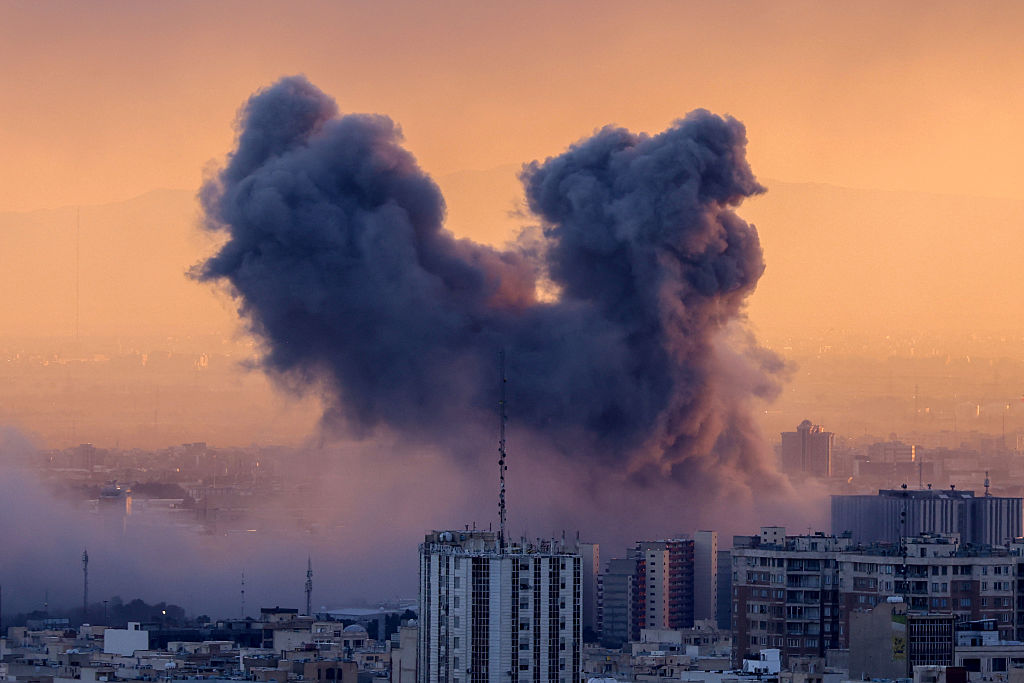
Since the end of World War II, almost every U.S. president has initiated a major military conflict without congressional approval. Donald Trump attempted to portray himself as a “peace president,” promising to end the U.S.’s endless wars and bring troops home from the Middle East and other parts of the globe. But he has proven to be even more trigger-happy than most of his predecessors. In just the first year since his return to office, he has attacked several countries. On February 28 he joined Israel in launching an attack on Iran, killing the country’s supreme leader and targeting both military installations and civilian projects, including bombing a girl’s primary school in Minab, in Iran’s Hormozgan province, that killed more than 170 people, most of them children.
The war in Iran is illegal. In addition to murdering and maiming civilians and spreading fear and suffering, it is also causing collateral damage to the world economy and may very well trigger a global economic crisis if it continues much longer. In an exclusive interview for Truthout, C. P. Chandrasekhar, a world-renowned scholar of finance and development, explains how the war could affect the global economy. He is emeritus professor at the Centre for Economic Studies and Planning at Jawaharlal Nehru University in New Delhi, where he taught for more than 30 years, and currently a senior research scholar at the Political Economy Research Institute at the University of Massachusetts Amherst.
C. J. Polychroniou: Over the past couple of decades or so, the global economy has experienced various shocks and seems to be in the midst of seemingly endless uncertainties. Capitalism, after all, is inherently unstable, subject to periodic crises. And today, due to the U.S. and Israel, the war Donald Trump and Benjamin Netanyahu initiated against Iran has sent tremors through the global economy. There are fears that the war will drive oil to $150 a barrel and that stagflation is knocking on the door. What’s your assessment of the way the U.S.-Israeli war against Iran will impact the world economy?
C. P. Chandrasekhar: I would not refer to the fallout of the joint, unilateral and unwarranted attack by the U.S. and Israel on Iran as a “shock.” The attack emanates from the most aggressive core of contemporary capitalism, and its effects should have been expected by those responsible for it, especially Donald Trump and Benjamin Netanyahu. If their assessment was that the fallout would be short-lived and limited, they were clearly wrong. The rise in the prices of oil and oil products is only the most immediate and visible consequence, given the crucial role of the region as a source of global supply. But even that rise is not driven just by the war-induced shifts in the supply of oil. It is aggravated and rendered hugely volatile by the role of large speculative trading multinationals subordinated by global finance, which may not control production but can influence supply prices. Capitalist and imperialist states today are at the mercy of these agents, who seize every opportunity to extract super profits. The decision of these states (especially the governments of the U.S., Germany, and Japan) as members of the International Energy Agency to release 400 million barrels of oil from their strategic reserves is at most a feeble response. Even if replicated, by depleting reserves, the move will only send a signal to speculators who assume that the war will last to bet that prices will only spike further. That would aggravate oil price inflation. Figures like $150 a barrel are at best guesstimates.
Thus, the real uncertainty is how long the war will last. Pushed to the wall, faced with the assassination of its supreme leader of decades, and confident (despite internal differences) that attack will not result in regime change and installation of a U.S.-chosen political leader, Iran shows no signs of retreating. The objectives of Netanyahu, both personal and political, are such that oil price increases and the implications they have for the global economy and the citizens of the rest of the world are not concerns. Occupation, genocide, and war are the means to pursue those abhorrent goals, at the expense of all else. But Netanyahu cannot pursue them by himself. He needs Trump to fund, support, and legitimize his actions. So, whether the war will last depends on Trump’s staying power.
The U.S. president is caught in a trap of his own making. If he withdraws, he admits that he made a mistake taking the U.S. to war despite his promise to voters that he will not repeat the blunders of his predecessors in Vietnam, Afghanistan, Iraq, and Syria; if he stays, he risks being identified as the principal agent driving the world to a crisis the dimensions of which are unclear. This explains the desperate efforts to rein in oil prices by restoring tanker transit through the all-important Strait of Hormuz sealed by Iran, by offering insurance to encourage shipping companies to risk their assets and crew to transport oil through the choke point and pressuring a recalcitrant U.S. Navy to escort ships through the strait. Such abortive efforts only prolong the war.
The attack emanates from the most aggressive core of contemporary capitalism, and its effects should have been expected by those responsible for it.
The nature of the consequent imminent crisis is partly divulged by the all-around fear of the inflation that it has unleashed. We are in a stage of capitalism in which the powerful epistemic community of finance has prescribed that countries should privilege the use of monetary over fiscal policy levers to manage their economies; that the principal objective of monetary policy should be to target inflation and keep it in a range that is low by historical standards; and that “independent” central banks should have the right to impose that agenda. In this context, a corollary of higher-than-mandated inflation is a rise in interest rates. So, inflation triggered by increases in oil prices would set off interest rate hikes. That spells a return to the hoary 1970s when high inflation and elevated interest rates resulted in low growth interspersed by recessions of varying intensity.
The route through which high interest rates are expected to tame inflation, if at all, is by reining in debt-financed consumption, housing acquisitions, and investment, and thereby reducing demand. A recession is an inevitable consequence. Stagflation, or a combination of inflation and recession, have obvious adverse implications for employment and real income. But it is not just the working people and the middle classes populating the “real economy” that are hit by inflation.
Finance capital, which is the fulcrum of present-day imperialism, is also hit by inflation in at least two senses.
First, a feature of the Age of Finance unleashed by financial deregulation is that financial profits are made through speculation-driven increases in asset prices, enabled by loose monetary policies of central banks. This is done not just by banks, but by new financial innovators like private equity firms. Such bubbles in turn generate increases in consumption and investment financed by debt. Interest rate increases aimed at reining in inflation also rein in this self-fueling spiral that underlies the rise of finance capital. As a result, finance capital finds it difficult to exercise the freedom it derived from deregulation to amass profits.
Finance capital also hugely profited from the low interest rates that characterized the years since the mid-1980s, when capitalism experienced a very long period of low inflation termed the Great Moderation. Access to cheap borrowing and supposed “innovations” drive increases in the value of financial assets, which translate into “profits” that were not warranted by “fundamentals.” In the Age of Finance, it became common to argue that fundamentals are irrelevant. However, if the low interest rates that underpin this boom give way, the financial edifice built on its basis will unravel and collapse. Finance capital will take huge losses, but so will the real economy as happened during the Great Recession of 2008 and after. So, the war spells doom for capital as well.
That is the scenario facing the world today.
Putting aside the human cost, wars are a profit-making enterprise for certain industries but generally detrimental to overall economic activity, so it makes one wonder why capitalist states engage in wars. How are capitalism and war linked? Has militarized accumulation become an integral component of the way global capitalism functions?
Capitalists belonging to and associated with the military-industrial complex that came to dominate capitalism in the 20th century have always loved a good war, because it increases defense spending, boosts demand for their products, and inflates profits. But the military-industrial complex as a driver of wars under capitalism, while still active, has diminished in significance. Estimates have it that as compared to the 8-10 percent of GDP allocated to the Pentagon in the U.S. before and during the Vietnam War years, the agency’s 2025 budget was at around $850 billion, or just around 3 percent of GDP.
But wars are central to capitalism in a larger sense. Since its inception, capitalism has engaged in war and conquest to facilitate the plunder and market invasion that facilitated accumulation on a world scale. That brutal process of “primitive accumulation” was not confined to the early stages of capitalism and years of colonial expansion, but has continued through its history, since the system’s expansion and stability depends on the surpluses and markets acquired through military intervention.
Since its inception, capitalism has engaged in war and conquest to facilitate the plunder and market invasion that facilitated accumulation on a world scale.
In time, the objectives of such militarism widened to include: defeating competing imperialist powers within what was still a capitalist world with conflicted nation states; making efforts to contain socialism; undermining movements for national self-determination and freedom from imperialism; and unseating Global South governments seen as anti-capitalist, overly nationalist, or just “insubordinate.” More recently, the drive of the U.S. as a waning hegemon to recover its past supremacy has intensified. As a result, aggressive efforts to gain control of the world’s resources, especially of critical minerals and energy, have once again come to the fore, reviving older versions of imperialist aggression. This is illustrated by the recent push to unseat governments in Venezuela and Iran, in a blatant resort to regime change that would ensure resource control without occupation.
It is in this larger sense that militarized accumulation has been and is integral to the functioning of capitalism.
The U.S. gets none of its oil through the Strait of Hormuz and higher oil prices could bolster the dollar against major currencies. Does this mean that the Iran war will have no negative impacts on the U.S. economy?
Even though the U.S. is now primarily an oil-exporting and not an oil importing nation as it was in the 1970s, oil prices in the U.S. in a domestically privatized and globally integrated economy cannot be insulated from international prices, including those set by profit-gouging speculators and corporations. And while its access to oil and the role of dollar-denominated assets as safe havens in times of uncertainty strengthens its hand, the unraveling of the financial balloon that defines the Age of Finance would, as I argued earlier, wreak heavy damage on a U.S. economy (and particularly its working class) that is still recovering from the financial crisis and Great Recession of 2008 and after.
The Iran war will likely have significant implications for economies that are vulnerable to high energy prices. But the impacts will not be confined to energy. As in the case of the war in Ukraine, the Iran war may trigger global disruptions for key food crops and fertilizers. Moreover, the economic fallout of the war will disproportionately affect the debt-stricken countries in the Global South. Could this war spark a new international economic crisis?
In an intrinsically unequal international economic order, which has seen global inequality only increase in the Age of Finance, the less-developed and poor countries that are the target of imperialist aggression which keeps them poor are always the main losers. That happened when the oil shocks of the 1970s destabilized the global economy. It would happen this time as well.
The crisis would be global in geography, but uneven in impact across peoples
Rising oil prices would widen the trade and current account deficits of the oil-importing less-developed countries. Rising interest rates would increase foreign exchange outgo to service outstanding debt liabilities. A global recession would affect migrant workers and therefore the remittances they send home, which are an important source of foreign exchange. Transportation bottlenecks and rising shipping costs would adversely affect export revenues. The damage resulting from a larger current account deficit on account of these reasons would be worsened by capital flight as foreign investors exit from economies that are more risky investment locations and domestic wealth holders flee to safe havens in the West. Balance of payments crises would be the outcome. As a result, currencies would depreciate sharply and raise the domestic currency costs of servicing foreign liabilities with foreign exchange payments. Bankruptcies and real economy recessions would follow.
That litany of woes can be endless. So, the crisis that a wanton act of war led by rogue states is likely to precipitate will be truly international. But states in countries of the Global North would step in to save capital as they did in 2008. The crisis would be global in geography, but uneven in impact across peoples, not just in terms of lives lost as a result of military devastation but also livelihoods destroyed because of economic destabilization.
Press freedom is under attack
As Trump cracks down on political speech, independent media is increasingly necessary.
Truthout produces reporting you won’t see in the mainstream: journalism from the frontlines of global conflict, interviews with grassroots movement leaders, high-quality legal analysis and more.
Our work is possible thanks to reader support. Help Truthout catalyze change and social justice — make a tax-deductible monthly or one-time donation today.