Truthout is an indispensable resource for activists, movement leaders and workers everywhere. Please make this work possible with a quick donation.
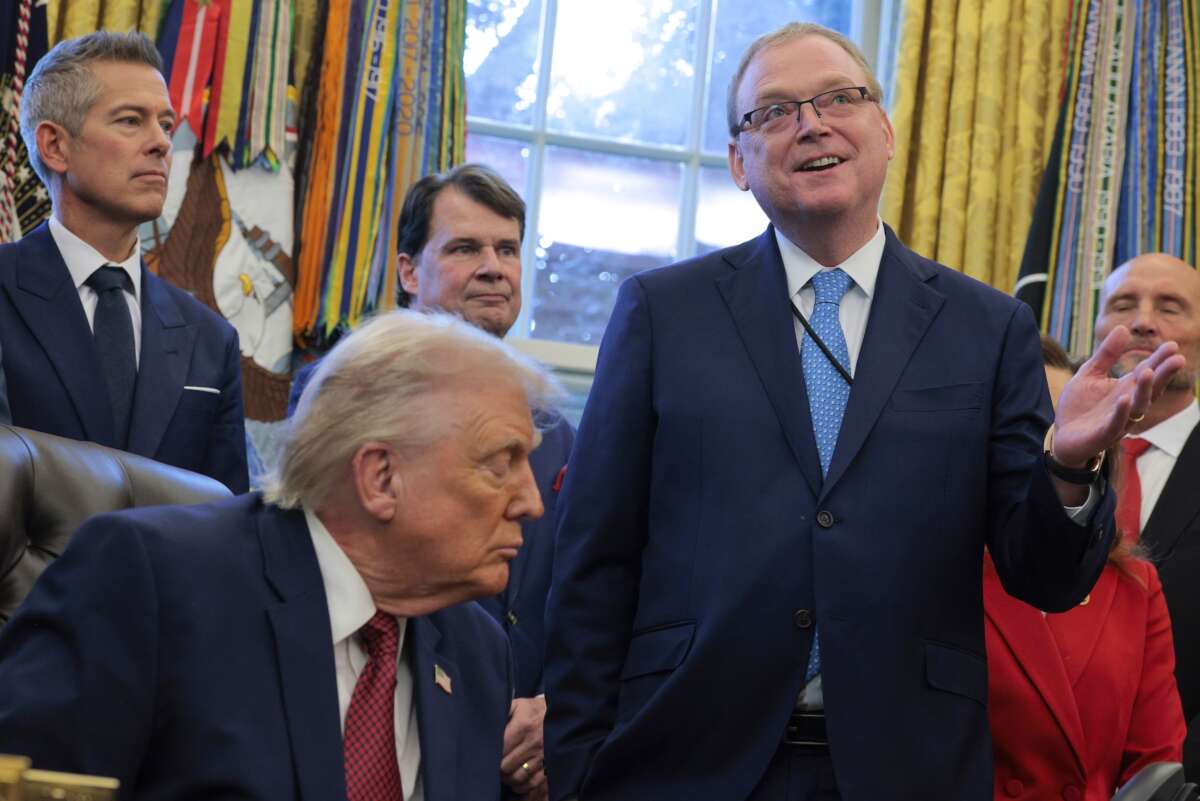
National Economic Council Director Kevin Hassett brushed aside concerns about harm to consumers caused by the U.S. and Israel’s war on Iran on Tuesday, saying that the war would hurt consumers if it continues but that’s “the last of our concerns.”
In an interview with CNBC, the Donald Trump appointee said that he believes the war will be over in a few weeks, and repeated the president’s assertion that the U.S. is “ahead of schedule” in relation to Trump’s four to six week projection for the war.
If the war continues past that, Hassett acknowledged that it would cause prices to rise for consumers — but he waved away concern over the possibility, claiming that the economy is strong.
“If [the war] were to be extended, it wouldn’t really disrupt the U.S. economy very much at all. It would hurt consumers, and we’d have to think about, you know, if that continued, what we would have to do about that,” Hassett said.
“But that’s really the last of our concerns right now. Because we’re very confident that this thing is going ahead of schedule,” he went on.
Hassett’s dismissive comments about the war’s effect on the economy ignore that the war is already causing pain for consumers.
Gas prices have spiked since the U.S. and Israel’s first strikes on February 28, going from a national average to $3.00 per gallon of regular unleaded gas to $3.79 a gallon, as of Tuesday. High oil prices are causing the price of jet fuel to rise, causing flight prices to increase significantly.
Iran’s closure of the Strait of Hormuz in retaliation for strikes may also cause downstream effects on the price of food. The strait is also a crucial choke point for the global fertilizer supply chain, choking supply right as the spring planting season is kicking off. This means that U.S. farmers may have to ration or forgo fertilizer in some areas, experts say, which may cause shortages of key crops that will cause food prices to rise.
These rising costs come as the Trump administration’s economic policies have caused large job losses, a worsening of an affordability crisis, and a record-setting transfer of wealth from the poor to the rich in the form of Republicans’ One Big Beautiful Bill last year.
The war, which is historically unpopular, has also already cost taxpayers $12 billion in its first two weeks, Hassett said on Sunday.
Hassett told CNBC that he believes that the war — now in the middle of its third week — will end in the coming weeks. The administration has refused to give a consistent answer on the expected length of the war, or given conditions on objectives they wish to achieve for it to end. Trump has repeatedly claimed that the U.S. and Israel have already destroyed Iran’s navy and air force, despite Iran still carrying out strikes.
An Israeli military spokesperson said on Sunday that Israel is preparing for three more weeks of war, and that the state has “deeper plans for even three weeks beyond that.” A U.S. Central Command request to the Pentagon sent in the first week of the war suggested that the agency expects the war to last through September.
Though Trump has said that the war is basically over and “way ahead of schedule,” his administration has continued to use escalatory rhetoric. Secretary of State Marco Rubio has reportedly directed diplomats globally to “move expeditiously to diminish the capabilities of Iran and Iran-aligned terrorist groups from attacking our respective nations and citizens” in an internal cable to be sent out by March 20, ABC reported Monday.
Meanwhile, the Pentagon ordered warships carrying about 2,500 Marines to depart to the Middle East on Friday. This could allow the military to launch ground raids against Iranian targets in and on the Strait of Hormuz— which would be a massive escalation.
Hassett’s confidence in the war ending soon comes despite the end of the war seemingly entirely being up to Trump’s whims. Trump has said that the war will end “when I feel it … in my bones” while also saying, on Sunday, that “maybe we shouldn’t even be there at all.”
An urgent appeal for your support: 72 Hours to raise $25,000
Truthout relies on individual donations to publish independent journalism, free from political and corporate influence. In fact, we’re almost entirely funded by readers like you.
Unfortunately, donations are down. At a moment when independent journalism is urgently needed, we are struggling to meet our operational costs due to increasing political censorship.
Truthout may end this month in the red without additional help, so we’ve launched a fundraiser. We have 72 hours to hit our $25,000 goal. Please make a tax-deductible one-time or monthly donation if you can.