Support justice-driven, accurate and transparent news — make a quick donation to Truthout today!
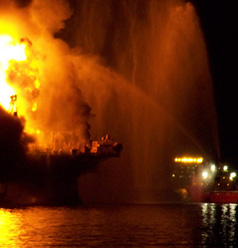
As attempts to stop the flood of oil in the Gulf of Mexico continues at the rate of 200,000 gallons a day and the full assessment of damage won’t be known for some time, a Washington, DC, think tank is proposing an independent commission to investigate the events and make recommendations to prevent similar future catastrophes.
Drawing on Presidents Jimmy Carter and Ronald Reagan during the Three Mile Island near-nuclear meltdown and the Challenger Space Shuttle explosion, Daniel J. Weiss of the progressive Center for American Progress argues that President Barack Obama should appoint a panel of high-profile public officials and experts “to completely examine the causes of the BP disaster and offer guidance for how we can make sure it never happens again.”
Obama, for his part, insists that the administration will “ensure that BP and the entire U.S. government is doing everything possible, not just to respond to this incident, but also to determine its cause.” It remains unclear, however, what mechanisms the Obama administration will utilize for the fact finding.
Weiss, senior fellow and the director of Climate Strategy at American Progress, who leads the Center’s clean energy and climate advocacy campaign, argued that an independent commission investigating the BP disaster should have subpoena power and conduct public hearings, with a final report to be issued in a matter of months.
Weiss praised the Obama administration’s swift action to the BP disaster from the outset for “mobiliz[ing] the U.S. government’s resources to attempt to minimize the harm from this unprecedented event on the health, economy, and environment of the Gulf Coast.” A continuation along that path would include Obama’s action of “complete scrutiny of the explosion and its aftermath by appointing an independent commission to assess the causes and damages and make recommendations to prevent future tragedies.”
Not all in Washington see it the same way, however. Conservatives, including libertarians, insist that the inevitable numerous lawsuits will disclose the spill’s details. Patrick J. Michaels, senior fellow in environmental studies at the Cato Institute, argued that a potential independent commission would be wasteful. “Why do we need another ‘independent commission?’ There are going to be tons of lawsuits which are going to get to the bottom of it in Discovery,” said Michaels. “The taxpayers need not fund this process; BP and the litigants are going to do it anyway.”
Others suggest that leaving fact finding in the hands of the courts will only disclose the information needed to win court cases, which may only disclose part of what is important to the public. Lisa Margonelli, director of the Energy Policy Initiative at the New America Foundation, argued that the “public needs to feel that the government cares about finding the real causes of the disaster, rather than letting lawyers decide how the spill is compensated in and out of the courts.”
Further, according to Margonelli, an independent commission fulfills a number of requirements for the public, including finding the real causes to help eliminate “the swirl of conspiracy theories around the oil industry in general and this spill in particular.” Citing everyone from eco-terrorists to terrorists to Obama’s administration itself to Halliburton and BP (as a “British” company) as potential scapegoats, with “various far-fetched motives attributed,” Margonelli argued that a public commission would “go a long way towards dispelling some of this, though probably not all.”
Another public good, according to Margonelli, will come out of a public commission: education. According to Margonelli, at least since the 1967 oil embargo, “Americans have understood our relationship to oil through the theater of public hearings.” The recurring theater around price gouging persists to this day, as does the oil industry’s comeback claim that environmentalists keep prices high by preventing offshore drilling, said Margonelli.
This argument is no longer useful, said Margonelli. However, a public investigation of the Deepwater Horizon Spill “would, in effect, give us a new and more relevant ‘play’ for our political theater” – a play about “risk,” which “would drill into the heart of every schoolchild the notion that every drop of oil carries with it risks that we as a society can choose to accept or eschew, but no longer deny their existence.”
Learning the intricacies and difficulties of oil-extraction mechanics would serve a public good. “The public has no idea how complex the business of extracting oil really is and hearings would be a great introduction,” said Margonelli.
But Margonelli admits an independent commission is not enough. “We also should put in place comprehensive legislation to reduce our reliance on oil, domestic and imported, in a programmatic way, much the way the spill of 1969 ushered in laws that cleared the skies and water and OPA90 reduced oil spills dramatically.”
For Adele Morris, fellow and policy director of the Climate and Energy Economics Program at the Brookings Institution, the complexities of the political decision making are when serious problems, governmental inability and overzealousness all collide.
“The oil spill in the Gulf points out the governance challenges when new technologies (in this case deep water drilling), combined with political enthusiasm for their deployment, outpace the capabilities and/or incentives of the agencies that oversee them (in this case the Department of the Interior’s Minerals Management Service [MMS]),” said Morris. “An independent review might help reveal the extent of any regulatory capture at MMS. But beyond the gaps that led to this spill, we should try to understand the broader policy implications of this disaster, not just for oversight of energy production but potentially other kinds of innovations.”
On Thursday, Rep. Lois Capps (D-California) and Rep. Ed Markey (D-Massachusetts) announced they will be introducing legislation to create an independent, nonpartisan, “blue-ribbon” commission. “As 200,000 gallons of oil per day continue to spill into the Gulf of Mexico, it’s becoming painfully clear that the economic, ecological and public health effects of this spill could dwarf any environmental disaster in our nation’s history. But this disaster will be all the more tragic if we fail to learn from it,” said Capps.
While it is unclear whether the Obama administration will invoke an independent commission or it will require an act of Congress, “one way or another there will be an investigation of this terrible accident,” said Weiss.
Important Message: Please Read
For 25 years, Truthout has survived by publishing impactful investigative journalism and analysis; distributing full editions 365 days a year; and building a community of readers who support us with small, hard-earned donations.
Eighty percent of our $3 million yearly budget comes from small donors alone. Of those, 8,000 readers support us with monthly donations. Back in 2018, when Facebook decided to suppress the circulation of posts made by organizations, thereby cutting readers off from seeing many articles shared by the news organizations they had intentionally decided to follow, Truthout’s total traffic declined by 40 percent, as nearly all of our traffic from that platform disappeared.
Now, Google has recently rolled out its AI search bar, providing AI summaries instead of directing readers to our site. Google Search is our single largest source of traffic; it’s the route by which nearly one third of our readers find us. Much like in 2018, a shocking 40 percent of our Google traffic has disappeared overnight.
It will not be easy for Truthout to shoulder this blow. Nor will it be easy for our peers and collaborators — news sites that depend on traffic and aren’t bankrolled by large corporations.
If you can support Truthout with a donation today, you can help us resist the AI onslaught. Please give today.