Truthout is an indispensable resource for activists, movement leaders and workers everywhere. Please make this work possible with a quick donation.
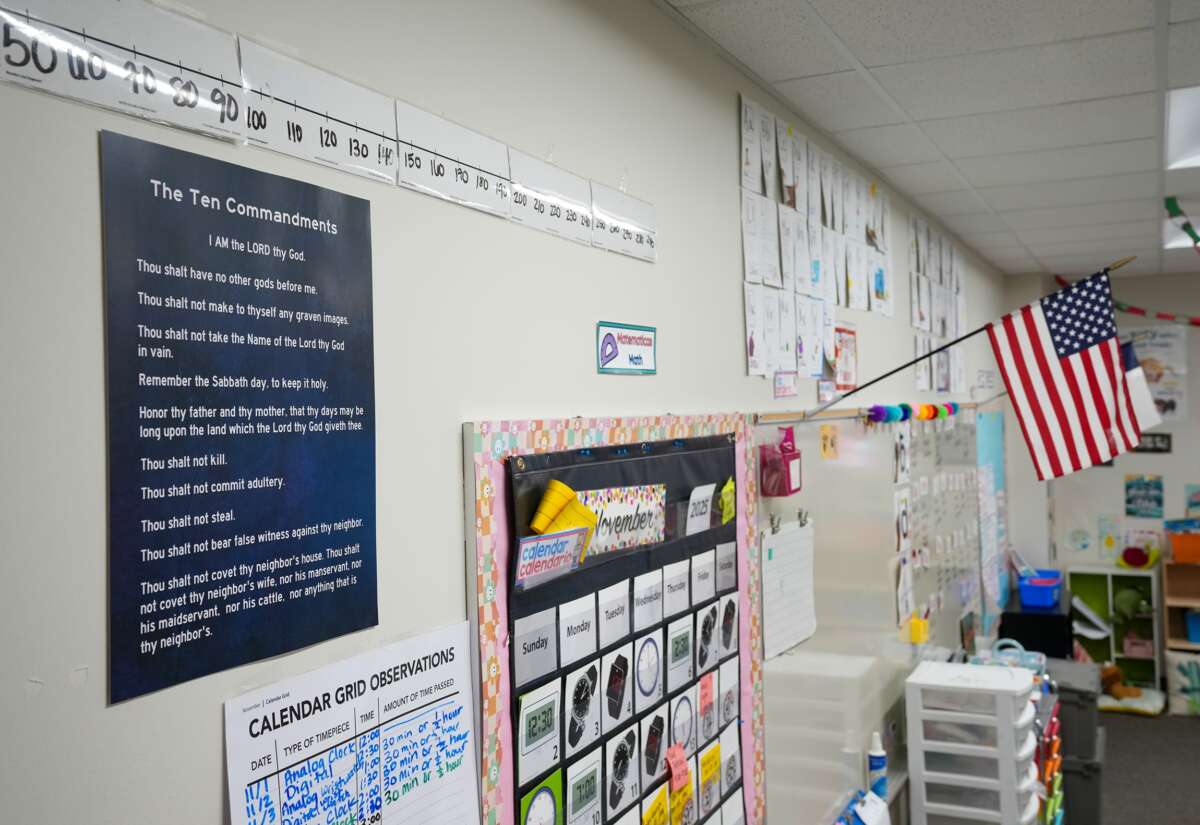
Civil liberties groups representing several families in Texas submitted a legal filing to the Supreme Court on Monday, formally requesting the overturning of a lower court’s opinion from earlier this year that allows the state to require the display of the Ten Commandments in every public school classroom.
Last year, Texas Republican lawmakers passed Senate Bill 10, which requires a poster-sized display of the religious doctrine in every classroom. The law was challenged by families of differing religious backgrounds, including Baha’ism, Christianity, Hinduism, Judaism, Unitarian Universalism, and nonreligious traditions. As one Baptist parent involved in the lawsuit explained last year, the law “undermines the separation of church and state as a bedrock principle.”
A federal district-level judge agreed, finding the law to be unconstitutional, in violation of the First Amendment’s religious freedom principles. However, in April, the Fifth Circuit Court of Appeals narrowly overturned that ruling in an en banc decision, finding that Texas should be allowed to require the displays if lawmakers deemed it proper.
The Fifth Circuit’s ruling doesn’t just appear to ignore those First Amendment protections, but also Supreme Court precedent itself, as the high court ruled nearly half a century ago, in 1980, that such displays as required by states were unlawful. Within that ruling, the Supreme Court noted that the purpose of such displays is “to induce the schoolchildren to read, meditate upon, perhaps to venerate and obey, the Commandments.”
“However desirable this might be as a matter of private devotion, it is not a permissible state objective under the Establishment Clause,” the court found in that decision.
The Texas parents filing the writ of certiorari to the Supreme Court — the formal request for the court to hear the case — are being represented by the American Civil Liberties Union (ACLU), the ACLU of Texas, and Americans United (AU), a group that promotes religious neutrality and secularism in U.S. law.
The court’s current justices will likely decide within the next couple of months whether to accept the challenge to the Fifth Circuit’s ruling, or to deny the writ and allow that court’s decision to stand. Four justices are required for a writ to be accepted, resulting in the full Supreme Court hearing a case.
The writ cites the First Amendment’s Establishment Clause in its justifications to overturn the Fifth Circuit’s decision. It also notes how that appeals court is ignoring the Supreme Court’s previous findings.
The Fifth Circuit court “flouted [the Supreme Court’s] binding precedents and gutted the religious freedom rights of public school children and parents,” the writ from the parents states.
Several of the parents spoke out publicly in statements accompanying the submission of the writ.
“As a rabbi and parent, forcing a Christian version of the Ten Commandments on children in every classroom is particularly upsetting,” said Houston-based Rabbi Joshua Fixler. “I am not only worried about my own kids, but I’m deeply concerned about all the children in my congregation. These displays put children in the position of having to defend themselves and their families’ religious beliefs against a government mandate that makes them feel different and separate from their classmates.”
“This law puts one version of religious beliefs above all others in our public schools and sends a message to our children that what we teach them about religion at home is somehow wrong,” said interfaith couple Rebekah and Ted Lowe.
The groups representing the parents also spoke out against the Texas law.
“Families — not politicians or public school officials — get to decide how, if, and when children engage with religion,” said Rachel Laser, president and CEO of Americans United. “We urge the Supreme Court to make clear that these Ten Commandments mandates violate students’ and families’ religious freedom as promised by the U.S. Constitution.”
“In our country, no legislature can force its preferred scripture on public school students and families,” added Cecillia Wang, national legal director of the ACLU.
An important fundraising appeal: We have until midnight to raise $14,000
Truthout is one of only a few platforms for justice-oriented, grassroots journalism. Today, as political censorship from the right intensifies, we have no choice but to ask for your help.
We are fundraising right now to cover our basic operating expenses. If you can support Truthout with a one-time or monthly donation, you will make a significant impact on our work. Anything you can do makes a difference — we appreciate your support.