Truthout is an indispensable resource for activists, movement leaders and workers everywhere. Please make this work possible with a quick donation.
Residents of Iran’s sprawling capital, Tehran, woke up earlier this month to scenes that they could probably imagine only in horror films. Clouds of smoke had shrouded the metropolis of 10 million, toxic rain blended with oil poured down from the sky, and the sun remained invisible through noon on the morning of March 8. Hours earlier, Israel had launched airstrikes on 30 oil facilities in Tehran and nearby regions, causing explosions that killed six people in the city of Karaj.
On social media, people in Iran who managed to bypass the ongoing internet blackout posted images of their cars being cloaked by thick layers of black toxicants that were the residues of an acid rain precipitated by the strikes the night before. Scientists have raised the alarm that long-term exposure to the compounds contained in this “black rain” may potentially increase the risk of cancer, cardiovascular conditions, and cognitive impairment among the inhabitants of Tehran.
When the United States and Israel launched their unprovoked and incoherent war on Iran on February 28, international observers decried the attack, questioning its legal basis in the absence of authorization by the UN Security Council and the U.S. Congress. Even some U.S. allies such as Italy’s Prime Minister Giorgia Meloni have criticized the war as being illegal.
Now, as the civilian death toll increases after more than two weeks of bombing, and as the destruction promised by U.S. Secretary of Defense Pete Hegseth materializes across Iranian cities, more Iranians are reflecting on why their lives unraveled and why the international community has failed them despite earlier declarations of support from influential U.S. and European politicians during the nationwide protests that rocked the country in December and January.
People in Iran posted images of their cars being cloaked by thick layers of black toxicants that were the residues of acid rain precipitated by the strikes.
On X (formerly Twitter), a Tehran resident named Amir Bakhshi posted a long thread on March 7, detailing some of his observations of the aerial bombardment of the Iranian capital. He wrote that his apartment is situated in a neighborhood that overlooks Mehrabad International Airport, which was heavily pounded by Israel over a four-day period.
“We could see everything. The sky lit up frequently and then the shockwaves would reach us, rattling the doors and windows to the point of disintegration,” Bakhshi wrote in his thread. “The nation’s airport was demolished before our eyes. I am thinking how much of the infrastructure that was built with the sweat and blood of our mothers and fathers is supposed to be destroyed, and how many years are we supposed to go back in time the morning after this war ends?”
Mehrabad used to be Iran’s main international airport before the Imam Khomeini International Airport was opened in 2004. It is a relic of the Pahlavi dynasty and was built in 1938 when Reza Shah Pahlavi raised funds to purchase 25 aircraft from the United States, as well as other equipment required to operationalize the airport. During World War II, a U.S. Army Air Forces unit known as the Air Transport Command maintained a base at Mehrabad. The bombing of Mehrabad has restarted as of March 15.
“The sky lit up frequently and then the shockwaves would reach us, rattling the doors and windows to the point of disintegration.”
Now, together with many other components of Iran’s revered history, the iconic airport has been seriously damaged. Golestan Palace in Tehran, the 3rd-century Falak ol-Aflak citadel in Khorramabad, and the Safavid-era Chehel Sotoun Palace in Isfahan are some of the cultural sites that have shouldered the burden of war. As the bombing of Iranian cities continues, it remains to be seen if the nation once known as Persia can withstand continued foreign aggression.
On X, Reza Kangazian, a theater director from the city of Isfahan, shared videos of his apartment and vehicle that were visibly destroyed in U.S.-Israeli airstrikes. Formerly the capital of the Safavid dynasty, Isfahan is home to several ancient landmarks and UNESCO World Heritage Sites, and social media users have widely criticized the recklessness of military operations in the city.
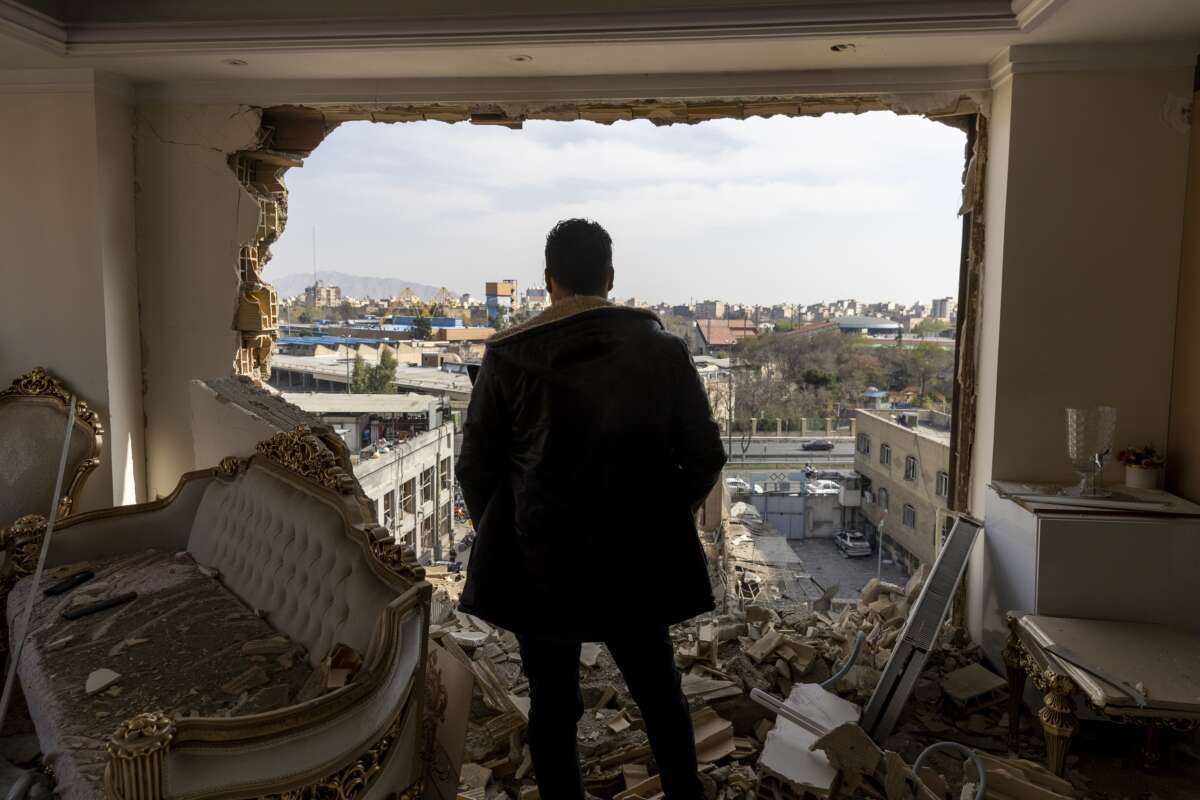
“When you walk over the ruins of your house and when your car has crumbled due to the shockwaves of explosion, nothing that used to be important to you would matter anymore,” Kangazian wrote in an X post on March 10. “The only thing you know is that the wars of politics and injustice in the region have taken life away from you. And that’s it.”
The different ways in which the politics of this war have been rationalized do not necessarily register with the Iranian citizens who are at the heart of the crisis, bearing the brunt of airstrikes and spiraling economic instability. When large cohorts of the Iranian diaspora celebrated the start of the war, they were aware that they wouldn’t be the ones experiencing its impacts.
Framed by Israeli and U.S. leaders as a regime change operation, the war has been welcomed by some Persian exiles as a precursor to the collapse of the Islamic Republic, which they blame for the hardships they’ve endured in Iran and their inability to travel there freely. Not every observer agrees that this joyous reaction is warranted.
“Ethically, as an opponent of war, human suffering, and destruction, I believe that collective moral blame is inappropriate in any situation, especially when innocent people are killed and infrastructures destroyed,” said Yahya Kamalipour, an Iranian American scholar and former chair of the Department of Journalism at North Carolina A&T State University.
“Most ethical frameworks would say that the authoritarian nature of a government does not justify taking pleasure in the suffering of ordinary people. Feeling or expressing schadenfreude toward civilians harmed by war is generally considered morally problematic,” he told Truthout.
The counterintuitive response of some sectors of the Iranian American community relishing the military conflagration in their ancestral homeland has been variably interpreted as a trauma response, an indication of failed integration in U.S. society, and a long-awaited opportunity for a pro-monarchy political vision that has been in the making for years.
“When you walk over the ruins of your house and when your car has crumbled due to the shockwaves of explosion, nothing that used to be important to you would matter anymore.”
Before the United States and Israel declared war on Iran on February 28, Reza Pahlavi, the son of Iran’s last reigning shah, had consistently encouraged sanctions and military intervention against his home country, despite earlier reservations. His supporters believe if a war can unseat Iran’s theocracy and restore the rule of the House of Pahlavi, the human cost can be condoned.
But many prominent Iranians who have adopted the United States as their home country do not see any merit in backing war, contending that such an end doesn’t justify the means, and that democratic change in a society cannot be outsourced to external actors.
In a recent essay in the Los Angeles Review of Books, Iranian American author Hooman Majd explained that he feels he bears a moral responsibility for this war of destruction on his country of origin, despite having no say in waging or ending it, and argued that complacency in the face of the bombing of a girls’ elementary school does not align with his values.
“Neither the U.S. nor Israel care about democracy or freedom in Iran,” Majd told Truthout. “No one should ever be under the illusion that states care about the interests of the people of another state; they care only about their own interests.”
“They won’t set aside their interests to promote a democratic regime for another country,” he added.
Meanwhile, U.S. media are also expressing more criticisms of the U.S. government’s decision to attack Iran than they have during previous U.S.-led foreign interventions. U.S. corporate media displayed a striking disregard for the loss of life that occurred in Iran during the 12-day war last June when Israel launched surprise attacks in the middle of Tehran-Washington negotiations, but since February 28, U.S. media have more frequently featured arguments against the ongoing military campaign.
What appears to be more nuanced coverage of the war on Iran hasn’t precluded an emphasis on economic costs for taxpayers, the Trump administration’s apparent lack of strategic planning, and repercussions for the oil market. The fact that these remain the key priorities in media commentary points to the importance of long-term reforms in international reporting.
Nevertheless, it’s still apparent how the dehumanization of Iranians is already ingrained in U.S., in part due to the entertainment industry’s prejudiced and Islamophobic presentations of Iran since 1979, when formal bilateral relations were suspended. Over time, fearmongering around Iran in the mainstream media has evolved into the standard practice, unconsciously dictating how journalists describe Iranians using clichéd jargon, even when their understanding of the country is limited. From movies such as 300 by Zack Snyder and The Wrestler by Darren Aronofsky, which depict Iranians as inherently violent, to the Showtime series “Homeland,” which had an entire season that characterized Iran using alarmist tropes, portrayals of Iran in the public domain have been predominantly negative. The circulation of these stereotypes has made it easier for proponents of the current unprovoked war on Iran to justify it.
“Right now is a critical time for the media coverage of Iran to be ultra-nuanced,” said Artemis Moshtaghian, an Iranian American journalist who has worked with CNN as a producer and news editor. “The voices inside Iran versus voices in the diaspora, whether it’s the European diaspora or the North American diaspora, are wide and varied, and the lived experience of all Iranians is wide and varied just as with any culture.”
“The humanitarian crisis that’s unfolding … is not of central focus right now for major outlets.”
“I think because the war is so front and center and we are following updates on the war front, the humanitarian crisis that’s unfolding — whether it’s the smoke plumes in the sky and the residual health concerns that Iranians will have to deal with the in the coming weeks, months and years —is not of central focus right now for major outlets,” she told Truthout.
Moshtaghian said she hopes reporters in the U.S. will make a larger effort going forward to highlight Iran-based stories of homelessness, energy crisis, environmental issues, and displacement induced by the war, which the elderly and people with disabilities are experiencing more acutely.
At a time of unprecedented instability, people currently living in Iran can best describe the complexity of life under war and sanctions, but the internet outage has made it virtually impossible for families to get in touch with their loved ones abroad and for reporters to contact sources in Iran. Exceptions are in place for government institutions, official media, and specific individuals, and some ordinary citizens manage to circumvent the restrictions using overpriced virtual private networks (VPNs), online tools developed to bypass internet bans.
Many predictions made by think tank experts and exiled activists about how Iranians will respond to the war have remained unfulfilled. No civil insurgency has happened, and although looting of malls and grocery stores has been reported in places where police stations were bombed, there have also been remarkable acts of kindness documented as people support each other.
Street vendors and bakeries have offered some of their products to fellow citizens free of charge, and more people are volunteering to donate blood. Undaunted gestures have become more common, too. President Masoud Pezeshkian was seen walking down the streets of Tehran on March 13 without security guards, taking selfies with passers-by while the U.S.-Israeli bombing of the capital continued. At the same time, the UN has reported that nearly 3.2 million Iranians have been temporarily displaced as they seek shelter in rural areas and the northern parts of the country.
As of March 14, more than 42,000 civilian units (including commercial centers and residential buildings) have been damaged in U.S.-Israeli airstrikes, the Iranian Red Crescent Society reported. Some iconic neighborhoods, including Tehran’s Majidiyeh district, which hosts a large Armenian population, have been indiscriminately targeted, causing substantial loss of property.
Like most other conflicts sparked by territorial and ideological ambitions, the war on Iran is already evolving into a humanitarian tragedy. Ordinary citizens are paying the price.
An urgent appeal for your support: 7 Days to raise $41,000
Truthout relies on individual donations to publish independent journalism, free from political and corporate influence. In fact, we’re almost entirely funded by readers like you.
Unfortunately, donations are down. At a moment when independent journalism is urgently needed, we are struggling to meet our operational costs due to increasing political censorship.
Truthout may end this month in the red without additional help, so we’ve launched a fundraiser. We have 7 days to hit our $41,000 goal. Please make a tax-deductible one-time or monthly donation if you can.