Honest, paywall-free news is rare. Please support our boldly independent journalism with a donation of any size.
Conservatives on the Supreme Court ruled on Tuesday to weaken limits on the dumping of raw sewage into bodies of water, in a blow to the government’s ability to enforce the Clean Water Act (CWA).
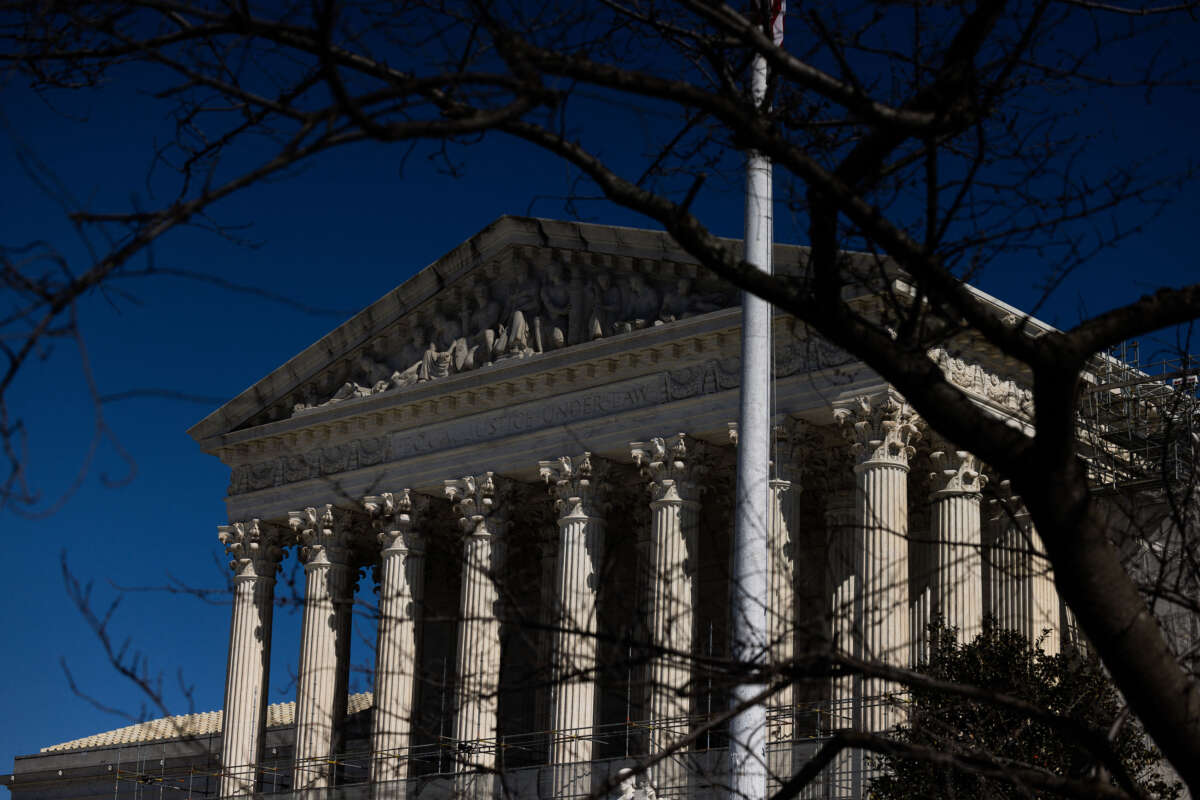
In a 5-4 decision, the Court ruled that the Environmental Protection Agency (EPA) exceeded its authority in requiring San Francisco to limit the discharge of raw sewage into the Pacific Ocean under the CWA — a bedrock environmental law credited with bringing American bodies of water back from staggering pollution prior to its passage in 1972.
The city had argued that the limits set by the EPA were too vague, and that it wasn’t possible for officials to determine when limits had been crossed.
The Biden administration argued last year that generic standards were necessary in order to lay the groundwork for more specific regulations, and that the rules were already made clear to officials.
Writing for the majority, Justice Samuel Alito wrote that the EPA does not have the authority to make cities and other polluters comply with what he called “end result” permits — or permits that allow a certain amount of pollution discharge, with limits — but rather that the EPA itself should be responsible for maintaining the standards.
He argued that the EPA is “armed with ample tools” to enforce such standards — at a time when Donald Trump and Elon Musk are slashing the EPA’s operations and after the Supreme Court dramatically weakened federal agencies’ ability to interpret and enforce laws.
San Francisco’s case was supported by numerous groups like the National Mining Association and the U.S. Chamber of Commerce, which have long challenged pollution standards in the U.S. Some San Francisco lawmakers had urged the city to drop the case, warning that it could have broad ramifications.
Environmental groups had expressed disappointment in the leadership of San Francisco for bringing the case to the Supreme Court at a time when the conservative supermajority has been taking any opportunity it can to weaken federal regulations.
Justice Amy Coney Barrett wrote the dissent for her and the court’s three liberals, saying that the majority’s decision is “puzzling” and that its conclusions are “wrong as a matter of ordinary English.” She said that the decision, in contrast to what the majority claims, “tak[es] a tool away from EPA,” a move that could make it harder to enforce pollution standards.
During Donald Trump’s first term, his administration made it easier for cities to dump raw sewage — including waste like human feces and urine — into waterways, as part of his widespread rollbacks of environmental rules and attacks on laws like the Clean Water Act. The Biden administration rolled back many of Trump’s attacks on environmental regulations, including rules putting waterways at risk. Biden’s protections were met with pushback from Republicans.
An important fundraising appeal: We fell short of our goal
Thank you for reading Truthout today. We have a brief message before you go.
Unfortunately, donations are down for Truthout at a time when media faces immense pressure. Yet, grassroots media is vital in the fight against Trump’s authoritarian reign. Our mandate to tell the truth, share strategies for resistance, and speak against fascism grows more urgent each day. We must appeal for your support.
If you can support Truthout with a one-time or monthly donation, you will make a significant impact on our work. Please give today.