Honest, paywall-free news is rare. Please support our boldly independent journalism with a donation of any size.
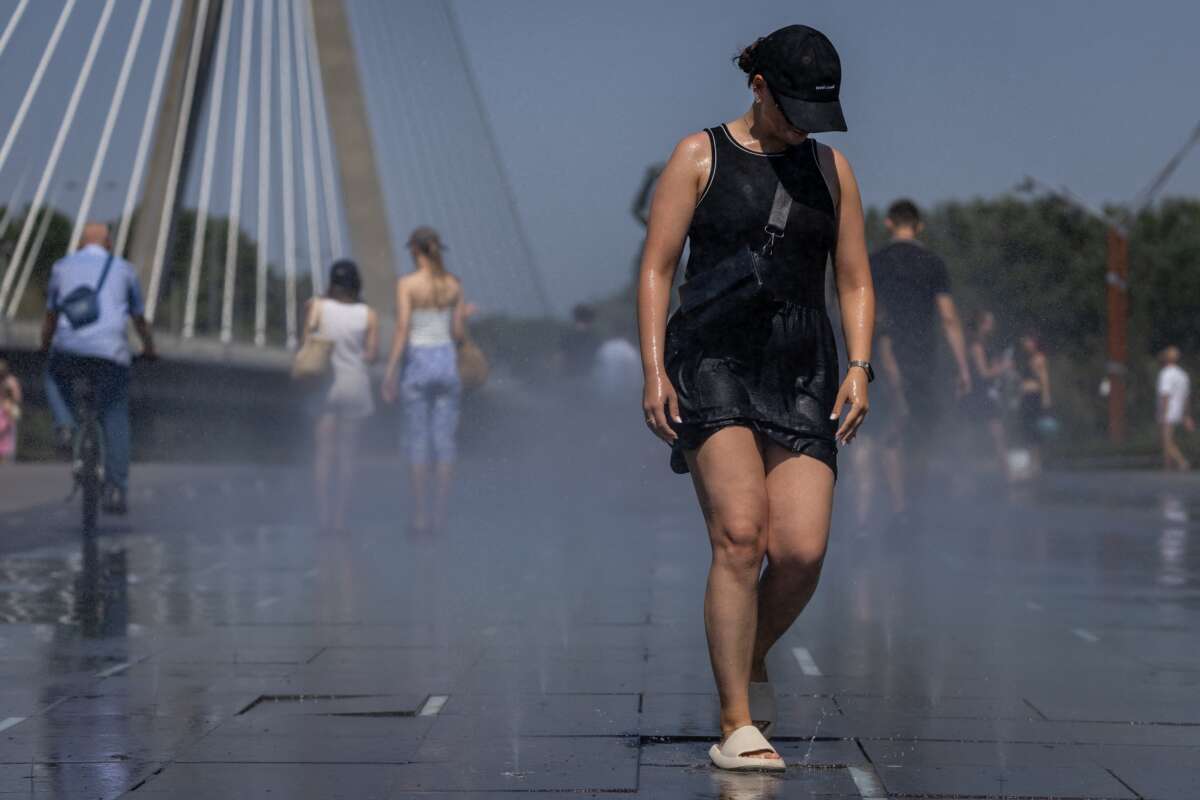
A recently published study finds that the current heat wave embroiling Europe would be “virtually impossible” were it not for human-made climate change.
The study from World Weather Attribution notes that, over the regions of the continent they examined, this heat wave is the most severe that has ever been seen, with nearly half of the cities and geographical areas observed breaking heat stress records. Heat stress occurs when the body is unable to cool itself through sweating.
“Climate change is to blame” for the heat wave that Europeans experienced, said Theo Keeping, co-author of the study and research associate at Imperial College London. “This heat wave would have been virtually impossible even 50 years ago without human-caused climate change.”
Hundreds of millions of people in Europe have been or are still being impacted by the heat wave. Temperatures would have likely been 3.5 degrees Celsius cooler (or about a 6 degrees Fahrenheit difference), on average, in 1976, the study suggests.
Heat is responsible for more deaths in Europe than all other natural hazards combined. Indeed, in the summer of 2022, more than 60,000 people across the continent died as a result of extreme heat. The current heat wave is believed to have resulted in at least 1,300 deaths in Europe so far.
World Weather Attribution studied more than 800 cities in Europe. Of those areas, 45 percent have recorded or are forecast to report their highest heat stress levels ever for the late June period, the organization said.
Greenhouse gas emissions emanating from the burning of fossil fuels, leading to climate change, are to blame, the report said.
“Fossil fuel emissions have rapidly worsened European heatwaves in just a few decades,” the report explained.
“We are not doing enough to slow the rate of global warming at the moment,” said Clair Barnes, a research associate at Imperial College London who co-authored the study. “And so, as that rate of warming continues … we should expect to see record temperatures being exceeded more and more frequently.”
The heat “dome” that western Europe had experienced most of last week is now traveling eastward. Several parts of eastern Europe are now facing heat warnings, with temperatures forecast to reach the low 40s Celsius (around 100 degrees Fahrenheit) this week.
Globally, there is an 86 percent chance that at least one year between 2026 and 2030 will surpass 2024 as the hottest year on record.
Given the presence of El Niño in the Pacific Ocean this year, 2027 could be even hotter, experts predict, as temperatures tend to soar in the year following that weather phenomenon.
Press freedom is under attack
As Trump cracks down on political speech, independent media is increasingly necessary.
Truthout produces reporting you won’t see in the mainstream: journalism from the frontlines of global conflict, interviews with grassroots movement leaders, high-quality legal analysis and more.
Our work is possible thanks to reader support. Help Truthout catalyze change and social justice — make a tax-deductible monthly or one-time donation today.